
Conduct Disorder in Adult Women: Breaking the Cycle of Destructive Behavior
Medical Disclaimer: This article is for informational purposes only and is not medical advice. Conduct Disorder behaviors that continue into adulthood often overlap with Antisocial Personality Disorder and can carry serious legal and safety risks. If you or someone you love is involved in violence, severe self-harm, or criminal activity, seek immediate psychiatric evaluation. For emergencies, call 911.
Introduction: The "She'll Grow Out of It" Myth
Families often cling to a hopeful line: “It’s just a phase — she’ll grow out of it.”
When those behaviors persist into the 20s and 30s, they usually get more harmful, not less.
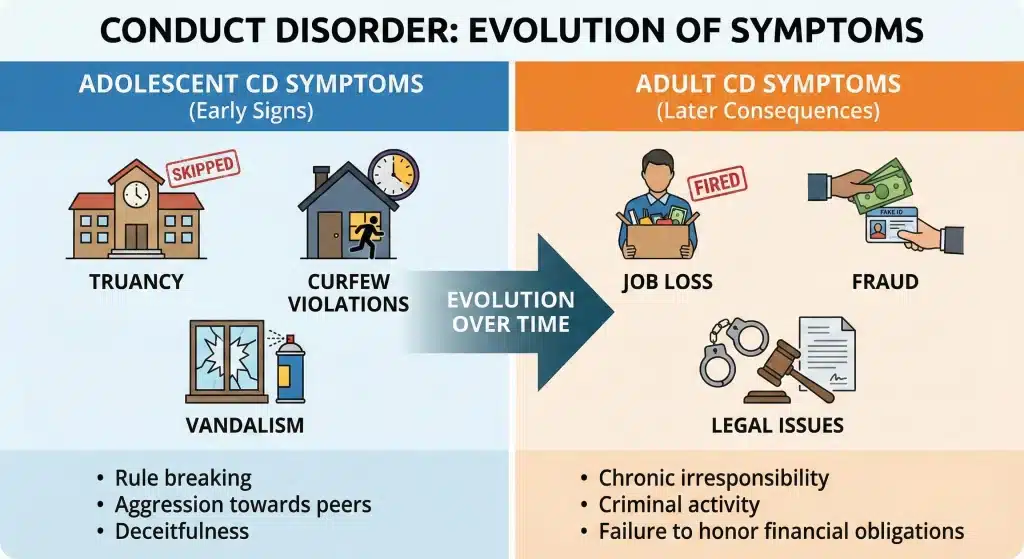
- What began as skipping school may become chronic unemployment or repeated firings for insubordination.
- Teenage bullying can evolve into workplace harassment or online campaigns that ruin an ex-partner’s reputation.
- Small thefts can escalate to identity fraud, credit-card scams, or other financial crimes.
This is the quiet but serious crisis of Adult Conduct Disorder.
Families often feel trapped. You might be covering rent to keep her off the street, terrified of her anger if you refuse, or constantly bailing her out of legal trouble. That exhaustion and guilt are real — she may be charming and socially adept, which can make the behavior confusing and easier to excuse.
At Sun County Wellness, we see you. These behaviors are too often dismissed as “drama” or instability. In truth, they frequently reflect deep neurobiological dysregulation. In this guide we explain how Conduct Disorder can present in adult women, the connection with Antisocial Personality Disorder, and practical next steps to stop enabling harmful patterns and address root causes.
If you are done living in the fallout from a loved one’s choices, learn more about our Mental Health Treatment Programs at Sun County Wellness.

The Clinical Reality: When Conduct Disorder Continues into Adulthood
Clinically, Conduct Disorder (CD) is most often diagnosed in children and adolescents. When the same pattern of behavior persists beyond age 18, clinicians frequently re-evaluate the diagnosis.
If harmful behaviors continue — especially violations of others’ rights without remorse — the person may be assessed for Antisocial Personality Disorder (ASPD). Many women do not meet full ASPD criteria yet still display the dangerous, repetitive patterns we see in Conduct Disorder.
The central feature is consistent: a persistent pattern of behavior that violates the rights of others or major age-appropriate social norms.
In adult women, this often goes beyond broken curfews — it can mean harming other people, breaking laws, and destroying relationships.
The four core symptom areas in adults
In women, these traits often appear in indirect, manipulative, or relational forms rather than overt physical violence (though physical aggression can occur).
1. Aggression toward people and animals
- Domestic violence: Women are sometimes overlooked as perpetrators, yet those with conduct problems can initiate physical harm against partners.
- Cruelty: Neglect or harm to pets, children, or dependents.
- Sexual coercion: Using sex as a tool to control, exploit, or manipulate — sometimes creating situations that allow for blackmail.
2. Destruction of property
- Retaliatory damage: Smashing a partner’s car, destroying a roommate’s belongings, or vandalizing a workplace after a firing.
- Arson: A notable subset of female arsonists have histories consistent with Conduct Disorder.
3. Deceitfulness or theft
- Financial abuse: Identity theft, opening credit accounts in others’ names, or embezzlement.
- Pathological lying: Repeated deception to gain money, sympathy, or control.
- Catfishing and fraud: Creating false online identities to manipulate or defraud victims.
4. Serious violations of rules
- Legal problems: Chronic probation violations, DUIs, or fraud charges.
- Workplace toxicity: Frequent terminations for insubordination, harassment, or theft.
- High-risk lifestyle: Dangerous substance use, risky sexual behavior, or survival-based activities driven by thrill-seeking rather than necessity.
Relational aggression: a favored strategy
Where men with conduct problems may use physical force more often, many women become highly skilled at relational aggression.
This is social violence — planned, hard to see, and deeply damaging.
- Workplace sabotage: Spreading rumors to get a colleague fired.
- Smear campaigns: Using social media to systematically destroy a person’s reputation.
- Triangulation: Manipulating family members against one another to control resources such as money or housing.
Why this matters: Because the harm is less visible, families frequently minimize it — saying, “She’s just emotional.” It isn’t harmless emotion. Systematically destroying someone’s livelihood or relationships is a form of violence.
The "Why": Trauma, neurobiology, and survival strategies
Why do some adult women behave this way? It’s rarely about being “evil.” At Sun County Wellness we focus on the brain, history, and survival strategies behind the behavior.
1. The trauma-to-prison pipeline
Research indicates that roughly 70–90% of women in the justice system report histories of sexual or physical abuse.
- Survival strategy: Aggression can begin as a way to survive dangerous environments. If being predatory keeps you safe, that pattern can become entrenched.
- Dissociation and emotional shutdown: What looks like coldness is often self-protection — shutting down empathy to avoid reliving pain.
2. Thrill-seeking and under-arousal
- Some individuals have lower baseline physiological arousal (low resting heart rate) and compensate by seeking high-stakes stimulation. Risky behavior can provide the dopamine or adrenaline they otherwise don’t feel.
- They may also be skilled at outward displays (crying on cue, charm) while feeling little internal remorse.
- The consequence: Ordinary life can feel intolerably dull, driving them toward chaos for a sense of aliveness.
3. The "callous-unemotional" pattern
- Lack of remorse: Many view victims as gullible rather than feeling guilt for their harm.
The urgency of early, structured intervention
As adults, the stakes rise from detention to incarceration, serious physical harm, or death. Untreated conduct-related problems increase risk for:
- Fatal overdose — often from using substances to manage boredom or emotional numbing.
- Violence — either as perpetrator or victim in unsafe environments.
- Suicide — impulsive responses to crises or consequences.
Treatment: Moving beyond "talk therapy"
Traditional supportive talk therapy alone is often not enough. Because these individuals can be highly verbal and persuasive, treatment needs structure, accountability, and specific skill-building.
Effective care typically includes a high-accountability systems approach with these core elements:
- Dialectical Behavior Therapy (DBT): Especially valuable for women — it shifts the focus from “why” to “how” and teaches distress tolerance, emotion regulation, and interpersonal effectiveness.
- Structured accountability: Clear, consistent consequences and boundaries from treatment teams, families, and legal systems.
- Vocational rehabilitation: Employment stabilizes daily life. We help identify high-stimulation, legitimate careers (sales, emergency services, skilled trades) where intensity becomes an asset rather than a liability.
- Financial skills and independence: Reducing dependence on family removes incentives for manipulation and abuse.
Dual diagnosis and addiction treatment
Alcohol and benzodiazepines: These substances lower inhibition and can increase the risk of violent or impulsive acts.
- Stimulants: Can heighten paranoia and aggression. At Sun County, we treat substance use disorders alongside personality and behavioral symptoms in an integrated program.

A guide for families: Stop enabling, start protecting
If you are the parent or partner of an adult woman with persistent conduct problems, you are likely woven into the pattern. That is not your fault — but you are in a position to change it.
The “rescue” trap: Each time you bail her out of jail, pay off debt, or cover for her at work, you remove the consequence she needs to learn from. Hard as it feels, consequences are often the catalyst for change.
How to set adult boundaries:
- Financial cut-off: “I love you, but I can’t be your bank. I will help pay for treatment directly to a provider, but I cannot give you cash.”
- Housing rules: “You may live here only if you remain sober and maintain employment. If you steal from us or become violent, you will need to leave and we will call the authorities.”
- Refusal to rescue: “I’m sorry you’re in jail/evicted — that sounds devastating. Tell me what your plan is to fix it. I can’t solve this for you.”
These steps feel harsh — but they are acts of care. Protecting someone from consequences keeps them stuck; clear limits create opportunities for growth.
Case Study: Erica’s Story
Families sometimes hide a loved one’s behavior to “protect her reputation,” which delays intervention and increases risk. Honest acknowledgment is the first step toward care.
Case Study: Sarah’s Turnaround
Here’s a composite example of recovery.
The crisis: Sarah, 19, had been expelled from two schools, ran away with older partners, and repeatedly stole from her mother to pawn jewelry. She presented as charming but showed little remorse for the harm she caused.
The intervention: In treatment, Sarah initially tried to split staff and manipulate the team. The program maintained consistent boundaries.
- Phase 2: In a trauma group, Sarah’s defenses slipped. She admitted her aggression began as a way to avoid becoming a victim.
- Phase 3: She began DBT skills work and learned healthier ways to tolerate boredom and distress instead of seeking the “rush” from risky behavior.
The result: Sarah is employed, living in a sober environment, and paying her own rent. Her relationship with her mother is cautiously rebuilding as she makes steady, small repairs to trust.

Conclusion: Behavior as communication
Conduct Disorder is frightening to witness, but behavior is often a desperate form of communication. For many women it is a scream for safety, expressed through aggression.
It is easy to love a compliant child. Loving the one who pushes you away is harder — and braver.
You don’t have to do this alone. A coordinated team of clinicians, psychiatrists, and support services can create the structure and care needed to change course.
If you’re ready to stop the chaos and begin healing, contact Sun County Wellness.
Frequently Asked Questions
Is Conduct Disorder genetic? Genetics play a strong role. A biological parent with Antisocial Personality Disorder, ADHD, or substance use increases risk. Environmental factors like trauma often trigger genetic vulnerability.
Can girls have Conduct Disorder? Yes. In boys, CD often shows as physical aggression. In girls, it frequently appears as relational aggression — lying, cyberbullying, running away, or survival-based sex work — and is therefore more likely to be missed.
Will my child grow out of it? Not without intervention. Unlike typical teenage rebellion, CD symptoms tend to escalate. Early, targeted treatment before age 18 greatly improves outcomes.
What if they refuse treatment? Refusal is common — they often see themselves as fine and view others as the problem. Families may need to use leverage (car, phone, finances) or consult an interventionist to connect them with care.