
Understanding Gender Dysphoria: A Compassionate Guide for Families
Medical Disclaimer: The content provided in this article is for informational purposes only and does not constitute medical advice. Gender dysphoria is a recognized medical diagnosis that often co-occurs with anxiety, depression, and trauma. If you or a loved one is experiencing severe distress, self-harm, or suicidal ideation, please seek immediate professional mental health support. For LGBTQ+ specific crisis support, contact The Trevor Project at 1-866-488-7386.
Introduction: When the Mirror Feels Wrong
Imagine waking up every day and putting on a costume that doesn’t fit. It’s too tight in some places, too loose in others. Everyone tells you it looks great, that it fits perfectly, but you feel a constant, itching discomfort. You want to take it off, but you can’t.
This is a simplified analogy for Gender Dysphoria.
For families, hearing a loved one say, “I don’t feel like the gender I was assigned at birth,” can be confusing, frightening, or overwhelming. Parents often worry: Is this a phase? Did I do something wrong? What does this mean for their future?
At Sun County Wellness, we want to start with clarity: Gender Dysphoria is real, and it is treatable.
It is not a choice, a trend, or a rebellion. It is a profound incongruence between a person’s internal sense of self and their physical body. In this guide, we will move beyond the political noise and look at the clinical reality of gender dysphoria, the mental health risks of ignoring it, and how compassionate care can save lives.
If you are navigating this journey and need support, explore our Mental Health Treatment Programs at Sun County Wellness.

What Is Gender Dysphoria? (The Clinical Definition)
It is crucial to distinguish between Gender Identity (who you know yourself to be) and Gender Dysphoria (the distress caused when your identity doesn’t match your body/social role).
According to the DSM-5, Gender Dysphoria is defined by a marked incongruence between one’s experienced/expressed gender and assigned gender, lasting at least 6 months, manifested by:
- A strong desire to be rid of one’s primary/secondary sex characteristics.
- A strong desire for the sex characteristics of the other gender.
- A strong desire to be of the other gender (or some alternative gender).
- Key Requirement: The condition causes clinically significant distress or impairment in social, occupational, or other important areas of functioning.
The “Distress” is Key: Being transgender is not a mental illness. The dysphoria—the anxiety, depression, and pain caused by the mismatch—is the clinical issue we treat. If a person is supported and allowed to transition, the dysphoria often resolves, even if the gender identity remains trans.
Beyond the Binary: Understanding Non-Binary Identities
For many parents, the concept of “Transgender” (moving from Boy to Girl or vice versa) is understandable. But what about when a child says they are Non-Binary?
This demographic is rapidly growing, and it often causes the most confusion in families.
- The Concept: Non-binary people experience their gender as falling outside the strict “Male” or “Female” boxes. They may feel like a mix of both, or neither.
- The Pronouns: They often use “They/Them” pronouns. While this can feel grammatically strange at first, it is linguistically valid (we use singular “they” all the time: “Someone left their umbrella”).
- The Dysphoria: Non-binary dysphoria is just as real. A non-binary person might feel distress at being grouped with “the ladies” or “the men,” and may seek medical transition to achieve an androgynous appearance that feels like home to them.
The Mental Health Stakes: Why Validation Matters
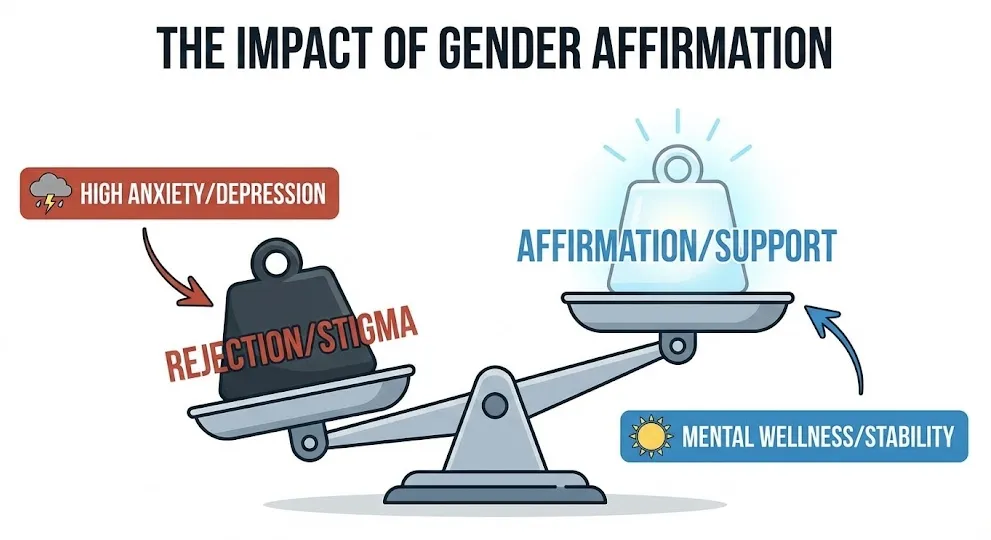
The statistics regarding untreated gender dysphoria are alarming, but they tell a clear story: Rejection is dangerous.
- Depression & Anxiety: Rates are significantly higher in the trans/non-binary population compared to cisgender peers.
- Suicidality: Studies show that over 40% of transgender individuals have attempted suicide.
- Substance Abuse: Many turn to drugs or alcohol to numb the pain of the dysphoria or the trauma of rejection.
The Good News: Research also shows that when a person’s gender identity is affirmed—by using their chosen name, pronouns, and allowing social/medical transition—these risks drop plummet. Affirmation is suicide prevention.
Debunking Myths: What Families Need to Know
Myth 1: “It’s just a phase/social contagion.” Fact: While identity exploration is normal in adolescence, persistent, severe dysphoria rarely just “goes away.” Dismissing it as a “trend” invalidates the person’s deep internal pain and erodes trust.
Myth 2: “They are too young to know.” Fact: Most children have a solid grasp of their gender identity by age 3-5. While they may not have the vocabulary for it, the internal sense of “boy,” “girl,” or “neither” forms very early.
Myth 3: “Therapy can ‘fix’ them back to their birth gender.” Fact: This is called “Conversion Therapy,” and it is widely discredited by every major medical association (APA, AMA). It is considered unethical and harmful. The goal of therapy is not to change the identity, but to help the person live authentically and manage the stress of transition.
The "Rapid Onset" Controversy: Facts vs. Fear
Parents often feel blindsided. “My child showed no signs in childhood, and suddenly at 14, they are trans. Is this peer pressure?”
This phenomenon has been colloquially termed “Rapid Onset Gender Dysphoria” (ROGD) in some online circles, but it is not a recognized clinical diagnosis.
The “Iceberg” Explanation: What looks “rapid” to you has often been agonizingly slow for your child.
- Internal Processing: Your child may have been wrestling with these feelings for years but hid them out of fear or shame.
- The Catalyst: Finding the vocabulary online or meeting a trans friend didn’t cause the dysphoria; it gave them the language to finally explain what they had been feeling all along.
- The Reveal: When they come out, you are seeing the tip of the iceberg. They have been living underwater with it for a long time.
The Layers of Dysphoria
Dysphoria isn’t just one feeling; it manifests in different ways.
1. Physical Dysphoria
Discomfort with physical characteristics (chest, voice, genitals, hair).
- Signs: Wearing baggy clothes to hide shape, hunching over, refusing to swim or shower, self-harm directed at specific body parts.
2. Social Dysphoria
Discomfort with how society perceives them.
- Signs: Distress when called by birth name (“Deadnaming”), discomfort with gendered terms like “son,” “daughter,” “bro,” or “miss.”
3. Mind Dysphoria
The cognitive dissonance of feeling like an imposter.
- Signs: Constant internal monologue checking behavior (“Am I walking like a man?”, “Is my voice too high?”). This hyper-vigilance is exhausting and leads to burnout.

Navigating the School System: Advocacy 101
For parents of trans youth, school can be a battleground. Here is how to advocate for your child’s safety.
- Know Your Rights: In California and many states, students have the right to be addressed by their chosen name/pronouns and use facilities consistent with their gender identity (AB 1266).
- The Support Plan: Request a meeting with the principal and school counselor to create a “Gender Support Plan.” This covers:
- Which name goes on the attendance sheet?
- Which bathroom/locker room will they use?
- Who is “safe” to talk to if they are bullied?
- Privacy: Under FERPA, schools generally cannot out a student to other parents or peers without consent. Ensure the school understands your child’s privacy needs.
- Which name goes on the attendance sheet?
- Which bathroom/locker room will they use?
- Who is “safe” to talk to if they are bullied?
Treatment at Sun County Wellness: A Safe Harbor
At Sun County Wellness, we provide gender-affirming care within a holistic mental health framework. We treat the whole person, not just the diagnosis.
1. Trauma-Informed Care
Many gender-diverse individuals have experienced bullying, family rejection, or assault. We use EMDR and trauma therapies to heal these wounds so they don’t carry the past into their future.
2. Treating Co-Occurring Conditions
We recognize that dysphoria often travels with friends: Eating Disorders (trying to control body shape), Substance Abuse, and Severe Anxiety. We treat these issues simultaneously, understanding that they are often coping mechanisms for the dysphoria.
3. Family Therapy: Building Bridges
This is often the hardest but most important work. Parents need a space to process their own grief (the loss of the “son” or “daughter” they imagined) without burdening the child.
- Our Goal: To move the family from “Tolerance” to “Celebration.” We help parents understand that they aren’t losing a child; they are finally meeting the authentic one.
Navigating the Transition: A Roadmap
Transition is not a single event; it is a journey.
- Social Transition: Changing name, pronouns, hair, and clothing. This is reversible and often the first step in alleviating social dysphoria.
- Medical Transition: Hormones (HRT) and surgery. This is a decision made with medical providers. At Sun County, we provide the psychological support and letters of readiness often required for these steps.
- Legal Transition: Changing ID documents. This provides safety and validation in the world.
The Chemistry of Calm: The Mental Impact of HRT
Many parents fear Hormone Replacement Therapy (HRT) because they focus on the physical changes (voice dropping, breast growth). However, the psychological changes are often the most profound.
Many of our clients report that within weeks of starting the correct hormones (Testosterone or Estrogen), their brain feels “quiet” for the first time.
- Dissociation Reduces: They feel present in their bodies.
- Anxiety Drops: It is as if the brain was trying to run on the wrong fuel (e.g., Estrogen) and finally got the right fuel (Testosterone). The engine stops sputtering and starts purring.
- The Takeaway: HRT is often a mental health intervention as much as a physical one.
A Note to Parents: Your Love Is the Lifeline
If your child has come out to you, you might feel scared. You might worry that their life will be harder. The world can be hard for trans people, but a safe home makes them bulletproof.
When a child knows they have one place where they are seen, loved, and celebrated exactly as they are, they develop resilience. You are that safe place. You don’t have to understand everything perfectly today; you just have to keep listening.

Conclusion: Authenticity Is the Cure
The antidote to dysphoria is not repression; it is authenticity.
When a person finally aligns their outside with their inside, the “mental noise” quiets down. The depression lifts. The anxiety subsides. They finally have the bandwidth to pursue dreams, relationships, and joy.
At Sun County Wellness, we are honored to walk this path with you. We offer a sanctuary where you can explore who you are without judgment.
If you are ready to be seen, contact Sun County Wellness today.
Frequently Asked Questions
Is gender dysphoria the same as being gay? No. Gender Identity is who you are (internal sense of self). Sexual Orientation is who you are attracted to. A trans person can be straight, gay, bi, or asexual, just like a cisgender person.
Do you prescribe hormones? Sun County Wellness is a mental health treatment center. While we do not prescribe HRT directly, we work closely with LGBTQ-affirming medical providers and endocrinologists to coordinate care.
What if I’m not sure if I’m trans? That is okay! Therapy is the perfect place to explore gender fluidity. You don’t need to have a label to seek help for the distress you are feeling. We support exploration, not just transition.
How do I support a friend with dysphoria? The simplest way is to use their correct name and pronouns. It sounds small, but it is a massive signal of safety and respect. Correct others gently if they get it wrong. Be an ally.