
Somatic Symptom and Related Disorders: When the Body Speaks
Medical Disclaimer: The content provided in this article is for informational purposes only and does not constitute medical advice. While somatic disorders are psychological in origin, physical symptoms should always be evaluated by a medical doctor to rule out organic disease. If you are experiencing sudden, severe pain, paralysis, or difficulty breathing, please go to the nearest emergency room immediately. For 24/7 mental health crisis support, call or text 988.
Introduction: "It’s Not All in Your Head"
If you are reading this, you or a loved one has likely been on a long, exhausting medical journey. You may have seen five different specialists. You may have undergone countless MRIs, blood panels, and nerve conduction studies. And you may have heard the most frustrating sentence in the English language:
“Everything looks normal.”
But you don’t feel normal. You feel pain, fatigue, dizziness, or weakness. When doctors say, “There is nothing wrong with you,” it can feel like gaslighting. It implies that you are making it up.
We want to start by validating your reality: Your pain is real.
Just because a symptom doesn’t show up on an X-ray doesn’t mean it isn’t happening. In Somatic Symptom and Related Disorders, the distress is genuine, but the root cause isn’t structural damage, it is a dysregulated nervous system. The brain is sending “danger” signals to the body, resulting in very real physical suffering.
In this guide, we will move past the stigma. We will explain the science of the mind-body connection, differentiate between the various disorders in this category, and outline how Sun County Wellness treats the whole person to restore quality of life.
If you are tired of chasing a diagnosis and are ready to treat the root cause, explore our Mental Health Treatment Programs at Sun County Wellness.

What Are Somatic Symptom and Related Disorders?
The term “Somatic” comes from the Greek word soma, meaning “body.” These disorders are characterized by an intense focus on physical symptoms (like pain or shortness of breath) that causes major emotional distress and disrupts daily life.
Historically, this was dismissed as “hysteria” or “hypochondria.” Today, we understand it as a complex interplay between emotional health and physical sensation.
The "Hardware vs. Software" Analogy
Think of your body like a computer.
- Organic Disease (e.g., a broken bone): This is a hardware problem. You can see the break.
- Somatic Symptom Disorder: This is a software glitch. The hardware (your bones, nerves, and organs) is fine, but the software (your brain’s pain processing center) is sending error messages.
The pain from a software glitch hurts just as much as the pain from a hardware break.
The Spectrum of Disorders
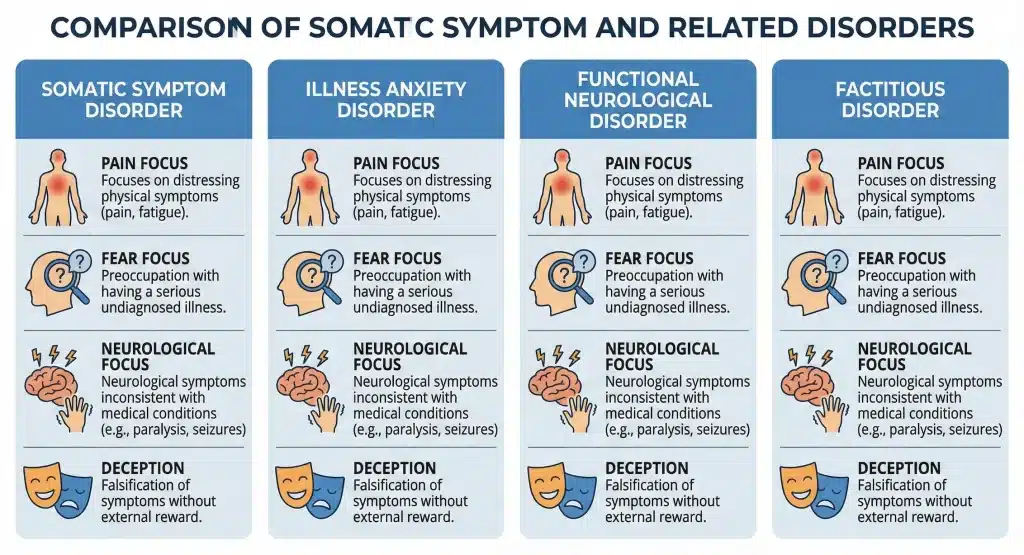
Not all somatic issues are the same. It is crucial to distinguish between the specific diagnoses to treat them effectively.
1. Somatic Symptom Disorder (SSD)
This is the most common diagnosis.
- The Core: The person has actual physical symptoms (e.g., chronic back pain, joint agony, severe fatigue).
- The Reaction: The reaction to the pain is excessive. The person spends hours googling symptoms, assumes the worst (catastrophizing), and their life revolves around the pain.
- Key Distinction: There is usually a physical sensation present, but the anxiety about it is disproportionate.
2. Illness Anxiety Disorder (formerly Hypochondriasis)
- The Core: The person has minimal or no physical symptoms.
- The Reaction: They are terrified of acquiring a serious illness. A tiny freckle is interpreted as melanoma; a mild headache is interpreted as a brain tumor.
- Key Distinction: The fear is about the idea of being sick, rather than the distress of a symptom itself.
3. Conversion Disorder (Functional Neurological Symptom Disorder)
This is one of the most fascinating and frightening conditions in psychiatry.
- The Core: The person experiences a sudden loss of motor or sensory function (e.g., going blind, becoming paralyzed, experiencing seizures).
- The Cause: There is absolutely no neurological reason for it. The brain has “converted” extreme psychological stress into a physical shutdown.
- Key Distinction: The symptoms are often incompatible with anatomy (e.g., “glove anesthesia” where numbness stops at the wrist, which isn’t how nerves work).
4. Factitious Disorder (Munchausen Syndrome)
- The Core: The person fakes or induces symptoms intentionally (e.g., tampering with urine samples, injecting bacteria).
- The Goal: To assume the “sick role” and receive care/sympathy.
- Key Distinction: Unlike SSD or Conversion Disorder (where the symptoms are unconscious and uncontrolled), the patient here is consciously deceiving others.
The Science of Safety: The Vagus Nerve Connection
To understand why the body is screaming in pain without an injury, we look to Polyvagal Theory.
The Vagus Nerve acts as the superhighway between your brain and your major organs. It controls your “Fight, Flight, or Freeze” response.
- The Safe State (Ventral Vagal): You are calm, connected, and pain is managed well.
- The Fight/Flight State (Sympathetic): Adrenaline pumps. Muscles tense up (leading to chronic back/neck pain). Digestion stops (leading to IBS symptoms).
- The Freeze State (Dorsal Vagal): The body shuts down. This leads to symptoms like extreme fatigue, fainting, or “heavy limbs.”
In Somatic Symptom Disorder, the nervous system gets “stuck” in Fight/Flight or Freeze. The body is braced for impact 24/7. This chronic tension eventually manifests as real, debilitating pain. Treatment focuses on signaling safety to the Vagus nerve.
The Gut-Brain Connection: Fueling the Flame
Another critical piece of the puzzle is the Gut-Brain Axis. When you are anxious, your body releases inflammatory chemicals called cytokines. These chemicals circulate in the blood and can sensitize pain receptors.
Furthermore, 90% of your serotonin (the happy chemical) is made in the gut. Chronic stress disrupts gut bacteria, leading to bloating and nausea—common somatic complaints. The Takeaway: The “stomach ache” isn’t imagined; it is a direct biological result of the brain’s stress signals causing inflammation in the gut.
The Cycle of Health Anxiety
Why does it get worse over time? Because of the Cycle of Reassurance Seeking.
- The Trigger: You feel a strange twinge in your chest.
- The Interpretation: “This is a heart attack.” (Catastrophizing).
- The Behavior: You check your pulse, Google the symptom, or rush to Urgent Care.
- The Short-Term Relief: The doctor says, “Your heart is fine.” You feel better for 24 hours.
- The Rebound: The brain doubts the doctor. “What if they missed something?” The anxiety returns stronger, and you look for a new doctor.
This cycle reinforces the brain’s “danger” pathways. Every time you check or scan your body, you are teaching your brain that there is a threat to be found.
Navigating the Medical System: How to Be Heard
One of the greatest sources of trauma for somatic patients is the medical system itself. Being dismissed creates more anxiety, which creates more pain.
Scripts for a Productive Doctor Visit: Instead of getting defensive when a doctor suggests anxiety, try these approaches to build a partnership:
- “I understand my tests are normal, and I am grateful for that. However, the pain impacts my ability to work. Can we look into treatments that calm the nervous system, like physical therapy or biofeedback?”
- “I am open to the idea that stress is a factor. Can we treat the stress and the pain simultaneously, rather than ignoring the physical symptoms?”
Understanding Cognitive Behavioral Therapy (CBT) for Somatic Symptom Disorder
Cognitive Behavioral Therapy (CBT) is a cornerstone treatment for Somatic Symptom Disorder (SSD). This table outlines the key components of CBT, its techniques, and the intended outcomes for individuals undergoing this therapeutic approach.
CBT Component
Description
Intended Outcome
Reframing
Changing negative thoughts about symptoms to more balanced perspectives.
Reduced anxiety and improved coping strategies.
Behavioral Activation
Encouraging engagement in enjoyable activities despite discomfort.
Increased life satisfaction and reduced focus on symptoms.
Mindfulness Techniques
Practicing present-moment awareness to reduce rumination on pain.
Enhanced emotional regulation and decreased stress levels.
Symptom Monitoring
Tracking symptoms and triggers to identify patterns and responses.
Better understanding of symptom management and reduction of health anxiety.
This table highlights the essential elements of CBT and their roles in treating Somatic Symptom Disorder. By focusing on reframing thoughts, engaging in activities, practicing mindfulness, and monitoring symptoms, individuals can significantly improve their quality of life and manage their symptoms more effectively.
Treating the Whole Person: The Sun County Approach
Treating Somatic Symptom Disorder is delicate. At Sun County Wellness, we bridge the gap. We treat the nervous system, which in turn calms the body.
1. Cognitive Behavioral Therapy (CBT)
CBT is the gold standard for SSD. We don’t try to convince you the pain isn’t real. Instead, we change how you respond to the pain.
- Reframing: Moving from “This headache means I’m dying” to “This headache is uncomfortable, but it is likely tension, and I can cope with it.”
- Stopping the “Check”: We help clients resist the urge to Google symptoms or scan their bodies for lumps.
2. Somatic Experiencing and Body Work
Since the trauma is stored in the body, talk therapy isn’t always enough.
- Grounding Techniques: Teaching the nervous system to feel safe. We use breathwork and sensory orientation to lower cortisol levels.
- Biofeedback: helping clients see their physiological responses (heart rate, muscle tension) and learn to control them consciously.
3. Medication Management
While there is no pill to “cure” somatic symptoms, treating the underlying anxiety or depression often reduces the physical pain.
- SSRIs/SNRIs: These antidepressants also have pain-relieving properties (especially for nerve pain) and help turn down the “volume” on the brain’s worry centers.

Case Study: Sarah’s Journey from Pain to Peace
To understand recovery, let’s look at “Sarah” (a composite of typical clients we see).
The History: Sarah, 32, suffered from debilitating migraines and digestive issues. She had visited three neurologists and two gastroenterologists. All tests were normal. She was convinced she had a rare autoimmune disease and spent 3 hours a night researching symptoms.
The Intervention at Sun County:
- Validation: We acknowledged her pain was real.
- The Shift: In CBT, Sarah learned that her “body scanning” (constantly checking for pain) was actually lowering her pain threshold.
- Somatic Work: She learned that her digestive issues flared whenever she felt unsafe at work. She used breathing techniques to stimulate her Vagus nerve before meetings.
The Result: Sarah still gets migraines occasionally. However, she no longer goes to the ER when they happen. She treats them with rest and hydration, without the panic that “something is dying.” Her quality of life returned because she stopped fighting her body and started listening to it.
Overcoming the Stigma: "I'm Not Crazy"
The hardest part of recovery is the shame. Patients often feel they are wasting resources or being “drama queens.”
We help clients understand the Mind-Body Connection through science, not judgment.
- The Stress Response: When you are chronically stressed, your body releases inflammatory chemicals (cytokines). These chemicals cause fatigue and ache.
- Sensory Amplification: An anxious brain acts like a microphone turned up too high. It picks up normal bodily noises (digestion, heartbeats) and blasts them as “pain.”
By explaining the biology, we remove the shame. You aren’t “crazy”; your system is just hypersensitive.
Conclusion: Reclaiming Your Life from Pain
Living with a Somatic Disorder is exhausting. It feels like a full-time job managing appointments, symptoms, and fears. But it doesn’t have to be this way.
Recovery looks like shifting the focus from Symptom Management to Life Engagement. It means going to dinner with friends even if your back hurts. It means trusting your body’s resilience instead of fearing its fragility.
At Sun County Wellness, we help you make that shift. We validate your pain, but we also believe in your power to live beyond it.
If you are ready to break the cycle of health anxiety and physical distress, contact Sun County Wellness today.
Frequently Asked Questions
Does Somatic Symptom Disorder mean I’m faking it? Absolutely not. “Faking it” is Factitious Disorder. In Somatic Symptom Disorder, the pain and suffering are 100% real and not under your control. The origin is psychological, but the experience is physical.
Can stress really cause paralysis or blindness? Yes. In Conversion Disorder, the brain’s emotional processing centers can override the motor cortex. It is similar to how “stage fright” can make you lose your voice, but on a much more severe scale.
How do I know if I should go to the ER or if it’s anxiety? This is the hardest question. We work with clients to develop a “Safety Plan.” Generally, if a symptom is new, sudden, and severe (chest pain, numbness), get it checked once. If the medical workup is negative and the symptom persists or migrates, it is likely somatic.
Will the symptoms ever go away? For many, yes. For others, the symptoms may persist but become much less distressing. The goal of treatment is often not the total elimination of pain, but the elimination of the suffering and fear attached to it.