
High-Functioning Anxiety vs. Intuition: Learning to Trust Your Gut Again
Medical Disclaimer: This article is for informational purposes only and is not medical advice. High‑functioning anxiety can lead to severe burnout, insomnia, and physical health problems. If you are having panic attacks or feel unable to function, call 988 or go to the nearest emergency room right away. For a confidential assessment and admissions, contact Sun County Wellness.
Introduction: The Paralysis of the "Smart" Woman
You are the one people rely on for clear thinking and steady leadership—you run a business, a household, or a team. You are capable, competent, and accomplished.
And yet, when it comes to your own life, you often feel stuck.
You draft and re-draft an email for hours before pressing send. You replay conversations and analyze every small expression. You get a gut feeling about a relationship or a choice—and then you talk yourself out of it, chalking it up to paranoia.
This is the particular pain of high‑functioning anxiety.
It muffles your inner compass and fills your head with static, so you can’t hear your own voice. You start outsourcing decisions—to friends, to family, to Google—because you’ve lost faith in the one person who knows you best: you.
At Sun County Wellness, in the restorative setting of San Juan Capistrano, we help women quiet that noise and reconnect with their inner wisdom. This guide clarifies the difference between the voice of Fear (Anxiety) and the voice of Wisdom (Intuition), and offers practical steps to rebuild trust in your gut.
If you’re ready to stop second‑guessing yourself, explore our Women’s Mental Health Programs.

The "Noise" Problem: Why You Can't Hear Yourself
We live in a culture that prizes analysis. We’re taught to think things through, list pros and cons, and optimize outcomes. That approach builds bridges—but it can sabotage how we build a life.
High‑functioning anxiety is an over-reliance on the analytical mind.
- The Mechanism: Your brain is on constant threat watch, trying to predict every possible negative outcome so you can prevent it.
- The Result: Decision fatigue. You get so absorbed in calculating the “safest” choice that you lose access to the choice that actually feels right.
The Cost: When you stop listening to your gut, you start abandoning yourself. You stay in roles that drain you because they look impressive. You stay in relationships because the boxes are checked. You become a passenger in your own life.
The Cheat Sheet: Anxiety vs. Intuition
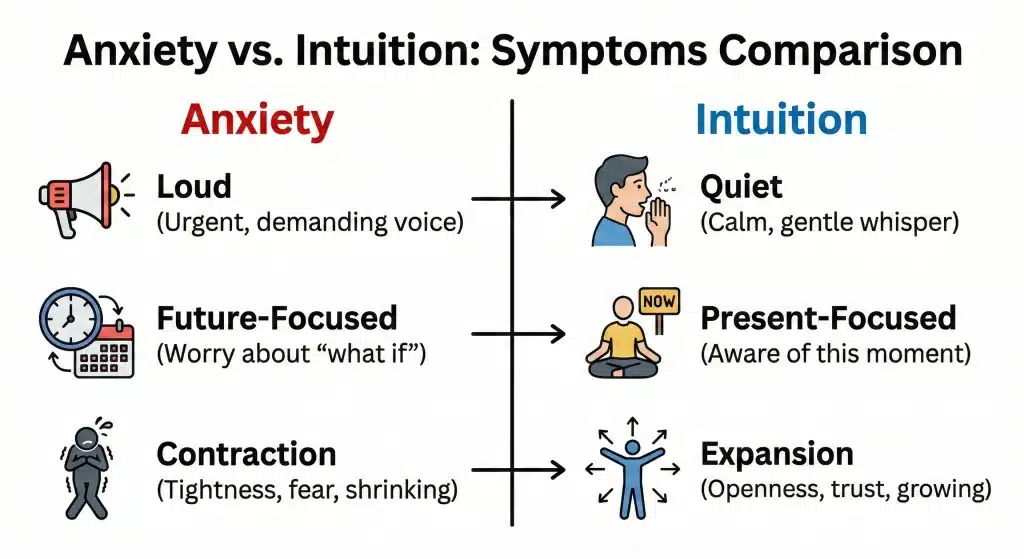
Both anxiety and intuition feel like inner voices, but they have very different energies. Use these markers to tell them apart.
1. The Quality of the Voice
- Anxiety: Loud, repetitive, frantic. It creates an urgent rush—“Decide NOW or everything will fall apart.” It feels like an internal debate that never ends.
- Intuition: Quiet, steady, singular. It doesn’t argue; it simply states what’s true: “This isn’t for you.” It lands like a single pebble in a still pond—clear and resonant.
2. The Physical Sensation (Somatic Marker)
- Anxiety: Contraction. Your chest tightens, shoulders lift, stomach knots, breath shortens. There’s a buzzy, restless energy.
- Intuition: Expansion or grounding. Even when the message is difficult (“You need to leave this job”), it feels like settling into your body—a heavy, solid knowing.
3. The Focus
- Anxiety: Future‑oriented (“What if…”). It obsesses over outcomes and worst‑case scenarios.
- Intuition: Present‑focused (“What is”). It is attuned to truth rather than hypothetical threats.
The "Gaslighting" of the Self
Often, anxiety grows out of self‑gaslighting.
- Scenario: You feel uneasy around a new male colleague.
- Anxiety Response: “Don’t be rude. He’s nice. You’re projecting—be polite.”
- Intuition Response: “This feels unsafe. Keep your distance.”
When you override your intuition in favor of politeness or logic, you tell your body it won’t be protected. Your nervous system then turns up the volume—panic attacks, racing thoughts—to force your attention. Many panic attacks are simply intuition that has been ignored for too long.
The "Good Girl" Syndrome: Why We Ignore the Gut
Why do we silence that quiet voice? Often because we were taught to. From early on, girls are socialized to be “good girls”—pleasing, accommodating, and easygoing.
The Conditioning: We learn that putting our comfort first is “selfish.” We hug relatives we don’t want to hug. We smile when we’re angry.
- The Consequence: You disconnect from your body’s signals and prioritize social harmony over internal truth.
Recovery: Recovery means unlearning those habits. It means accepting that following your intuition may disappoint people—and that’s preferable to abandoning yourself.
Clearing the Static: How SJC Heals the Signal
You can’t hear a whisper in a hurricane. To notice intuition again, you must lower the volume of anxiety. San Juan Capistrano offers the quiet, restorative conditions for that work.
1. "Blue Mind" Quiet
Ocean air and wide open spaces help lower cortisol. When your nervous system shifts from sympathetic (fight/flight) to parasympathetic (rest/digest), the static clears and your inner voice becomes audible.
2. Equine Therapy: The Lie Detector
Horses are highly attuned to authenticity. If you approach a horse while pretending you’re not afraid, the horse will sense the mismatch.
- The Exercise: Stand with the horse and check in—“What am I feeling?”
- The Validation: If you say, “I’m sad,” and the horse leans into you, that immediate, nonverbal feedback confirms your internal data and helps rebuild trust.
3. Somatic Grounding
We use the earth: walking barefoot on trails, touching the adobe walls of the Mission. When you’re stuck in your head (anxiety), you’re disconnected from your body. When you’re in your gut (intuition), you feel grounded. We teach practical ways to drop your energy downward and feel present.
Feel it in your body.

Nutritional Psychiatry: The Biological "Gut Feeling"
“Trust your gut” is more than a metaphor—it’s biological. The vagus nerve links brain and gut, and about 90% of your serotonin is produced in the digestive tract.
The Inflamed Brain: Inflammation from processed foods, alcohol, or chronic stress disrupts that communication. When the gut is inflamed, the signal between body and brain is noisy—you literally have trouble trusting the gut.
- The SJC Approach: We follow a farm‑to‑table nutritional philosophy. By removing inflammatory foods and restoring the microbiome with fresh, local produce, we reduce biological static so intuition can be heard more clearly.
Sleep and Decision Fatigue
You can’t access wise judgment when you’re exhausted. Exhaustion looks a lot like anxiety. A tired prefrontal cortex can’t regulate emotion, and everything feels like a crisis.
The “Sleep on It” Rule: Sleep hygiene is a core part of our work. Before making a major decision, ask: “Am I rested?” If not, postpone the choice. Very often, what seems urgent at 11 PM resolves after a solid night’s sleep.
Practical Tools: How to "Check Your Gut"
1. The “Body Compass” Bring a real decision to mind (for example, “Should I go to this event?”).
- Close your eyes.
- Say “Yes” out loud. Notice your body—does it expand or tighten? Do you breathe more easily or hold your breath?
- Say “No” out loud. Notice the difference.
- Your body is a reliable data source.
2. The 24‑Hour Rule Anxiety demands immediate action; intuition is patient.
- Rule: “I will not make any major decision for 24 hours.”
- This gives cortisol time to settle. If the feeling remains once you’re calm, it’s more likely intuition.
3. Journaling Prompts for Clarity Writing slows racing thoughts. Try asking:
- “If I weren’t worried about disappointing anyone, what would I choose?”
- “Does this choice make me feel heavy or light?”
- “What’s the kindest thing I could do for myself right now?”
Case Study: Rachel’s Clarity
The Crisis: Rachel, 35, was a CFO offered a major promotion that would require moving to New York. On paper it was a dream opportunity—but every time she imagined signing the contract she developed a migraine. Her anxious voice said, “You’re sabotaging yourself—take it!”
The Intervention: Rachel joined our Women’s IOP.
- Week 1: We addressed her physical anxiety symptoms (insomnia, migraines) with somatic regulation.
- Week 3: In equine therapy she recognized her migraine as a clear “No”—her body was signaling that the lifestyle the job demanded would harm her health.
- Week 5: She declined the promotion. The migraines stopped.
The Result: Rachel stayed in Orange County and launched her own consulting practice. She earns less than the New York role would have paid, but her health and daily ease returned. She learned that her body knew what her resume could not.

Conclusion: You Know More Than You Think You Do
For years you may have ceded your authority—to anxiety, to employers, to partners. It’s time to reclaim it.
Take back your voice.
Your internal guidance system is older and wiser than your anxious mind. It has been waiting for you to listen. Recovery isn’t about becoming someone new; it’s about remembering who you were before the world taught you to be afraid.
If you’re ready to tune in, contact Sun County Wellness today.
Frequently Asked Questions
Is intuition just “magic”? No. Intuition is a fast, efficient cognitive process. Your brain synthesizes millions of tiny cues—micro‑expressions, tone, body language, past experience—faster than conscious thought can label them. It’s unconscious competence, not mysticism.
Can anxiety medication help me hear my intuition? Often, yes. If anxiety is deafening, medication can lower the volume so you can perceive the quieter voice underneath. It’s not about numbing feeling; it’s about reducing interference.
What if my gut tells me to do something scary? Intuition often asks for brave choices—leaving a relationship or quitting a job. Intuitive fear feels like growth: a constructive, forward‑moving fear. Anxiety feels like danger: paralyzing and catastrophic.
Does trauma damage intuition? Trauma can scramble the signal, causing triggers to be mistaken for intuitive guidance. That’s why trauma‑informed therapies (like EMDR) are important: they help recalibrate your internal compass so it points in the right direction again.