Women’s Mental Health IOP — Finding Balance in the Storm
Medical Disclaimer: This article is for general information and does not replace medical advice. If you are experiencing a mental health emergency, active suicidal thoughts, or feel unsafe because of domestic violence, call 911 or go to the nearest emergency room right away. For 24/7 confidential support, call or text 988 to reach the Suicide & Crisis Lifeline.
Introduction: The "Superwoman" Trap
There’s a persistent cultural story that a woman’s value is measured by how much she can carry.
We’re taught to be flawless parents, ambitious professionals, supportive partners, and caretakers for aging family members. We manage the household “mental load”—birthdays, appointments, meals—and make it look easy.
For many women, that pressure builds slowly until it becomes crushing. You can perform well for years while quietly carrying anxiety or depression, until one day the dam breaks. Maybe you cry in the car before work. Maybe rage shows up and scares you. Maybe you rely on wine or pills just to quiet the noise.
We want you to know: you can’t pour from an empty cup.
Asking for help isn’t failure—it’s survival. At Sun County Wellness, our Women’s Mental Health IOP (Intensive Outpatient Program) is built for women who are done simply surviving and are ready to start living with intention again.
In this guide, we’ll explain why gender-specific care matters, what an IOP really looks like, and how we help women find themselves beyond the roles they carry.
If you’re ready to put yourself on your priority list, explore our Women’s Mental Health Programs at Sun County Wellness.

Why Gender-Specific Treatment Matters
Mental health care isn’t one-size-fits-all. Women face distinct biological, psychological, and social factors that call for specialized care. Treating women like “small men” misses important differences.
1. The Biological Reality (Hormones & Health)
Fluctuations in estrogen and progesterone affect more than reproduction—these hormones act on brain chemistry and influence serotonin and dopamine.
- PMDD (Premenstrual Dysphoric Disorder): Intense mood changes tied to the menstrual cycle.
- Perimenopause: Hormonal shifts in your 40s can trigger anxiety and “brain fog” that may look like early dementia or severe ADHD.
- Postpartum Depression/Anxiety: The steep hormonal drop after childbirth can lead to prolonged mood symptoms if left untreated.
2. Nutritional Psychiatry: The Gut–Hormone Connection
Women are more likely to experience autoimmune and digestive issues (like IBS), which affect mental health through the gut–brain axis.
- Serotonin Production: About 90% of serotonin is produced in the gut. Chronic stress and poor diet can disrupt gut flora and increase anxiety.
- Inflammation: Long-term stress raises systemic inflammation, which can upset hormonal balance and worsen mood swings. Our program includes nutritional support to help restore that balance.
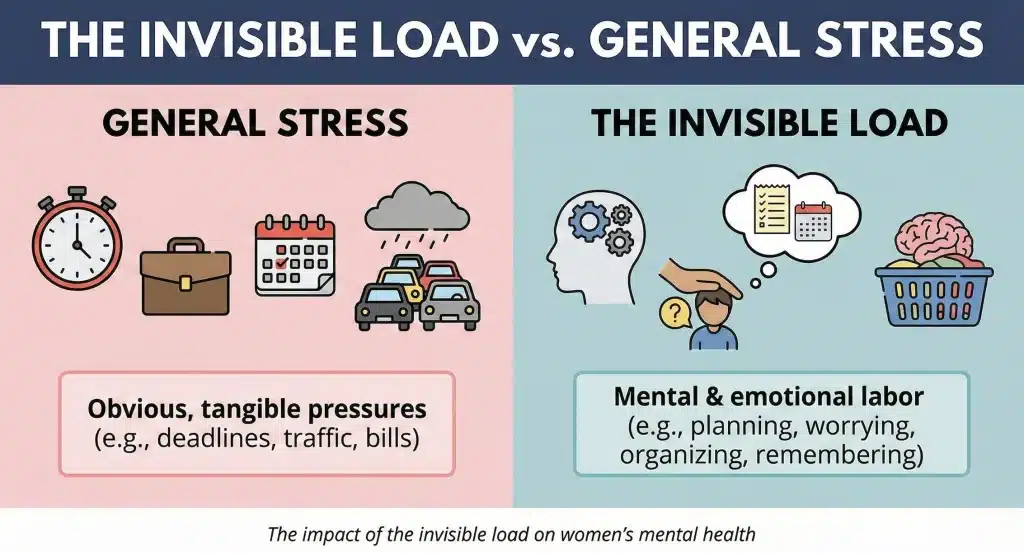
3. The "Invisible Load"
Sociologists call it the “second shift.” Many women work full-time, then come home to a second job of childcare and household labor. That nonstop strain keeps the nervous system stuck in fight-or-flight, driving physical burnout and adrenal fatigue.
4. Trauma and Safety
Women are statistically more likely to experience sexual assault or domestic violence. For survivors, co-ed treatment can feel unsafe or triggering. Women-only groups offer a safer space to process trauma without the added stress of the male presence.
The Heavy Weight of "Mom Guilt"
One of the biggest obstacles to treatment is mom guilt—the persistent thought, “If I take time for myself, I’m neglecting my kids.”
We name it and reframe it. Self-care is not selfish; it’s stewardship.
- The Oxygen Mask Analogy: On a plane, you put your mask on first. If you lose oxygen—burn out—you can’t help anyone.
- Modeling Health: Do you want your daughter to believe she must sacrifice her well-being to be loved? Seeking help models boundaries and self-respect and breaks the cycle of martyrdom.
What Is an IOP? (The "Sweet Spot" of Care)
Many women avoid treatment because they think the only options are:
- Weekly therapy: Often not enough when you’re in crisis.
- Inpatient care: Requires leaving work, home, and children for 30 days or more.
The Intensive Outpatient Program (IOP) offers a middle path.
- The Structure: Treatment sessions typically run about 3 hours a day, 3–5 days a week.
- The Flexibility: You return home each night—still tuck your kids in and often continue a modified work schedule.
- The Goal: Stabilize your mental health while you live your real life, so you can practice new skills in real time.
The Pillars of Our Women’s Program
At Sun County Wellness, our curriculum is designed to meet the specific wounds women carry.
1. Trauma-Informed Care
We view behaviors like drinking or withdrawing as coping strategies for pain. We use evidence-based approaches, including EMDR (Eye Movement Desensitization and Reprocessing), to process trauma safely and reduce re-traumatization.
2. Holistic Modalities: Reconnecting with the Body
Many women feel disconnected from their bodies because of trauma, body-image struggles, or chronic pain. Talk therapy alone often isn’t enough.
- Trauma-Informed Yoga: Not about exercise—about feeling safe in your body and building presence.
- Art Therapy: When words aren’t enough, creative work helps release and make sense of rage, grief, and hope.
3. Dialectical Behavior Therapy (DBT)
Women are often taught that their emotions are “too much.” DBT honors those feelings while teaching practical skills to manage them.
- Emotion Regulation: How to feel sadness without spiraling into despair.
- Interpersonal Effectiveness: How to set boundaries—crucial for people-pleasers who’ve forgotten how to say “no.”
4. Process Groups: Breaking the Isolation
Shame grows in secrecy. Sitting with other women—mothers, professionals, students—who nod and say, “Me too,” is powerful medicine. It helps you see you’re not alone.
Case Study: Elena’s Journey Back to Herself
To show how IOP works, here’s “Elena”—a composite of many women we support.
The Crisis: Elena, 38, was a marketing executive and mother of two. Outwardly she seemed fine; inside she was barely holding on. She had panic attacks at work, drank nightly to sleep, and felt like a failure.
The Intervention: Elena joined the Sun County Wellness IOP. She attended morning sessions from 9 AM to 12 PM while her children were at school, then worked remotely in the afternoons.
The Process:
- Week 1: Elena learned her symptoms were burnout, not weakness. We helped her negotiate a reduced workload.
- Week 3: In group, she admitted her drinking for the first time. Other women met her with understanding; her shame began to lift.
- Week 6: She practiced DBT skills and asked her husband to take on more household tasks, easing the invisible load.
The Result: Elena didn’t have to choose between her family and her health. She quit the “Superwoman” act and left IOP with practical tools and clearer boundaries.
Navigating Relationships: A Guide for Partners
When a woman enters treatment, family roles can shift. Partners may feel unsure. Here’s how to help:
- Don’t fix it—listen: Many men are taught to solve problems. When she shares, resist offering immediate solutions. Say something like, “That sounds really hard. I’m proud of you for doing this work.”
- Expect boundaries: As she heals, she may say “no” more and ask for practical help. This isn’t a rejection of you; it’s a rejection of burnout. Respect and support her limits.
- Be patient: Recovery isn’t linear. She’ll have good and hard days. Your steadiness during the low moments is one of the best supports you can offer.
Addressing the Barriers: "I Don't Have Time"
The most common reason women skip treatment is: “I can’t step away. My family will fall apart without me.”
We counter that with a clear truth: If you don’t invest time in your wellness now, you’ll likely be forced to take time for illness later.
Your family needs a healthy you more than a perfect house or a constant chauffeur. Taking six weeks to rebuild your foundation is an investment that pays lifelong dividends.
Conclusion: Permission to Prioritize Yourself
You’ve spent years caring for others—nurse, cheerleader, chef, unofficial therapist.
It’s okay to let someone else care for you.
At Sun County Wellness, we offer the space, the evidence-based treatments, and the sisterhood you need to heal. You are more than what you do for others. You are worth the care.
If you’re ready to find balance again, contact Sun County Wellness today.
Frequently Asked Questions
Will I have to talk about my trauma immediately? No. Trauma work is paced to your readiness. We begin with safety and stabilization, and you’ll never be pushed to share details before you’re ready.
What if I can’t leave work? We offer flexible schedules and, in some locations, evening tracks. Many clients use FMLA (Family and Medical Leave Act) to protect their job while in treatment—we can assist with that paperwork.
Is this just for postpartum depression? No. While we treat postpartum concerns, our Women’s IOP supports the full range of conditions: anxiety, depression, bipolar disorder, PTSD, and co-occurring substance use.
Does insurance cover IOP? In most cases, yes. IOP is a clinical medical treatment, and many major insurance plans cover it. Our admissions team can verify your benefits at no cost.