
Insurance Covered Mental Health Treatment for Women: Breaking the Barrier
Medical Disclaimer: The content provided in this article is for informational purposes only and does not constitute financial or medical advice. Insurance coverage varies by plan and provider. For a free, confidential verification of your specific benefits, contact the admissions team at Sun County Wellness.
Introduction: The "Can I Afford It?" Panic
You know you need help. You feel the burnout in your bones. You wake up with dread. You are snapping at your children or withdrawing from your partner.
But before you even pick up the phone to call a treatment center, a paralyzing thought stops you: “I can’t afford this.”
You imagine that quality mental health treatment—especially in a beautiful, healing environment like San Juan Capistrano—is reserved for the ultra-wealthy. You worry about draining your savings, taking money away from your family, or fighting with insurance companies who deny your claims.
At Sun County Wellness, we want to clear the fog: High-quality care is accessible.
We believe that financial fear should never be the barrier between a woman and her recovery. Thanks to laws like the Mental Health Parity Act, your health insurance is a powerful tool that can cover the majority (or all) of your treatment costs.
In this comprehensive guide, we will demystify the insurance process, explain your rights, and show you how to leverage your benefits to get the “Sanctuary” care you deserve without breaking the bank.
If you are ready to invest in yourself, explore our Admissions and Insurance Verification.

The "Cost of Waiting": Reframing the Expense
Women are socialized to put everyone else’s financial needs first. We will spend money on our children’s tuition, our partner’s business, or home repairs without blinking. But spending money on our own mental health feels “selfish.”
We need to reframe this. Treatment is not an expense; it is Asset Protection.
Ask yourself: What is the cost of not getting treatment?
- Divorce: Untreated trauma and addiction are leading causes of separation (legal fees, asset division).
- Job Loss: Burnout leads to mistakes, missed promotions, or termination.
- Physical Health: Chronic stress causes autoimmune issues, heart disease, and hospitalization.
The Reality: The cost of a mental health crisis is infinitely higher than the cost of your deductible. Investing in your stability protects your family’s future.
Understanding Your Rights: The Mental Health Parity Act
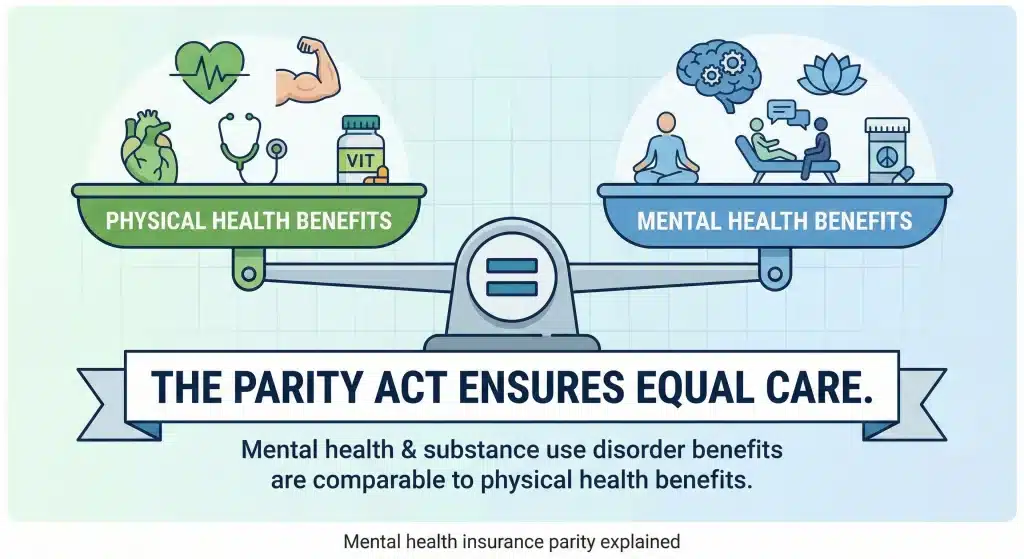
Many women assume their insurance won’t cover therapy or rehab because, historically, it didn’t. However, the Mental Health Parity and Addiction Equity Act (MHPAEA) changed the game.
What it means: Federal law requires most health insurance plans to provide coverage for mental health and substance use disorders that is no more restrictive than coverage for medical/surgical conditions.
- If your plan covers unlimited days for cancer treatment, it generally must cover unlimited days for mental health treatment (if medically necessary).
- They cannot charge higher copays for therapy than they do for a specialist doctor visit.
You have a legal right to care. Insurance companies count on you not knowing this. At Sun County Wellness, our utilization review team fights for every day of coverage you are entitled to.
PPO vs. HMO: Knowing Your Plan
The type of insurance you have dictates your options.
1. PPO (Preferred Provider Organization)
- The Gold Standard: PPO plans (like Anthem Blue Cross, Aetna, Cigna) offer the most flexibility.
- Out-of-Network Benefits: This is key. It allows you to choose a high-quality facility (like Sun County) even if we aren’t “in-network.” The insurance pays a percentage (e.g., 60-80%), and you pay the rest.
- No Referrals: You don’t need to ask your primary care doctor for permission to seek a specialist. You can call us directly.
2. HMO (Health Maintenance Organization)
- The Restriction: HMOs (like Kaiser) typically require you to stay strictly within their network of hospitals.
- The Challenge: In-network facilities are often overcrowded and institutional. However, if they cannot provide the specialized care you need (e.g., trauma-specific women’s care), you can sometimes petition for a “Single Case Agreement” to come to a specialized center.
Decoding the Jargon: Deductibles and Out-of-Pocket Max
Insurance language is designed to be confusing. Here is the translation.
- Deductible: The amount you must pay before insurance kicks in. (e.g., If your deductible is $2,000, you pay the first $2,000, then insurance starts paying).
- Coinsurance: The split. Once the deductible is met, the insurance might pay 80%, and you pay 20%.
- Out-of-Pocket Maximum (OOPM): This is your safety net. This is the most you will have to pay in a year. Once you hit this number (e.g., $5,000), insurance pays 100% of covered services for the rest of the year.
The “Silver Lining”: Treatment is often expensive enough that you hit your Out-of-Pocket Maximum quickly. This means any further care that year (therapy, doctors) is fully covered.
What "Medical Necessity" Actually Means
Insurance companies don’t pay for “wellness retreats.” They pay for Medical Necessity. To get coverage, we must prove that your condition requires clinical intervention.
Criteria for Coverage:
- Safety Risk: Are you a danger to yourself (self-harm, suicidal ideation) or unable to care for yourself?
- Failure of Lower Care: Have you tried seeing a therapist once a week, and it wasn’t enough?
- Functional Impairment: Is your anxiety/depression stopping you from working, parenting, or sleeping?
Our Role: Our clinical team documents your symptoms in “insurance language.” We translate your pain into the data they need to authorize payment. You don’t have to fight them; we do it for you.

The Sun County Difference: High-End Care, Insurance Accepted
There is a misconception that “nice” rehabs don’t take insurance, and “insurance” rehabs are sterile hospitals.
Sun County Wellness bridges this gap. We offer a boutique, high-end environment in San Juan Capistrano—gardens, equine therapy, organic food—while working with PPO insurance policies to cover the clinical costs.
- Hybrid Model: Insurance often covers the clinical treatment (therapy, psychiatry, nursing), while clients may pay a smaller portion for the “room and board” or amenities. This makes luxury care accessible to the middle class.
Scripts: How to Call Your Insurance
If you want to check your benefits yourself, call the number on the back of your card.
Ask these 3 Questions:
- “Do I have ‘Out-of-Network’ benefits for mental health and substance abuse?”
- “What is my deductible, and how much of it have I met so far this year?”
- “What is my Out-of-Pocket Maximum?”
Or, let us do it. Calling insurance is stressful. You can simply fill out our Insurance Verification Form, and our team will call them, get the exact numbers, and explain them to you in plain English—for free, with no obligation to admit.
Case Study: Sarah’s Solution
The Situation: Sarah, 38, was struggling with severe postpartum depression and alcohol use. She was terrified of the cost. She had a Blue Cross PPO plan through her husband’s work.
The Verification: She called Sun County. We found that she had a $3,000 deductible.
- The Fear: “$3,000 is a lot of money.”
- The Reality: We explained that a 30-day stay would cost significantly more without insurance. By paying the $3,000 deductible, her insurance kicked in to cover tens of thousands of dollars in medical and clinical care.
The Outcome: Sarah admitted. Her family pooled resources for the deductible (viewing it as a medical emergency). She utilized her benefits to get 45 days of treatment. She is now home, sober, and her insurance is paying 100% of her ongoing outpatient therapy because she met her max for the year.

Conclusion: You Are Worth the Investment
Money is a renewable resource. You can always make more money. You cannot make more time. You cannot replace your mental health.
Do not let a number on a spreadsheet stop you from saving your life. There are scholarships, financing options, and insurance benefits waiting to be used.
You have paid your premiums every month for years. It is time to let that policy work for you.
If you are ready to verify your benefits, contact Sun County Wellness today.
Frequently Asked Questions
Does insurance cover Equine Therapy/Yoga? Insurance typically covers “Clinical Groups.” We integrate holistic modalities into the clinical day. While insurance pays for the therapeutic processing, the facility covers the cost of the horses/instructors as part of our program fee.
Will my employer know I used mental health benefits? No. Your employer sees aggregate data (e.g., “5 employees used mental health services”), but they do not see names or diagnoses due to HIPAA laws. Your privacy is protected.
What if I have Kaiser/HMO? We are primarily a PPO facility. However, we can help you find an in-network provider, or discuss cash-pay rates/financing if you choose to come to us out-of-pocket.
Can I use FMLA for this? Yes. FMLA protects your job while you are away. Short-Term Disability insurance (if you have it) can often protect your income, paying you a percentage of your salary while you are in treatment.