
Anxiety in Women: Symptoms That Are Often Missed or Misunderstood
Medical Disclaimer: The content provided in this article is for informational purposes only and does not constitute medical advice. Severe, untreated anxiety can lead to physical illness, major depressive episodes, and cardiovascular distress. If you are experiencing chest pain, severe panic attacks, or thoughts of self-harm, please call 988 or go to the nearest emergency room immediately. For a confidential clinical assessment and holistic treatment options, contact Sun County Wellness.
Introduction: The Invisible Struggle in the Golden State
If you type the word “anxiety” into a search engine, the images you see are almost always identical. You will see a person curled up in a corner, clutching their knees to their chest, visibly hyperventilating, or looking terrified.
While that can be what anxiety looks like, for the vast majority of women in Orange County, it looks entirely different.
It looks like the mother at the San Juan Capistrano equestrian center who is flawlessly organizing a charity event but hasn’t slept a full night in three months. It looks like the female executive in Irvine who snaps at her partner over a misplaced pair of shoes. It looks like the woman sitting in a doctor’s office for the fifth time this year, trying to figure out why her stomach constantly hurts, only to be told her labs are “normal.”
Anxiety is a master of disguise.
Because society has a very narrow view of what mental illness looks like, millions of women are suffering in plain sight. They are dismissing their own pain, assuming they are just “stressed,” “hormonal,” or “difficult.” They push through their days, relying on caffeine, sheer willpower, and perhaps a glass of wine at night, never realizing that their bodies and minds are screaming for help.
At Sun County Wellness, we know that female anxiety rarely fits into a neat, stereotypical box. In this comprehensive guide, we will break down the neurobiology of the female nervous system, explore the subtle, misunderstood symptoms of clinical anxiety, and explain how our holistic sanctuary in South Orange County can help you finally find relief.
If you are tired of living with unexplained tension and exhaustion, explore our Women’s Mental Health Treatment Programs at Sun County Wellness.

The Neuroscience: Why Women’s Anxiety Hides
According to the Anxiety & Depression Association of America (ADAA), women are twice as likely as men to be diagnosed with an anxiety disorder in their lifetime.
This is not because women are “weaker” or inherently more fragile. It is the result of a complex collision between biology and sociology.
1. The "Invisible Load"
Women are socially conditioned from a young age to be the emotional barometers of their environments. You anticipate the needs of your children, manage the logistical calendar of your household, act as a sounding board for your friends, and maintain your professional career. This constant, low-level scanning of the environment requires the brain’s Amygdala (the threat-detection center) to be permanently switched to the “ON” position. You are running a marathon every single day without ever moving your feet.
2. Hormonal Intersections
The female nervous system is exquisitely sensitive to fluctuations in estrogen and progesterone. These hormones directly impact the production of serotonin (which stabilizes mood) and GABA (the brain’s natural “brake pedal” that induces calm). When hormones fluctuate—such as during the luteal phase of your menstrual cycle, postpartum, or perimenopause—the brain’s ability to naturally quiet anxiety diminishes drastically.
Because we are taught that we should be able to handle it all, when the anxiety hits, women often mask it. Instead of breaking down, the anxiety mutates into symptoms that are easily misunderstood.
The Physical Mask: When the Body Keeps the Score
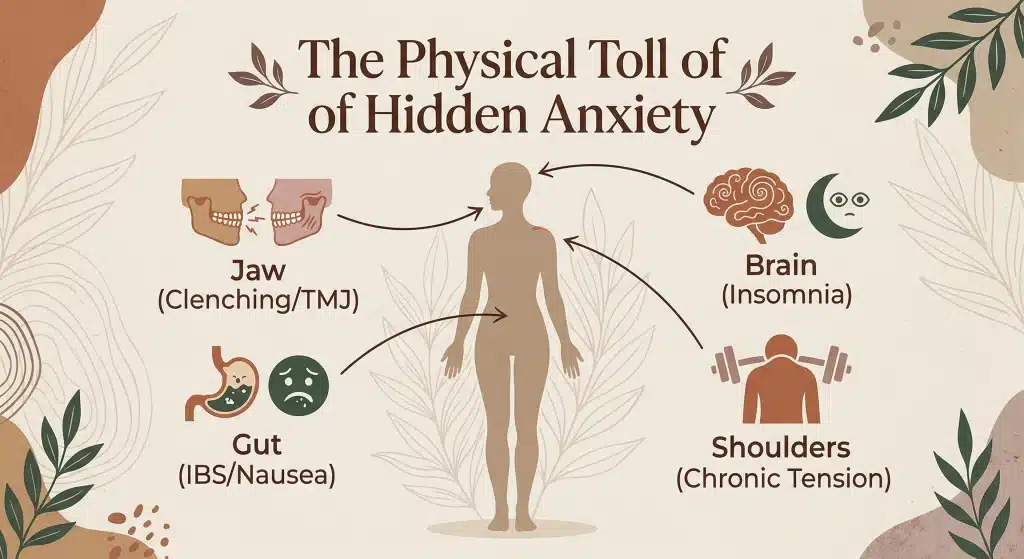
The most commonly missed symptoms of anxiety are physical. When the mind refuses to process emotional overload, the body will process it physically. This is known as Somatic Anxiety.
If your brain constantly believes you are in danger (Fight or Flight), it floods your bloodstream with cortisol and adrenaline. Over time, this chemical bath causes systemic inflammation and physiological breakdown.
1. Gastrointestinal Chaos (The Gut-Brain Axis)
The gut and the brain are directly connected by the Vagus Nerve. When you are in a state of chronic anxiety, your body diverts blood flow away from the digestive tract to send it to your muscles (preparing you to run from a predator).
- The Symptom: Chronic bloating, unexplainable nausea, constipation, or diarrhea. Many women are misdiagnosed with Irritable Bowel Syndrome (IBS) or food intolerances when the root cause is actually a dysregulated nervous system.
2. Chronic Muscle Tension and Pain
Your body is quite literally “bracing for impact.” You hold this tension subconsciously.
- The Symptom: Severe, chronic neck and shoulder pain. You might experience daily tension headaches or migraines. Another heavily missed symptom is Bruxism (jaw clenching or grinding your teeth at night), which leads to TMJ disorders and cracked teeth.
3. The "Tired but Wired" Sleep Disruption
Anxious women rarely experience the classic “sleeping for days” symptom often associated with depression. Instead, their sleep architecture is shattered.
- The Symptom: You collapse into bed at 10:00 PM, exhausted to your bones. But at 3:00 AM, your eyes fly open. Your heart is pounding, and your brain begins a frantic, unstoppable review of everything you forgot to do yesterday and everything that could go wrong tomorrow. You are exhausted, but your nervous system will not allow you to rest.
The Behavioral Mask: How Anxiety Changes Your Personality
Anxiety doesn’t just change how you feel; it changes how you act. But because these actions don’t look like “fear,” they are often misinterpreted by partners, friends, and even the women themselves.
4. Irritability and the "Short Fuse" (Anxiety as Rage)
When we think of a panic attack, we think of hyperventilating. But anxiety is the activation of the sympathetic nervous system. It is “Fight or Flight.” For many women, anxiety bypasses “Flight” and goes straight to “Fight.”
- The Symptom: You find yourself snapping at your spouse for leaving a dish in the sink. You experience intense, disproportionate road rage on the 5 Freeway. You feel a constant, simmering anger just beneath the surface.
- The Reality: You are not an angry person; you are an overwhelmed person. When your nervous system is at a 9 out of 10 all day, a minor inconvenience (a 1) pushes you to a 10, causing an emotional explosion.
5. High-Functioning Perfectionism
Society praises perfectionism, but clinically, it is often a trauma response or an anxiety management tool.
- The Symptom: You cannot tolerate mistakes. You rewrite emails five times before sending them. You obsessively clean your house before guests arrive because you fear judgment.
- The Reality: You are trying to control your external environment because your internal environment feels completely out of control. You believe that if you are “perfect,” you will be safe from criticism and rejection.
6. Isolation Disguised as "Introversion"
- The Symptom: You start declining invitations to dinners, school events, or professional networking opportunities. You tell your friends, “I’m just tired,” or “I’m really embracing being an introvert right now.”
- The Reality: It isn’t introversion; it is Avoidance. The thought of managing the sensory input of a crowded room, or the fear of saying the wrong thing, is so overwhelming that your anxiety convinces you it is safer to stay home. You are not recharging; you are hiding.
The Danger of the "Quick Fix": The Self-Medication Trap
Because the symptoms of chronic anxiety are so deeply uncomfortable, the drive to find a “mute button” is incredibly powerful.
In affluent areas of Southern California, this often leads to the normalization of self-medication.
- The “Wine O’Clock” Illusion: Alcohol is a central nervous system depressant. It provides a highly effective, temporary mimicry of the calming chemical GABA. Having two large glasses of wine feels like the only way to physically force your shoulders to drop at 6:00 PM.
- The Chemical Backfire: While alcohol numbs the anxiety for a few hours, the metabolic breakdown of alcohol causes a massive spike in excitatory chemicals in the brain. This is what causes you to wake up in a cold sweat at 3:00 AM (often called “Hangxiety”). You are chemically pouring gasoline on the exact fire you were trying to put out.
According to the Substance Abuse and Mental Health Services Administration (SAMHSA), women who suffer from untreated anxiety disorders are significantly more likely to develop a substance use disorder.
At Sun County Wellness, we understand this progression. We do not shame the coping mechanism; we treat the root cause. Learn more about how we untangle this in our Dual Diagnosis Treatment Programs.

Medical Gaslighting: Why the Diagnosis gets Missed
One of the most frustrating experiences for a woman with somatic anxiety is trying to get medical help.
You go to your primary care physician complaining of exhaustion, heart palpitations, and stomach issues. The doctor runs a blood panel, does an EKG, and comes back into the room to say, “Everything looks perfectly normal. You are totally healthy. Try to get some more sleep.”
This is a form of unintentional medical gaslighting.
When a doctor tells you that you are “fine,” but you feel like you are dying, the anxiety doubles. You begin to think you are losing your mind.
The traditional medical model is designed to find and fix structural, organic diseases (like a broken bone or a tumor). It is not always equipped to diagnose a software issue—a nervous system that is misfiring and sending phantom danger signals to the body. You need a specialized, psychiatric, and somatic approach to recalibrate the system.
The SJC Sanctuary: How Sun County Wellness Treats Anxiety
You cannot logic your way out of a biological survival response. Telling an anxious woman to “just calm down” is biologically impossible when her amygdala is flooded with adrenaline.
To heal anxiety, you must signal undeniable safety to the physical body. At Sun County Wellness, we use the grounding, historic, and natural landscape of San Juan Capistrano to do exactly that.
1. Somatic Experiencing and Vagus Nerve Regulation
We bypass the “thinking” brain and go straight to the nervous system. Through trauma-informed yoga, specific breathwork protocols, and grounding exercises, we teach you how to manually stimulate your Vagus Nerve. This acts as a physical brake pedal, stopping the flow of cortisol and pulling you out of “Fight or Flight.”
2. Equine-Assisted Therapy
San Juan Capistrano is deeply connected to equestrian culture. Horses are highly attuned prey animals; they act as living biofeedback machines. If you walk into a corral masking your anxiety with a fake smile, the horse will become agitated. To connect with the horse, you must physically lower your heart rate, drop your mask, and become congruent. This profound, non-verbal connection rebuilds your self-trust and forces your nervous system into a state of authentic calm.
3. Advanced Psychotherapies (CBT and EMDR)
Once your nervous system is regulated, we do the deep clinical work.
- We use Cognitive Behavioral Therapy (CBT) to help you identify and dismantle the cognitive distortions and perfectionism driving your anxiety.
- We use EMDR (Eye Movement Desensitization and Reprocessing) to address any underlying trauma or core wounds (such as childhood emotional neglect) that set your alarm system to be hyper-sensitive in the first place.
4. The Power of the Sisterhood
Anxiety thrives in secrecy and shame. In our women-only programs, the armor comes off. You will sit in our beautiful facility with other highly capable, successful women who will say, “I feel that exact same way.” The therapeutic power of being seen, understood, and validated without judgment accelerates healing faster than any medication.

Flexible Levels of Care for the Busy Woman
We know that pausing your life to go to a 30-day residential rehab is often impossible for the women we treat. Your family and your career depend on you.
At Sun County Wellness, we offer robust, flexible outpatient programs that provide immersive healing while allowing you to sleep in your own bed.
- Partial Hospitalization Program (PHP): Intensive “Day Treatment.” You attend clinical therapy, psychiatric care, and holistic groups for roughly 6 hours a day, 5 days a week. You focus entirely on healing during the day and return home in the evening.
- Intensive Outpatient Program (IOP): A step-down level of care (typically 3 hours a day, 3-5 days a week). This allows you to maintain your career and family life while practicing your new nervous system regulation tools in the “real world” with a powerful clinical safety net behind you.
Explore how we can curate a path for you on our Admissions and Assessments page.
Conclusion: You Do Not Have to Live Like This
Anxiety is a liar. It tells you that you must carry the weight of the world alone. It tells you that if you let your guard down for one second, everything will fall apart.
It is time to put the weight down.
You do not have to wait until your body completely breaks down or your relationships shatter to validate your pain. Experiencing exhaustion, irritability, and panic is not a character flaw; it is a treatable medical condition.
You deserve to wake up with a quiet mind. You deserve to experience a Sunday afternoon without guilt. You deserve to feel safe in your own skin.
San Juan Capistrano offers the sacred, grounded earth. We offer the clinical roadmap and the compassionate hands to help you walk it.
If you are ready to turn off the alarm bell, contact Sun County Wellness today. Let us help you find your way back to calm.
Frequently Asked Questions (FAQs)
Can hormonal imbalances mimic anxiety? Absolutely. The endocrine system and the nervous system are intimately connected. Conditions like thyroid dysfunction, perimenopause, and adrenal fatigue can perfectly mimic or severely exacerbate clinical anxiety. This is why we advocate for a holistic, whole-body psychiatric assessment rather than just treating the symptoms.
Will I have to be on anxiety medication forever? Not necessarily. For some women, non-addictive psychiatric medication (like an SSRI) is a vital tool that provides a biological “floor” so they have the bandwidth to engage in therapy. For others, lifestyle changes, somatic therapy, and EMDR are enough to achieve lasting remission. Your treatment plan will be uniquely yours.
How do I explain an IOP to my employer? Under the Family and Medical Leave Act (FMLA), you are legally protected to take intermittent or continuous leave for a serious medical condition. You do not need to disclose the specific diagnosis to your employer, only that you are attending a specialized, recurring medical program. Our team can help you navigate this paperwork.
I feel guilty spending the time and money on myself. This is the “Invisible Load” speaking. You have been conditioned to put yourself last. However, untreated anxiety eventually leads to burnout, which severely impacts your ability to be the mother, partner, or professional you want to be. Investing in your mental health is the most profound act of love you can offer your family, because it returns the authentic, healthy version of you back to them.