
How Long Does It Take to Feel Better? A Realistic Healing Timeline for Women
Medical Disclaimer: The content provided in this article is for informational purposes only and does not constitute medical advice. Mental health recovery timelines vary significantly based on individual biology, trauma history, and diagnosis. If you are experiencing a mental health emergency, severe panic attacks, or thoughts of self-harm, please call 988 or go to the nearest emergency room immediately. For a confidential clinical assessment and timeline estimate, contact Sun County Wellness.
Introduction: The "Prime Delivery" Expectation
We live in a culture of instant gratification, particularly in the high-achieving, hyper-optimized environment of Orange County. We are accustomed to next-day delivery, 10-minute grocery drop-offs, and “life hacks” designed to fix our problems with maximum efficiency.
Because you are a capable, successful woman, you apply this same standard of efficiency to yourself. You track your macros, you schedule your meetings to the minute, and you manage the logistical chaos of your family perfectly.
So, when the anxiety finally becomes too much—when the burnout crushes you, or the depression leaves you unable to get out of bed—you approach it like a project to be managed. You make the brave decision to seek treatment, and immediately, your brain asks the ultimate project-management question:
“Okay, how long is this going to take?”
You want a date on the calendar. You want to know exactly when the chest tightness will stop, when the brain fog will clear, and when you can get back to your life at 100% capacity.
At Sun County Wellness, we believe in radical transparency: Healing your nervous system is not a 10-day project. You cannot “hack” neurobiology.
In this comprehensive guide, we will dismantle the myth of the “quick fix” and pull back the curtain on the actual, biological timeline of mental health recovery. We will break down exactly what happens in the brain during treatment, what to expect month by month, and why the beautiful, grounding sanctuary of San Juan Capistrano is the perfect place to do the slow, profound work of rebuilding your life.
If you are ready to put away the stopwatch and pick up a compass, explore our Women’s Mental Health Treatment Programs at Sun County Wellness.

The Neuroscience of Time: Why Can't I Just "Snap Out of It"?
To understand why therapy takes time, you have to understand how your brain got injured in the first place.
Whether you are suffering from Generalized Anxiety Disorder, Major Depressive Disorder, complex trauma (C-PTSD), or chronic burnout, your brain has literally rewired its physical structure to survive your environment.
The "Superhighway" of Anxiety
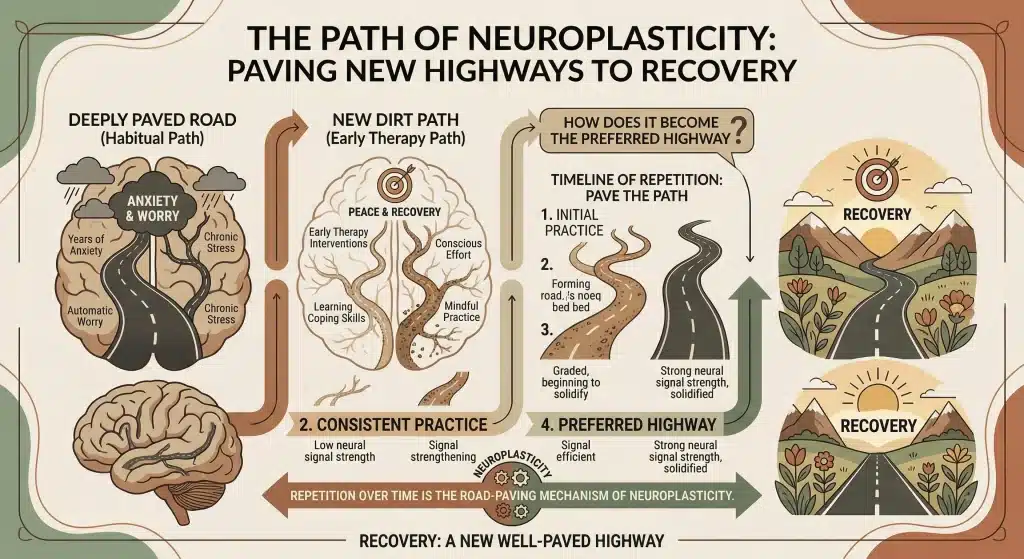
Imagine your brain is a dense field of tall grass. Every time you experience a stressful thought (“I am going to fail,” “I am not safe,” “I have to be perfect”), you walk a path through that grass.
If you have been living with high-functioning anxiety or suppressing trauma for twenty years, that path is no longer grass. It has been paved over with concrete. It is a multi-lane superhighway. According to the American Psychological Association (APA), these established neural pathways mean your brain will automatically, instantly travel down the road of panic or depression because it is the path of least resistance.
The Law of Neuroplasticity
Treatment relies on Neuroplasticity—the brain’s miraculous ability to form new neural connections and reorganize itself.
When you enter a Partial Hospitalization Program (PHP) or Intensive Outpatient Program (IOP), we are asking you to step off the superhighway and start walking a new path through the tall grass. We are asking you to build a dirt road of “Safety,” “Boundaries,” and “Self-Compassion.”
- The Reality: Walking that new dirt path is exhausting. It takes immense concentration. It feels unnatural.
- The Timeline: It takes consistent, daily, repetitive practice for the new dirt path to become a paved road, and for the old superhighway of anxiety to slowly grow over with weeds from disuse.
You cannot pave a new neural highway in 14 days. True, sustainable recovery requires months of clinical and somatic reinforcement.
Phase 1: Stabilization & The "Exhale" (Days 1 to 14)
When women first walk through the doors of our sanctuary in San Juan Capistrano, they are usually running on sheer adrenaline.
What is happening biologically: Your body is flooded with cortisol. Your Amygdala (the threat-detection center) is stuck in the “ON” position. You might be suffering from severe insomnia, digestive chaos, or the effects of self-medicating with alcohol (the “Wine Mom” trap).
What you will experience in Phase 1:
- The Drop: The first week is about stopping the bleeding. If you require medical stabilization or a change in psychiatric medication, our board-certified doctors handle this immediately.
- The “Pink Cloud”: Often, women feel an immediate, profound sense of relief in the first two weeks. We call this the “Pink Cloud” or the “Exhale.” Simply being in a safe environment where you do not have to manage the “Invisible Load” of your household causes your cortisol levels to drop.
- The Illusion: You might think, “Wow, I feel great! I’m cured. I can go home next week.” But this is just the stabilization phase. You have turned off the alarm bell, but you haven’t fixed the wiring that caused the fire.
Phase 2: The "Messy Middle" (Weeks 3 to 6)
This is the most critical and challenging phase of treatment. It is the phase where the real work happens, and it is the phase where you will most want to quit.
What is happening biologically: The initial relief of the “Pink Cloud” wears off. If you were using alcohol, perfectionism, or constant busyness to numb your feelings, those tools have now been taken away. You are sitting in the quiet, and for the first time in years, you have to actually feel your pain.
What you will experience in Phase 2:
- The Vulnerability Hangover: As you begin advanced trauma work—like EMDR (Eye Movement Desensitization and Reprocessing)—you are unearthing memories and core wounds that have been buried. You will likely feel exhausted. You might feel irritable or weep unexpectedly.
- The Extinction Burst: Your brain will fight back. It will tell you that therapy is making you worse. It will beg you to go back to your old coping mechanisms.
- The Clinical Anchor: At Sun County Wellness, we anticipate the Messy Middle. This is why we use Somatic Therapies (like yoga and breathwork) alongside clinical talk therapy. When your mind is overwhelmed by the trauma processing, we teach you how to physically ground your body using the earth of San Juan Capistrano to keep you anchored.
Phase 3: Integration and Skill Mastery (Weeks 6 to 12)
If you survive the Messy Middle without quitting, you enter the dawn of integration. The heavy lifting begins to pay off.
What is happening biologically: The new neural pathways are thickening. The Prefrontal Cortex (the logical, emotional regulation center) is coming back online and successfully communicating with the Amygdala, telling it to stand down.
What you will experience in Phase 3:
- Automatic Boundaries: You will face a stressor—perhaps a demanding email from your boss or a conflict with your spouse—and instead of spiraling into an immediate panic attack, you will find yourself using a DBT (Dialectical Behavior Therapy) skill. You will pause, breathe, and respond calmly. You won’t have to force it; it will start to feel natural.
- Equine Therapy Breakthroughs: In our equestrian programs, you will notice that the horses (who act as biofeedback mirrors) approach you with ease because your internal heart rate and energy match your external presentation. You are becoming congruent.
- The Return of Joy: The “gray filter” of depression begins to lift. You find yourself genuinely laughing in our women’s process groups. You notice the smell of the ocean breeze from Dana Point. You begin to care about your future again.

Phase 4: Maintenance and the "New Normal" (Months 3 and Beyond)
Treatment does not end the day you step down from a PHP or IOP program; it evolves. Mental wellness is a lifelong practice, much like physical fitness.
What you will experience in Phase 4:
- Stepping Down: You will likely transition from an intensive program (spending 15 to 30 hours a week with us) to standard outpatient therapy (1 to 2 hours a week).
- Testing the Armor: You are back in the “real world” full-time. You will face triggers. You will have bad days. But the fundamental difference is that a bad day no longer dictates your identity. A panic attack no longer derails your entire week.
- The Alumni Sisterhood: You lean on the network of resilient women you met at Sun County Wellness, knowing you have a community that understands the “Invisible Load” you carry.
Discover how our continuum of care supports this transition on our Admissions and Aftercare Page.
Variables That Affect Your Healing Timeline
When clients ask, “Will it take exactly three months?”, we have to look at their unique biological and environmental footprint. Certain factors can extend the timeline of recovery, which is why patience is non-negotiable.
1. Dual Diagnosis (Co-Occurring Substance Use)
If you have been using alcohol (the “Wine Mom” culture) or prescription pills (like Xanax or Adderall) to manage your anxiety, your timeline will be longer. According to the Substance Abuse and Mental Health Services Administration (SAMHSA), the brain’s dopamine and GABA receptors require significant time to regenerate after chemical dependency. Post-Acute Withdrawal Syndrome (PAWS) can cause waves of anxiety and insomnia for several months while the brain heals.
2. The Depth of the Trauma (C-PTSD)
Recovering from a single traumatic event (like a car accident) generally takes less time than recovering from Complex PTSD (C-PTSD). If you grew up in an abusive home, or spent 15 years in a narcissistic marriage, your entire personality and nervous system were built around survival. Dismantling that architecture is delicate, long-term work.
3. The Home Environment
You cannot heal if you are returning to a war zone every night. If your home environment is highly toxic, abusive, or unsupportive, healing will stall. This is why Sun County Wellness mandates Family Therapy and Partner Coaching—we must heal the ecosystem you are returning to, ensuring your partner understands how to validate rather than trigger you.
Why San Juan Capistrano Accelerates Healing
While you cannot rush neurobiology, you can provide it with the optimal environment for growth. A seed grows faster in rich, watered soil than it does in dry concrete.
San Juan Capistrano is the rich soil.
- The “Blue Mind” Advantage: Our proximity to the Pacific Ocean utilizes the scientific principle of “Blue Mind”—the calming, meditative state triggered by water. The negative ions and rhythmic sounds lower cortisol instantly, allowing the clinical therapy to take root without resistance.
- Somatic Grounding: The historic adobe structures, the sprawling equestrian trails, and the ancient pepper trees provide a deep sense of “Earth.” When trauma has made you feel disconnected from your body, the physical landscape of SJC anchors you back to the present moment.
- The Escape from the Hustle: We pull you out of the frantic, high-pressure corporate and social arenas of Irvine or Newport Beach, placing you in an environment where “slow” is celebrated.

Conclusion: Throw Away the Stopwatch
When you break your leg, you do not ask the doctor to make it heal in two weeks. You accept that the bone requires a cast, crutches, and months of physical therapy to bear weight again.
Your mind deserves the same grace you afford your bones.
Stop watching the clock. Healing from burnout, anxiety, and depression is not a race to be won; it is a life to be reclaimed. The time is going to pass anyway. You can spend the next six months white-knuckling your way through a miserable existence, or you can spend the next six months doing the profound, brave work of rebuilding your foundation.
You will not always feel this heavy. The light does come back. But you must give it time to dawn.
If you are ready to begin the journey, no matter how long it takes, contact Sun County Wellness today. Let us hold the compass for you.
Frequently Asked Questions (FAQs)
How long will I need to be in a PHP or IOP program? While every woman’s clinical needs are different, a standard stay in an intensive program (Partial Hospitalization or Intensive Outpatient) typically ranges from 4 to 12 weeks. This provides the necessary immersion to stabilize a crisis and build new coping skills before stepping down to traditional weekly therapy.
Will I have to be on psychiatric medication forever? Not necessarily. For some women, non-addictive psychiatric medication (like an SSRI) is a vital, temporary “life jacket” that provides a biological floor, giving them the energy to engage in therapy. For others with chronic biological conditions, long-term medication is a healthy tool. Our board-certified psychiatric team works collaboratively with you to determine a timeline for medication.
What if I feel worse after starting therapy? Feeling a temporary spike in anxiety or fatigue is incredibly common and actually a sign that the therapy (especially trauma processing like EMDR) is working. This is the “Vulnerability Hangover.” Our intensive programs provide daily support to keep you safe and regulated during this specific phase.
Can I take time off work for treatment without losing my job? Yes. Under the federal Family and Medical Leave Act (FMLA), eligible employees are entitled to up to 12 weeks of unpaid, job-protected leave to seek treatment for a serious medical condition, which explicitly includes severe anxiety, depression, and substance use disorders. Your HR department is legally bound to keep your medical information confidential.