
Nervous System Regulation: The Overlooked Key in Women’s Mental Health
Medical Disclaimer: This article is for informational purposes only and is not medical advice. Long-term nervous system dysregulation can contribute to serious autoimmune, cardiac, and mental health complications. If you are having panic attacks, dissociation, or thoughts of harming yourself, call 988 or go to your nearest emergency room right away. For confidential assessment and admissions, please contact Sun County Wellness.
Introduction: The "Wired but Tired" Epidemic
You wake up already spent. Three cups of coffee later, your chest feels tight and the day moves in a blur of tasks. By evening, a glass of wine feels like the only way to “take the edge off.” Then, at night, your mind spikes awake the moment your head hits the pillow.
You’re exhausted, and yet you can’t sleep. This is the familiar, frustrating state people call “wired but tired.”
For many women in Orange County, this has become the new normal—dismissed as stress or productivity culture. Clinically, though, it points to something deeper.
It points to nervous system dysregulation.
Think of your nervous system as your internal thermostat. When it’s out of balance, you can be locked in survival mode (fight/flight) even when everything around you is safe. This isn’t just “stress”—your body is interpreting ordinary life as a threat.
At Sun County Wellness, tucked into the calming landscape of San Juan Capistrano, we hold that healing requires shifting physiology, not only thoughts. In this guide, we’ll explain the nervous system, why talk therapy alone can fall short, and how nature, connection, and somatic tools help you find real rest.
If you’re ready to step off the treadmill, explore our Holistic Women’s Programs.

The Science: It’s Not Just in Your Head — It’s in the Vagus Nerve
To understand these sensations, follow the Vagus Nerve. It’s the body’s longest nerve, linking brain to heart, lungs, and gut — a key regulator of how you feel.
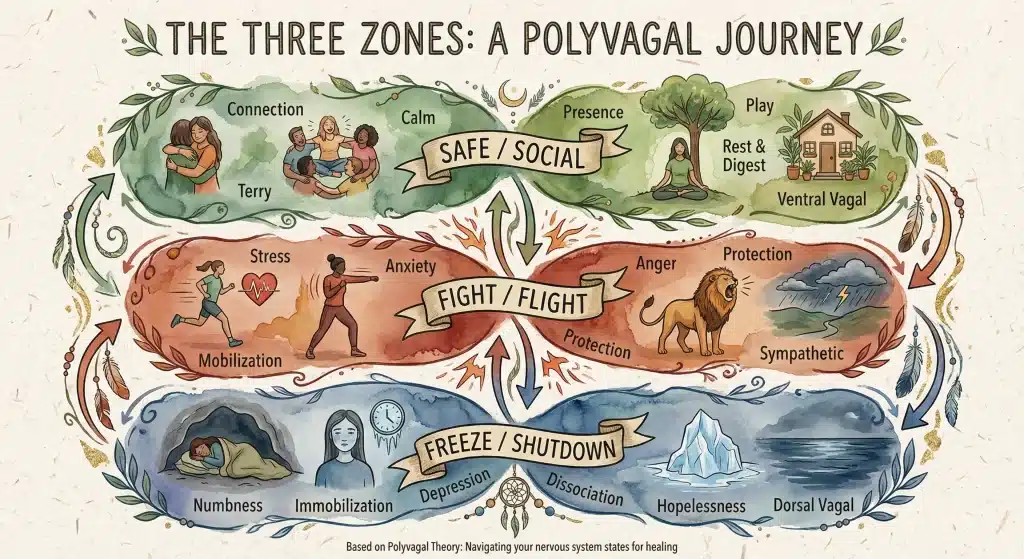
Polyvagal Theory (by Dr. Stephen Porges) describes three core nervous system states. Healing starts with recognizing which state you’re living in.
1. The Green Zone (Ventral Vagal)
- The State: Safety and connection.
- How it Feels: Calm curiosity, ease in your body, steady heart rate, good digestion—and the ability to be present with others.
- The Goal: To spend most of your time here.
2. The Red Zone (Sympathetic)
- The State: Mobilization — fight or flight.
- How it Feels: Anxiety, irritability, racing heart, quick shallow breaths. This is the “wired” side of being wired but tired.
3. The Blue Zone (Dorsal Vagal)
- The State: Immobilization — shutdown or freeze.
- How it Feels: Numbness, fog, low energy, wanting to hide. This is the “tired” side.
The Dysregulation Trap: Healthy regulation means moving between these zones with ease. Trauma and ongoing stress can lock the system in Red (chronic anxiety) or Blue (chronic depression), making it hard to return to Green.
The "Window of Tolerance": Why You Snap
Clinician Dr. Dan Siegel calls the safe operating range the “Window of Tolerance.” Inside it, you can handle life’s ups and downs without getting hijacked.
- Trauma shrinks the window. Past injuries or burnout can make your window very small—a spilled cup or a curt email can push you into rage (Red) or shutdown (Blue).
- Treatment widens the window. At Sun County, our aim is to increase your capacity to feel sensations without being overwhelmed. We want you to do more than survive—we want you to have room to breathe.
Why Women Are More Vulnerable
Women show higher rates of autoimmune conditions, anxiety disorders, and chronic pain syndromes—issues often tied to nervous system dysregulation. Several factors help explain why.
1. Hormonal Interplay Estrogen and progesterone interact with the nervous system. Monthly and life-stage hormonal shifts demand flexibility; when stress makes the system rigid, these changes can feel destabilizing (PMS, perimenopause).
2. The “Tend and Befriend” Load Many women take on emotional labor—soothing children, partners, and family members—which drains physiological resources. If you rarely receive regulation in return, your reserves run low.
3. Constant Vigilance Everyday safety concerns (walking alone at night, navigating microaggressions) keep a low hum of alertness. That background vigilance keeps the sympathetic system engaged.
The Functional Freeze: The High-Achiever’s Trap
In Orange County, many women aren’t just wired—they’re frozen in a way that still looks productive. We call this a Functional Freeze. You keep showing up—lead meetings, drive carpools, host dinners—but inside you’re checked out.
- Signs: A flatness where joy should be, trouble feeling emotion, procrastination driven by needing a huge adrenaline jolt to start.
- The Cost: This mismatch—high internal stress with outward performance—wears down the body. It taxes your adrenal system and can lead to physical collapse over time.
Digital Dysregulation: The Blue Light Effect
Our nervous systems still react to threats as if they were immediate physical dangers. A 10 PM work email can trigger the same alarm system as a real predator.
- Blue Light: Screens emit wavelengths that tell your brain it’s daytime. Late-night scrolling can increase cortisol and push you toward a sympathetic state when you should be winding down.
- Dopamine Loops: Fast-paced social media conditions the brain for constant stimulation, shrinking your tolerance for quiet or boredom—precisely the spaces where healing begins.
- The Simple Fix: We teach “Digital Sunsets”—powering down screens about two hours before bed to let your nervous system down-regulate naturally.
Nutritional Support: Feeding Your Nervous System
You can’t repair nervous-system function on caffeine and sugar. Nerves need specific nutrients—especially to rebuild their myelin sheaths and reduce inflammation.
- Magnesium (The Calm Mineral): Many stressed women are low in magnesium. It helps relax muscles, calm the nervous system, and supports vagal tone.
- Healthy Fats: Omega-3s (salmon, walnuts, chia) support nerve signaling and lower neuroinflammation.
- Hydration: Connective tissue and fascia—areas where tension often holds—need water to stay supple. Dehydration signals danger to the brain.
Healing in San Juan Capistrano: Nature as a Co-Regulator
Regulation rarely happens alone. Co-regulation—borrowing calm from people, animals, or environments—helps your system settle.
San Juan Capistrano provides natural cues that support safety and nervous system repair.
1. Sound Healing: The Mission Bells
Sound directly affects the vagus system.
- Urban Noise Problem: Sirens, horns, and traffic are jarring and can keep your nervous system on edge.
- SJC Remedy: The deep, steady toll of the Mission Bells, the whisper of wind in the trees, and the distant ocean create slow rhythms that signal safety to the brain.
2. Equestrian Therapy: Borrowing a Horse’s Heart
Horses produce a large electromagnetic field; being near a calm horse can naturally entrain your heart rate and breathing. This is powerful biological co-regulation.
- The Experience: No performance required—grooming, gentle contact, or just standing beside a horse can shift someone from Red toward Green within minutes.
3. Earthing and Negative Ions
SJC’s soil and coastline offer grounding benefits. Earthing—walking barefoot—can help neutralize oxidative stress, and the salty ocean air rich in negative ions supports relaxation. Together, they act like a natural “chill” intervention.

Practical Tools: Finding Your "Glimmers"
Clinician Deb Dana named pleasant safety cues “Glimmers.” While triggers alert us to danger, glimmers remind us the world can be kind.
How to practice: Your nervous system needs repeated small proofs that you’re safe.
- Notice a Glimmer: Spot something tiny that brings a flicker of ease—the way sunlight hits a leaf, the smell of coffee, a dog’s wagging tail.
- Savor it: Pause and let that small pleasant sensation land in your body for 20–30 seconds.
- Over time: Those moments build safety pathways in the brain and widen your Window of Tolerance.
Somatic Boundaries: Learning to Feel "No"
We often say “yes” while our bodies are shouting “no.” That mismatch fuels chronic stress. Somatic work teaches boundary-setting from the body out.
- The Check-in: Before accepting a request, scan your body. Is there tightness in your throat or heaviness in your gut? That’s a somatic “no.”
- A Practical Exercise: Push gently against a wall with both hands. Notice your muscles engage. Say “No” aloud. This trains your nervous system to feel capable of protecting your limits, which reduces background anxiety.
The "Voo" Breath: A Simple Reset
If you’re caught in the Red Zone, try this quick practice:
- Take a slow, full inhale.
- Exhale while producing a low, steady hum: “Vooooooo.”
- Feel the vibration in your belly and chest.
- Repeat for two minutes or until you feel calmer.
Why it helps: The vagus nerve runs near the vocal cords and diaphragm. Gentle humming stimulates the nerve and signals the brain to shift from mobilize to rest.
When Self-Regulation Isn’t Enough: Professional Support
Sometimes the system is so stuck that self-help tools feel worse than helpful. Meditation can trigger panic, or a breath exercise can feel unbearable.
That’s when clinical intervention is necessary. At Sun County Wellness, we provide structure and safety so your nervous system can relearn regulation.
- Somatic Experiencing (SE): A guided approach that helps release incomplete fight/flight responses held in the body.
- Neurofeedback: Technology-supported training to help your brain discover calmer states.
- Nutritional Psychiatry: Reducing inflammatory foods (excess sugar, alcohol) that act as chemical stressors on the nervous system.
We provide the scaffolding your system needs until it can steady itself again.

Conclusion: You’re Not Broken — You’re Overloaded
Imagine a computer with dozens of tabs open trying to run a heavy program. It doesn’t mean the computer is defective—it’s overloaded.
It’s the same with your body. Anxiety, burnout, and irritability aren’t moral failings; they’re signs your system is running at capacity.
You deserve the chance to close some tabs and reboot. San Juan Capistrano offers a supportive environment; we offer the clinical and somatic tools to help you come back online.
If you’re ready to begin, contact Sun County Wellness today.
Frequently Asked Questions
Is this the same as “adrenal fatigue”? They’re related. What’s often called “adrenal fatigue” reflects HPA-axis and hormonal consequences of a dysregulated nervous system. Treating the nervous system—root causes—can ease those hormonal symptoms.
Can I heal my nervous system while working? Yes. Our Intensive Outpatient Program (IOP) teaches practical regulation tools you can use during your day. You don’t have to withdraw from life to start feeling better.
Does alcohol help regulate the nervous system? No. Alcohol offers temporary calming but creates a rebound effect that increases anxiety and, over time, impairs vagal tone—making natural regulation harder.
How long does it take to see results? Nervous system-focused work often produces physical shifts faster than cognitive-only approaches. Many clients notice better sleep, calmer breathing, or more ease within the first one to two weeks of somatic work.