
IOP vs. PHP: Understanding the Difference and Finding Your Level of Care
Medical Disclaimer: The content provided in this article is for informational purposes only and does not constitute medical advice. Determining the appropriate level of care requires a clinical assessment. If you are experiencing a life-threatening emergency, acute withdrawal seizures, or active suicidal plans, please call 911 immediately. For a professional assessment, contact Sun County Wellness.
Introduction: Decoding the Alphabet Soup
When you finally make the brave decision to seek help—whether for burnout, trauma, or addiction—you are immediately hit with a wall of acronyms.
PHP. IOP. OP. LOC.
It can feel like learning a new language right when you have the least mental bandwidth to do so. You might wonder: “Is PHP just for severe cases?” “Is IOP enough support for me?” “Do I have to sleep at the facility for either of them?”
Clarity is the first step to healing.
At Sun County Wellness, nestled in the grounding hills of San Juan Capistrano, we believe you should understand exactly what you are signing up for. In this guide, we will break down the key differences between Partial Hospitalization (PHP) and Intensive Outpatient (IOP), explain how they fit into the “Continuum of Care,” and help you determine which sanctuary is right for you.
If you are ready to find your path, explore our Women’s Treatment Programs.

The "Continuum of Care": A Ladder to Healing
Think of recovery not as a single event, but as a ladder. You start where you need the most support and step down as you regain your strength.
- Rung 1: Residential/Inpatient: 24/7 monitoring. You sleep there. (Highest intensity).
- Rung 2: PHP (Partial Hospitalization): All-day treatment. You sleep at home.
- Rung 3: IOP (Intensive Outpatient): Part-time treatment. You work/school and sleep at home.
- Rung 4: Outpatient: Weekly therapy.
Most women enter our program at the PHP level to stabilize, then transition to IOP to reintegrate into their lives.
What is PHP? (The "Day Treatment" Model)
PHP stands for Partial Hospitalization Program. Despite the name, it is not a hospital stay. It is best described as “Day Treatment.”
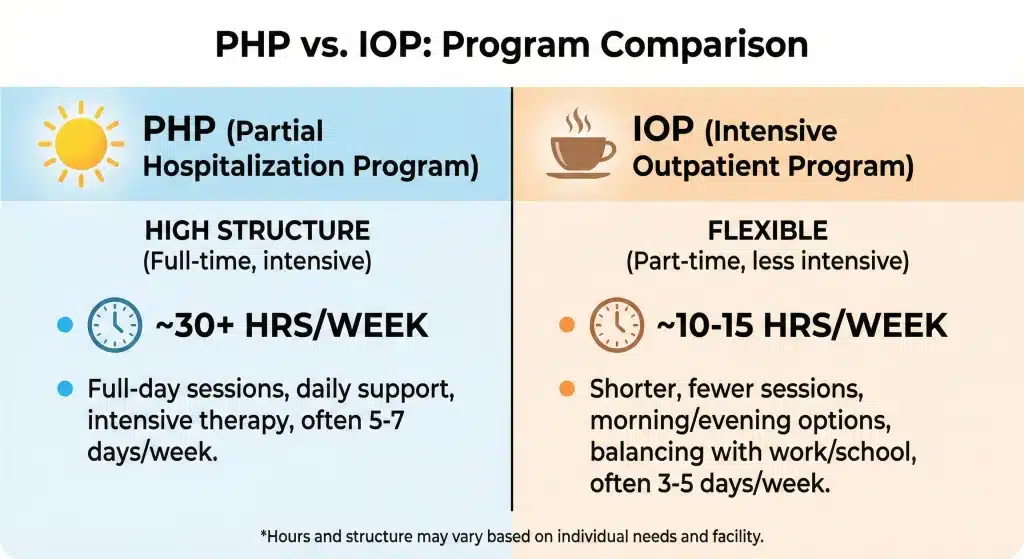
- The Schedule: Roughly 6 hours a day, 5 days a week (e.g., 9:00 AM to 3:00 PM).
- The Vibe: Immersive. Your “job” right now is recovery. You are in clinical groups, individual therapy, and holistic sessions for the majority of the day.
- Who It’s For:
- Women stepping down from Residential who aren’t ready for total freedom.
- Women in crisis who need daily medical monitoring/psychiatry but can safely sleep at home.
- Those who need to break the cycle of daily substance use or severe depression.
- Women stepping down from Residential who aren’t ready for total freedom.
- Women in crisis who need daily medical monitoring/psychiatry but can safely sleep at home.
- Those who need to break the cycle of daily substance use or severe depression.
The SJC Advantage: In our PHP, the day includes lunch (farm-to-table nutrition) and experiential therapies like Equine or Art therapy to break up the clinical work.
What is IOP? (The "Real World" Model)
IOP stands for Intensive Outpatient Program. This is the bridge between full-time treatment and full-time life.
- The Schedule: Roughly 3 hours a day, 3 to 5 days a week (e.g., 9:00 AM to 12:00 PM or an evening track).
- The Vibe: Integration. You are spending half your time in treatment and half your time in your real life (working, parenting, studying).
- Who It’s For:
- Women who have stabilized in PHP and are ready to return to work/school.
- Mothers who need to be present for school pick-up and bedtime.
- Professionals who can carve out a morning or evening but cannot take a leave of absence.
- Women who have stabilized in PHP and are ready to return to work/school.
- Mothers who need to be present for school pick-up and bedtime.
- Professionals who can carve out a morning or evening but cannot take a leave of absence.
The SJC Advantage: IOP allows you to practice the grounding skills you learn in our groups immediately in your home environment.
Detailed Daily Schedules: What Does It Look Like?
To help you visualize the commitment, here is a typical day in each level of care at Sun County Wellness.
A Typical PHP Day (The Immersive)
- 9:00 AM: Morning Check-in & Mindfulness (Grounding with the view of the hills).
- 10:00 AM: Process Group (Deep dive into trauma/emotion).
- 11:30 AM: Psychoeducation (Neuroscience of addiction/anxiety).
- 12:30 PM: Lunch (Nutritional Psychiatry focus).
- 1:30 PM: Experiential Therapy (Equine Therapy or Trauma Yoga).
- 2:45 PM: Wrap-up and planning for the evening.
- 3:00 PM: Dismissal.
A Typical IOP Day (The Integrative)
- 9:00 AM: Check-in (Drug testing & Accountability).
- 9:30 AM: Process Group (Focus on current life stressors: work/relationships).
- 10:45 AM: Skills Group (CBT/DBT tools for managing triggers).
- 11:45 AM: Dismissal.
- 12:00 PM: Client heads to work or picks up kids.
The Science of Step-Down: Why Gradual is Better
Why not just leave PHP and go back to normal life? Because the brain needs time to adjust. This is called Neuroplasticity.
In PHP, you are building new neural pathways (“I can handle stress without using”). These pathways are fragile.
- The Cliff Edge: If you jump from 30 hours of support a week to zero, the brain often panics, leading to relapse.
- The Ramp: IOP acts as a ramp. It allows you to test the new pathways in the real world while still having a safety net to catch you if you stumble.
Managing the "Double Life" of IOP
For women in IOP, balancing treatment with life can feel like having two full-time jobs. You might be a CEO by day and a patient by night.
Strategies for Balance:
- The “Medical Appointment” Script: You do not need to tell your boss or colleagues you are in “rehab.” You can simply say, “I have a recurring medical appointment for the next few weeks.” This is legally protected.
- Time Blocking: We teach clients to block out their calendar not just for sessions, but for the transition time. You cannot go from deep trauma work to a board meeting in 5 minutes. You need a 20-minute buffer to regulate.
- Explaining it to Kids: For mothers, we suggest framing it as “Mommy’s Class.” “Mommy is taking a class to learn how to have less stress and be happier.”
Family Involvement: Crisis vs. Connection
Family therapy looks different at each level.
In PHP (Crisis Mediation): The focus is often on stabilization. The family is in crisis. We focus on:
- De-escalating conflict.
- Establishing immediate safety plans (no alcohol in the house).
- Education on the disease model.
In IOP (Relationship Building): The crisis has passed. Now we build the future. We focus on:
- Communication skills (“I statements”).
- Rebuilding trust that was broken.
- Setting healthy boundaries so the family isn’t “walking on eggshells.”
Key Differences at a Glance
Feature
PHP (Partial Hospitalization)
IOP (Intensive Outpatient)
Hours per Week
25 – 30+ hours
9 – 15 hours
Days per Week
Usually 5 days (M-F)
3 to 5 days
Medical Oversight
Daily/Weekly meetings with Psychiatrist & Nursing
Weekly/Bi-weekly check-ins; less medical focus
Primary Goal
Stabilization: Getting the crisis under control.
Maintenance: Learning to live sober/stable in the real world.
Work/School
Difficult to maintain full-time employment.
Designed to accommodate work/school schedules.
Shared Elements: The Sun County Standard
Regardless of which acronym you fall under, the quality of care at Sun County Wellness remains the same. Both tracks feature:
- The “Sisterhood”: Gender-specific groups that provide safety from the male gaze and a shared understanding of the “Invisible Load” women carry.
- Holistic Integration: Access to trauma-informed yoga, mindfulness, and the grounding energy of the San Juan Capistrano landscape.
- Trauma Focus: Both tracks utilize EMDR and somatic therapies to treat the root cause, not just the symptom.
How to Decide: A Checklist
Are you stuck between the two? Ask yourself these questions:
You likely need PHP if:
- [ ] You cannot imagine going 24 hours without using a substance or having a panic attack.
- [ ] You are currently unable to function at work or perform basic self-care (showering, eating).
- [ ] Your home environment is stressful, and you need a full day of sanctuary to heal.
You likely are ready for IOP if:
- [ ] You have achieved some stability (a few days/weeks of sobriety or calmness).
- [ ] You have a supportive home environment (partner/family) that is safe.
- [ ] You are motivated to return to work or school and need support navigating the triggers that come with that.
!

The Financial Picture: Insurance Coverage
Both PHP and IOP are clinical levels of care, meaning they are typically covered by PPO Insurance (Blue Cross, Aetna, Cigna, etc.) as a medical necessity.
- The Difference: PHP is billed at a higher daily rate (due to more hours/medical care), so insurance authorization requires more “severity” of symptoms.
- The Transition: Often, insurance will approve PHP for 2-4 weeks, and then “step you down” to IOP as you show improvement. This maximizes your benefits and extends your support timeline.
We handle all the utilization review and advocacy for you.
Case Study: Elena’s Journey Through the Continuum
Phase 1: PHP (The Reset) Elena, 34, admitted to Sun County for severe burnout and alcohol use. She took a month of FMLA from her job.
- In PHP: She spent her days in SJC, away from the stress of her office. She stabilized her sleep, detoxed safely, and did deep trauma work. She was home for dinner but focused entirely on healing during the day.
Phase 2: IOP (The Bridge) After 30 days, Elena felt stronger but was terrified to go back to the office full-time.
- In IOP: She returned to work part-time (mornings) and attended IOP in the afternoons. When work stress triggered a craving, she brought it to her group that same day.
The Result: The gradual step-down prevented a relapse. She didn’t have to go from “0 to 100”; she eased back into life with a safety net.

Conclusion: It’s Not a Race
Recovery is not about how fast you can get back to “normal.” It is about building a new normal that is sustainable.
Whether you need the immersive cocoon of PHP or the guided flexibility of IOP, you are making a choice to honor your own worth. You are choosing to stop white-knuckling your life.
San Juan Capistrano offers the ground; we offer the map.
If you are ready to start, contact Sun County Wellness today for a free assessment to find your level.
Frequently Asked Questions
Can I switch from IOP to PHP if I need more help? Absolutely. Healing is non-linear. If you start in IOP and realize you are struggling to stay safe, we can “step you up” to PHP immediately to provide more structure.
Do I have to do residential first? No. Many women start directly in PHP if they are medically stable. It is a great option for those who want high-level care but absolutely need to sleep at home.
Is there a difference in the therapy types? The modalities (CBT, DBT, EMDR) are the same. The difference is the frequency. In PHP, you might have therapy every day; in IOP, you might have it 3 days a week.
Do you treat dual diagnosis in both? Yes. Whether you are in PHP or IOP, we treat the substance use and the underlying mental health (anxiety/trauma) simultaneously.