
How to Ask for Help When You’re Used to Holding Everything Together: A Guide for the Strong One
Medical Disclaimer: This article is for informational purposes only and is not medical advice. Chronic stress and persistent self-reliance can lead to serious burnout and health problems. If you are having panic attacks, chest pain, or thoughts of harming yourself, call 988 or go to the nearest emergency room right away. For confidential intake and assessment, contact Sun County Wellness.
Introduction: The Weight of Being the "Strong One"
There’s a particular loneliness that comes with being the person everyone depends on.
You organize the vacations, cover the bills, remember everyone’s birthdays, and put out the fires. You’re the steady presence at home, the high-performer at work, and the friend who always picks up—no matter the hour.
To others, you look like you’ve got it handled. You seem unbreakable.
Inside, though, you are worn thin.
You carry a quiet anger that no one ever asks how you are. You daydream about driving past your exit and keeping going. Then you inhale, pull on a smile, and keep everything upright.
At Sun County Wellness, we see that exhaustion.
We understand that for many women, asking for help feels risky. It can feel like conceding defeat or threatening the balance you keep in your life.
In this guide we’ll look at the psychology behind hyper-independence, how “being strong” can be a trauma response, and practical, gentle ways to ask for and accept support.
If you’re ready to let someone else shoulder the load for a while, learn more about our Women’s Wellness Programs at Sun County Wellness.

The Myth of the Superwoman
We grow up bought into the Superwoman ideal: she can do it all—work, home, family—and she never shows strain.
That story isn’t true.
No one carries everything without cost. Usually, the price is your health.
- The emotional cost: You become isolated. If you never show vulnerability, people know you for what you do, not for who you are.
- The relational cost: Your relationships shift toward transactions. People stop offering help because you’ve signaled that you don’t need it.
The Biological Cost: What "Holding It Together" Does to Your Body
You may still meet deadlines and keep commitments, but your body records the stress.
With sustained hyper-independence, your nervous system can stay in sympathetic activation—the fight-or-flight state—keeping cortisol elevated around the clock.
Signs of adrenal or stress overload:
- The “tired but wired” pattern: You feel exhausted at night but lie awake in the early hours.
- Persistent midsection weight: Weight that seems stuck around your middle despite diet and exercise—your body’s protective response to chronic stress.
- Autoimmune or pain flares: Long-term stress weakens immune function and can contribute to conditions like thyroid dysfunction, chronic pain syndromes, or migraine.
This is not a moral failing; it’s a biological response. You can’t out-think hormones.
Why Asking for Help Feels Impossible
If the words “I can’t do this” make you physically recoil, there’s usually a deeper reason than pride. Asking often feels unsafe because it once was.
1. The "Parentified Child"
If you grew up in a household where adults were inconsistent or overwhelmed, you may have learned to become the caretaker early. In that environment, needs = danger. Needing someone could be ignored or punished, so you learned not to show need.
2. Perfectionism as armor
Perfection can feel like protection. If everything looks flawless, criticism feels less likely. Asking for help can feel like taking off that armor in the middle of a fight.
3. The fear of rejection
There’s a quiet worry: “If I stop being useful, will they still love me?” You’ve trained others to rely on you. The thought of becoming the one who needs support can feel like risking abandonment.
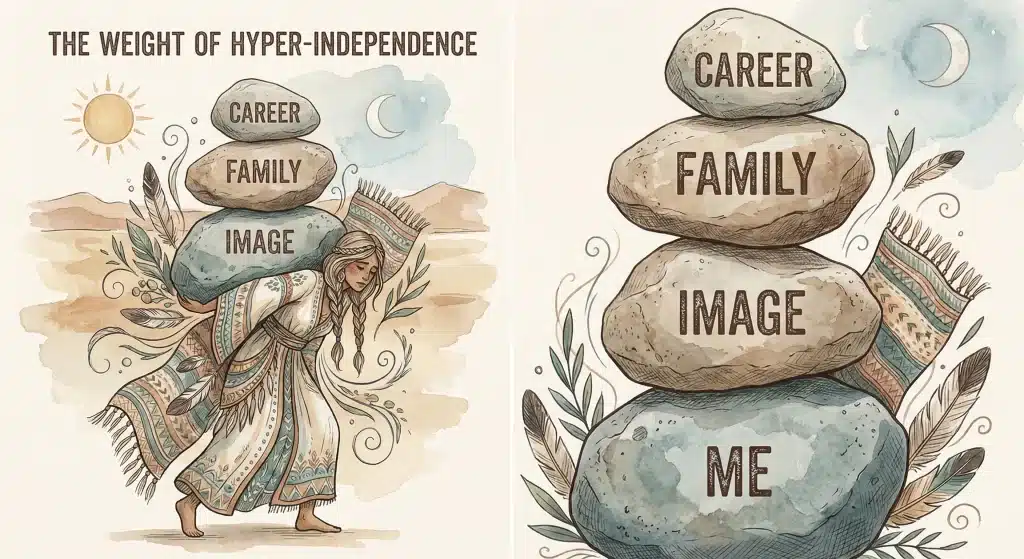
The "Friendship Audit": Who Is Holding You?
Part of asking for help is choosing the right person to ask. Not everyone has earned the space for your vulnerability.
As someone who carries a lot, you may attract people who need saving. Your circle can fill with takers. That’s why we recommend a simple Friendship Audit.
Ask yourself:
- Reciprocity: When did this person last ask how I was—then actually listen?
- Energy: Do I feel lighter or heavier after time with them?
- Safety: If I share I’m struggling, will they hold space or make it about themselves?
The shift: You may need to step back from “energy vampires” and create room for “energy givers.” Aim to have at least one person who doesn’t need anything from you in return.
Workplace Boundaries for the Superwoman
At work, the pressure to say “yes” can be strongest. You worry that saying “no” will make you look weak or incapable.
The truth: Saying “yes” to everything guarantees burnout and a drop in the quality of your work.
Scripts you can use:
- Instead of: “I’ll do it.”
- Try: “I can help, but with my current workload I wouldn’t be able to give this the attention it deserves until next week. Does that timeline work, or should we assign it elsewhere?”
- Instead of: “I’m fine, I don’t need help.”
- Try: “I’m at capacity right now. To meet this deadline, I need support with the administrative pieces.”
The Signs You Are About to Break
Because you function at a high level, things won’t necessarily snap all at once. Instead, you’ll see a slow wearing down.
- Resentment: Irrational anger at small requests (e.g., you want to snap when your partner asks where the ketchup is).
- Numbing: Increasing alcohol use or scrolling to escape for hours each night.
- Somatic pain: Unexplained headaches, back pain, or jaw tension from clenching under stress.
- Escape fantasies: Catching yourself wishing for a short illness so you can rest without guilt.
If you’re fantasizing about being sick just to rest, consider that a red flag for crisis intervention.
Somatic Release: The SJC Way
Relaxing isn’t just a decision—your body may need help learning safety again. Years of holding tension require physical release.
At Sun County Wellness we use San Juan Capistrano’s surroundings to support that process.
- Earthing at Doheny: Standing barefoot on sand or grass. This is practical grounding—simple contact with the earth can help reduce stress and support calm.
- The physiological sigh: A breathing pattern that helps lower CO2 and soothe the heart: two short inhales through the nose, followed by one long exhale through the mouth.
- Shaking: Like animals who shake after danger, gentle shaking of the limbs signals to the nervous system that the threat is over and helps discharge excess adrenaline.

How to Ask: A Script for the "Strong One"
Recognizing you need help is the first step. Learning how to ask is the next. You don’t have to begin with a big confession—start small.
Scenario 1: Asking your partner
- The worry: “He’ll think I’m lazy.”
- A script to try: “I need to be honest. I’ve been running on fumes and I’m getting scared for myself. I’m overwhelmed and need us to look at our schedule to see what can change so I don’t keep going at this pace.”
Scenario 2: Calling a professional (admissions)
- The worry: “I don’t belong in treatment.”
- A script to try: “I’m not sure if I need formal rehab, but I can’t keep doing this alone. What options do you have for someone who still needs to work and parent but needs structured support?”
The Art of Receiving (The Hardest Part)
Asking is difficult; accepting help can be harder. When someone offers to help, your impulse may be to correct them or take back control.
- Example: You ask your partner to handle laundry. He folds it differently, and you redo it.
Stop. Re-doing the task teaches others their help isn’t acceptable—so they stop trying. Practice tolerating imperfect help.
- Let the laundry be folded a different way.
- Let the kids have pizza for dinner sometimes.
- Accept a B+ presentation when you normally expect an A+.
This is gentle exposure: you’re retraining your tolerance for loss of control. The world will not fall apart because things are imperfect.
Why San Juan Capistrano Is the Place to Let Go
Women come to South Orange County to slow down because the place itself supports it.
In San Juan Capistrano, mission bells mark the day and the returning swallows remind us that rest is a natural rhythm—not a luxury dictated by your inbox.
At Sun County Wellness we focus on treating the “Strong One.”
- Privacy: A discreet setting where you can set down the Superwoman mask without judgment.
- Holistic healing: Equine work, yoga, and guided nature time to help your nervous system remember safety.
- Validation: You’ll meet other capable, successful women who are also exhausted—so you can see you’re not broken, just burned out.
A New Definition of Strength
Let’s redefine strength. It’s not how much you can carry before you collapse. Strength is knowing when to put the weight down.
Asking for help is a quiet act of rebellion against a culture that drains you. It’s an act of care. It may be the bravest thing you choose.
You have kept everyone else together. Let us hold you for a while.
If you’re ready to rest, contact Sun County Wellness today.
Frequently Asked Questions
Will my family fall apart if I go to treatment? This is the most common fear. The reality: if you don’t get care, you risk a collapse that could put the whole family into crisis. Taking time now often prevents a larger, forced crisis later.
I feel guilty spending money on myself. Think of it as protecting what matters most. You are your family’s greatest resource. If the engine (you) breaks down, everything else suffers. Investing in repair is investing in the family’s future.
Can I do this while working? Yes. Our Intensive Outpatient Program (IOP) is tailored for high-functioning women. You can receive meaningful treatment and still maintain work and family responsibilities.
What if I’m not “addicted” to anything? We treat primary mental health concerns—anxiety, depression, trauma—just as often as substance use. You do not need a substance issue to qualify for care. Burnout and chronic overwhelm are valid reasons to seek help.