
People-Pleasing, Anxiety, and Emotional Exhaustion in Women: The High Cost of Being "Nice"
Medical Disclaimer: The content provided in this article is for informational purposes only and does not constitute medical advice. Chronic anxiety, trauma, and severe emotional exhaustion can lead to physical illness, panic disorders, and major depressive episodes. If you are experiencing chest pain, severe dissociation, or thoughts of self-harm, please call 988 or go to the nearest emergency room immediately. For a confidential clinical assessment and holistic treatment options, contact Sun County Wellness.
Introduction: The Exhaustion of the "Yes" Woman
You are the ultimate team player. You are the woman who takes on the extra project at work because “it’s just easier if I do it.” You are the mother who volunteers for the school fundraiser even though you are already running on four hours of sleep. You are the partner who carefully monitors your spouse’s mood when they walk through the door, twisting yourself into knots to ensure the evening goes smoothly.
To the outside world, particularly in the high-achieving culture of Orange County, you are perceived as selfless, reliable, and “so nice.”
But internally, you are drowning.
You feel a deep, gnawing resentment that you quickly push down with a wave of guilt. You are chronically exhausted, but when you finally have a moment to rest, your mind races with anxiety about who you might have disappointed today. You feel like a supporting character in the movie of your own life.
At Sun County Wellness, we want to validate a hard truth: Your people-pleasing is not a personality trait. It is a highly effective, incredibly exhausting anxiety management tool.
In this comprehensive guide, we will pull back the curtain on the clinical reality of people-pleasing. We will explore the neuroscience of the “Fawn” trauma response, the devastating physical toll of emotional exhaustion, and how our holistic, somatic sanctuary in San Juan Capistrano can help you finally learn how to say “No”—and mean it.
If you are ready to stop abandoning yourself to keep everyone else comfortable, explore our Women’s Mental Health Treatment Programs at Sun County Wellness.
!

The Neuroscience of "Nice": Understanding the Fawn Response
To stop people-pleasing, you have to understand why you do it. You don’t say “yes” to everything because you have boundless energy; you say “yes” because the thought of saying “no” triggers a biological panic response.
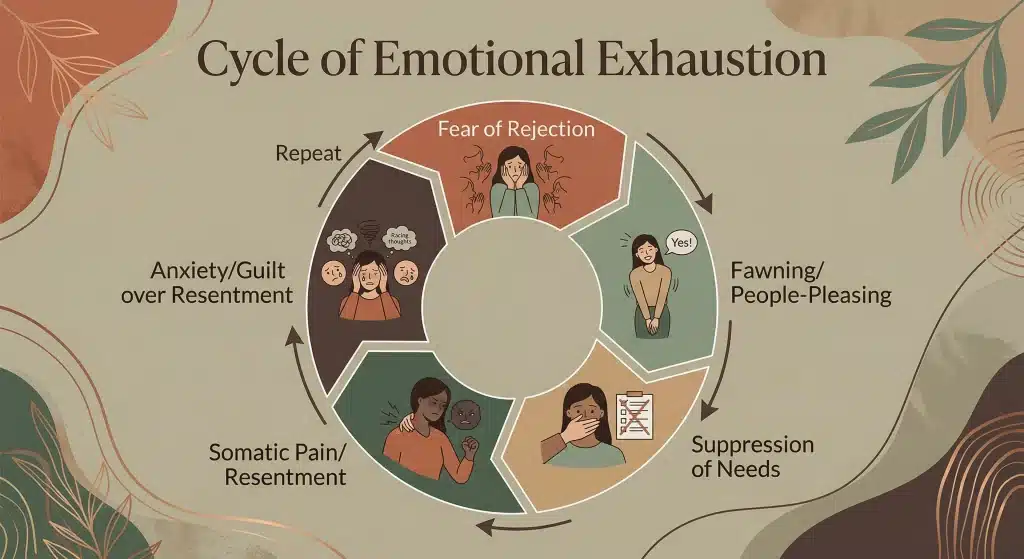
Most people are familiar with the brain’s classic trauma responses: Fight, Flight, or Freeze. But there is a fourth, highly common response in women: Fawn.
Coined by complex trauma expert Pete Walker, the “Fawn” response is a survival mechanism. When the brain detects a threat (which, to an anxious person, can be as simple as someone being slightly irritated with them), it attempts to preemptively soothe the threat by becoming entirely submissive and accommodating.
- The Logic of Fawning: “If I merge with what this person needs, if I am perfectly helpful and agreeable, they will not abandon me, criticize me, or hurt me. If I keep the peace, I am safe.”
According to the American Psychological Association (APA), chronic anxiety wires the brain to constantly scan for danger. For the people-pleaser, the “danger” is the disapproval of others. Your brain views a missed text, a sighed breath, or a disappointed look as a life-or-death emergency.
The Cultural Trap: The "Good Girl" Conditioning
The Fawn response doesn’t develop in a vacuum. It is heavily nurtured by society.
From a very young age, women are socialized to be the emotional shock absorbers of their environments. We are taught that our value is inextricably linked to our usefulness and our palatability.
In affluent, high-pressure environments like South Orange County, this conditioning is amplified. The “Perfect Woman” aesthetic demands that you build a successful career, raise immaculate children, maintain a beautiful home, and look effortless doing it.
- The “Invisible Load”: You carry the emotional spreadsheet for your entire family. You know when the dog needs shots, when your partner’s mother’s birthday is, and which child needs extra reassurance today.
- The Cost: When you are constantly managing the emotional climate of the room, you lose connection to your own internal climate. You become so hyper-attuned to what everyone else needs that if someone asked you, “What do you actually want?” you would likely freeze, entirely unable to answer.
The Somatic Toll: When Unspoken "No's" Become Physical Pain
You cannot suppress your authentic needs for decades without your body keeping the score.
Every time you say “yes” when every fiber of your being is screaming “no,” you create internal friction. This friction generates immense amounts of Cortisol and Adrenaline. Because you are “fawning” (smiling and being polite), you do not physically discharge that stress energy. It gets trapped in your nervous system.
Over time, this emotional exhaustion transforms into Somatic (Physical) Illness.
- Chronic Resentment and Fatigue: You sleep for nine hours but wake up feeling like you ran a marathon. Your adrenal glands are entirely burned out from the constant hyper-vigilance of monitoring everyone else’s moods.
- Autoimmune Flares and Gut Issues: According to the National Institute of Mental Health (NIMH), chronic anxiety and stress severely disrupt the gut microbiome and immune response. Women who chronically people-please often suffer from unexplained IBS, severe bloating, migraines, and autoimmune conditions like Hashimoto’s.
- Jaw Clenching (Bruxism): You are literally biting your tongue. All the things you want to say—the boundaries you want to set, the anger you want to express—are held back by physically clenching your jaw, leading to severe TMJ and neck pain.
The Breaking Point: Secret Coping Mechanisms
When the emotional exhaustion reaches a critical mass, the pressure cooker needs a release valve. Because a people-pleaser is terrified of appearing “messy” or “unstable” to the outside world, they often turn to secret, solitary coping mechanisms to numb the pain.
In our practice at Sun County Wellness, we frequently see high-functioning women using “socially acceptable” methods to survive their own lives.
- The “Wine O’Clock” Buffer: A heavy pour of wine at 6:00 PM becomes the only way to manually force the nervous system to stop worrying about everyone else. It provides a temporary illusion of boundaries (numbness), but ultimately fuels the “Hangxiety” cycle the next morning.
- Revenge Bedtime Procrastination: You are exhausted, but you refuse to go to sleep. You scroll on your phone or watch television until 2:00 AM because it is the only time of day that no one is asking anything of you. You sacrifice your sleep just to experience a fleeting sense of autonomy.
- Disordered Eating or Spending: Using food restriction or impulsive shopping to exert control over a life that feels entirely dictated by the demands of others.
If you are using substances or compulsive behaviors to survive the demands of your daily life, it is time to intervene. Learn more about how we untangle these overlapping issues in our Dual Diagnosis and Mental Health Programs.
Healing at Sun County Wellness: Relearning Your "No"
You cannot logic your way out of a trauma response. Telling a people-pleaser to “just set boundaries” is like telling someone with a broken leg to just run faster. The thought of setting a boundary triggers sheer, biological terror of abandonment.
To heal, you must convince your nervous system that it is safe to disappoint people.
At Sun County Wellness, our sanctuary in San Juan Capistrano provides the perfect container for this deep, restorative work. We use a blend of advanced clinical therapies and somatic healing to help you reclaim your voice.
1. Equine-Assisted Therapy: The Ultimate Boundary Practice
San Juan Capistrano’s rich equestrian culture provides one of our most effective therapeutic tools. Horses do not care if you are “nice.” They care if you are congruent.
- The Mirror: If you approach a horse while feeling terrified but painting on a fake, “people-pleasing” smile, the horse will become agitated. They read the internal anxiety, not the external mask.
- The Breakthrough: To connect with the horse, you must drop the mask. Furthermore, horses require clear, firm physical boundaries to feel safe. We teach women to use their physical space to say “No” to a 1,200-pound animal. When you realize you can assert a boundary with a horse without the horse “hating” you, your brain realizes you can do it with humans, too.
2. Somatic Experiencing: Feeling the "No" in Your Body
Because people-pleasers live from the neck up, completely disconnected from their bodies, we use somatic therapy to bridge the gap.
- The Practice: Before your brain can invent a reason why you should say yes to a request, your body already knows the answer. We teach you to identify your physical “No.” Is it a constriction in your throat? A heavy feeling in your gut?
- The Healing: Through trauma-informed yoga, breathwork, and grounding in the natural landscape of SJC, we help you tolerate the physical discomfort of asserting yourself. You learn that the anxiety of setting a boundary will peak and then wash away, leaving peace in its wake.
3. Cognitive Behavioral Therapy (CBT) and EMDR
We use evidence-based clinical modalities to rewrite the software of your brain.
- CBT: We challenge the core cognitive distortion of the people-pleaser: “If I say no, they will leave me, and I will be alone.” We act as lawyers in your mind, demanding evidence for this catastrophic thinking.
- EMDR: If your fawning response is rooted in childhood trauma (such as having a volatile, narcissistic, or emotionally immature parent where you had to be the “good girl” to survive), we use EMDR to process that root wound. We disconnect the past terror from your present-day relationships.

Practical Tools: Scripts for the Recovering People-Pleaser
While you are doing the deep clinical work, you need practical tools to protect your energy in the real world. Setting boundaries is a muscle; it will ache when you first start using it.
Here are actionable scripts to help you buy time and protect your peace:
1. The “Pause” Script (Buying Time) People-pleasers often say “yes” out of sheer panic before they even realize what they are agreeing to. You must eliminate the immediate response.
- Script: “That sounds like a great opportunity, but I need to check my schedule and bandwidth first. I will get back to you by tomorrow afternoon.”
2. The “Soft No” (Declining without Apologizing) You do not need to invent a lengthy, dramatic excuse to say no. Over-explaining invites negotiation.
- Script: “Thank you so much for thinking of me for this. Unfortunately, I don’t have the capacity to take this on right now, but I hope it goes wonderfully.”
3. The “Boundary with Love” (For Partners and Family)
- Script: “I love you, and I want to support you, but I am completely depleted right now. I cannot have this conversation tonight. I need an hour of quiet time to decompress, and then we can talk.”
Remember: A boundary is not a demand on someone else’s behavior; it is a statement of what youwill do. If someone gets angry when you set a boundary, that is proof the boundary was desperately needed.
The Sisterhood of Recovery: You Are Not Alone
One of the most isolating aspects of emotional exhaustion is the belief that you are the only one failing to “keep it all together.”
In our Women-Only Intensive Outpatient (IOP) and Partial Hospitalization (PHP) programs, that isolation shatters on the first day.
When you sit in a beautifully lit, serene room at Sun County Wellness and hear another brilliant, successful woman say, “I am so exhausted from trying to make everyone happy that I don’t even know what my own favorite color is anymore,” the relief is palpable.
You are surrounded by a sisterhood of recovering perfectionists. The validation you receive from peers—guided by our master-level clinicians—accelerates the healing process exponentially. You learn to practice your boundaries safely within the group before taking them out into the world.
To explore which level of care is right for you, visit our Admissions and Assessments page.

Conclusion: Your Needs Are Not a Burden
For your entire life, you have operated under the silent assumption that your needs are an inconvenience. You have believed that the rent you must pay to exist in this world is to be endlessly helpful, agreeable, and accommodating.
It is time to stop paying rent on your own existence.
You are allowed to be tired. You are allowed to be messy. You are allowed to disappoint people. You are allowed to take up space simply because you are human.
Learning to put yourself first will feel incredibly uncomfortable at the beginning. It will feel like you are doing something wrong. But on the other side of that discomfort is a life of authentic joy, deep rest, and relationships based on truth rather than performance.
San Juan Capistrano offers the sacred, grounding earth. We offer the clinical roadmap and the compassionate hands to help you walk it.
If you are ready to let go of the exhaustion and find your voice, contact Sun County Wellness today. Let us help you come home to yourself.
Frequently Asked Questions (FAQs)
Does setting boundaries mean I will lose my friends and partner? When you start setting boundaries, the relationships built entirely on your compliance may fracture. This is painful, but necessary. However, the healthy people in your life will adapt, respect your “no,” and your relationships with them will become infinitely deeper and more authentic because they will finally be interacting with the real you.
How do I know if I need a treatment program like an IOP for this? Look at the impact on your life (Functional Impairment). If your people-pleasing and anxiety are causing severe insomnia, chronic physical pain, driving you to self-medicate with alcohol or pills, or causing you to experience panic attacks, a weekly therapy session is likely not enough support. An IOP provides the robust, multi-day clinical scaffolding required to interrupt the cycle of a dysregulated nervous system.
Is it normal to feel incredibly guilty when I finally say “no”? Yes. Guilt is the brain’s conditioned response to breaking a long-held rule. In therapy, we teach you that Guilt does not equal Wrong. You can feel guilty about setting a boundary and still know that the boundary was the absolute right thing to do. Over time, the guilt fades.
Will my insurance cover an outpatient program for anxiety and burnout? Yes. Under the federal Mental Health Parity Act, most major PPO health insurance plans are required to cover treatment for clinical anxiety (Generalized Anxiety Disorder, PTSD, Major Depressive Disorder) in a PHP or IOP setting, treating it as a medical necessity. Our admissions team can verify your specific benefits free of charge.