
PTSD in Women: Why It Shows Up Differently (And How to Finally Heal)
Medical Disclaimer: The content provided in this article is for informational purposes only and does not constitute medical advice. Post-Traumatic Stress Disorder (PTSD) and Complex PTSD are serious medical conditions that can lead to severe dissociation, physical illness, and depression. If you are experiencing flashbacks, uncontrollable panic attacks, or thoughts of self-harm, please call 988 or go to the nearest emergency room immediately. For a confidential clinical assessment and trauma-informed treatment options, contact Sun County Wellness.
Introduction: The Invisible Battlefield
When the average person hears the acronym “PTSD,” a very specific image comes to mind. We think of combat veterans returning from a war zone. We think of loud explosions, dodging danger, and dramatic, movie-like flashbacks.
Because of this narrow, culturally ingrained stereotype, millions of women walk through their daily lives carrying the crushing weight of Post-Traumatic Stress Disorder without ever realizing they have it.
You might look at your life in Orange County—your beautiful home, your successful career, your family—and tell yourself, “I have no right to be this anxious. I didn’t go to war. I haven’t survived a catastrophic disaster. I’m just stressed.”
But trauma is not defined by the event; it is defined by how your nervous system processed the event.
For women, the “battlefield” is often invisible. It is the childhood home ruled by a volatile, emotionally abusive parent. It is the marriage defined by quiet, relentless gaslighting. It is the systemic, societal pressure of a world that demands you be perfect while simultaneously invalidating your pain.
At Sun County Wellness, nestled in the grounding, historic hills of San Juan Capistrano, we want to validate your reality: Your trauma is real, and the way your body is reacting to it makes perfect biological sense.
In this comprehensive guide, we will break down why PTSD in women presents so differently, explore the unique phenomenon of “Complex PTSD” (C-PTSD), decode the physical (somatic) toll it takes on the female body, and show you how our holistic, evidence-based sanctuary can help you set the heavy backpack down for good.
If you are ready to stop surviving and start healing, explore our Women’s Trauma Treatment Programs at Sun County Wellness.

The Science of Trauma: The Broken Time Machine
To understand why you feel the way you do, you have to understand the mechanics of trauma in the brain.
When a healthy brain experiences a memory, the Hippocampus (the brain’s librarian) files it away with a time stamp. It tells your body, “This happened in the past. It is over.” When you experience trauma, the stress hormones (adrenaline and cortisol) are so overwhelmingly high that the Hippocampus goes offline. The memory never gets a time stamp. Instead, it gets trapped in the Amygdala—the brain’s primitive alarm system.
The Result: When you are triggered by something in your present environment—a specific tone of voice, a smell, or a feeling of rejection—your Amygdala believes the original trauma is happening right now.
You aren’t just remembering the past; you are biologically reliving it. This is why telling a woman with PTSD to “just let it go” is as ineffective as telling someone with a broken leg to “just walk it off.” It is a structural, neurobiological injury.
Complex PTSD (C-PTSD): The Trauma of a Thousand Paper Cuts
While classic PTSD is often the result of a single, terrifying incident (a car crash, a physical assault), women are statistically much more likely to suffer from Complex PTSD (C-PTSD).
According to the National Center for PTSD, prolonged, repeated trauma—especially trauma that occurs in situations where the victim feels they cannot escape—leads to a distinct set of psychological injuries.
What causes C-PTSD in women?
- Childhood Emotional Neglect: Growing up with a parent who was physically present but emotionally absent, volatile, or narcissistic.
- Intimate Partner Abuse: Enduring years of coercive control, financial abuse, or gaslighting in a marriage.
- Systemic Betrayal: Repeated experiences of not being believed or protected by institutions designed to keep you safe.
While classic PTSD is characterized by flashbacks, C-PTSD attacks your core identity. Women with C-PTSD do not just believe “Something bad happened to me”; they fundamentally believe “I am bad.” It results in a harsh, unrelenting inner critic, toxic shame, and the pervasive belief that you are uniquely broken.
The 4th Trauma Response: "Fawning" and People-Pleasing
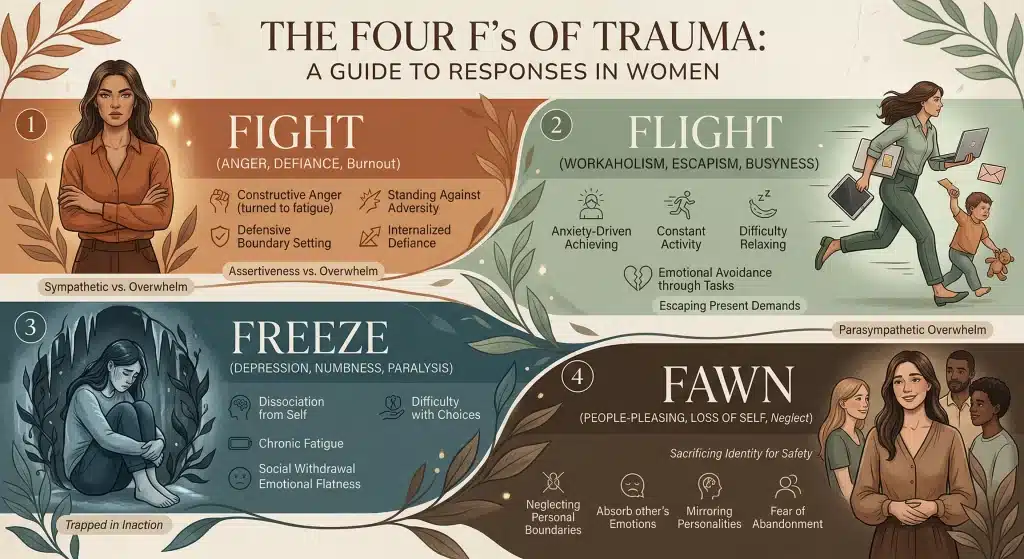
We are all familiar with the classic survival responses: Fight, Flight, and Freeze. But for women, the most common trauma response is often the fourth one: Fawn.
Fawning is the instinct to preemptively appease a threat by merging with their needs. It is the ultimate form of people-pleasing. If you grew up in a volatile home, you quickly learned that the only way to stay safe was to keep the volatile person happy. You became a chameleon, constantly scanning the room to figure out what everyone else needed you to be.
How Fawning Looks in Adulthood:
- You have no idea how to set a boundary without feeling crippling, biological terror.
- You apologize constantly, even for things that are not your fault.
- You stay in draining friendships or abusive partnerships because the thought of asserting your own needs feels too dangerous.
In Orange County’s high-achieving culture, “Fawning” is often mislabeled as being “easygoing,” “a team player,” or a “great mother.” But clinically, it is an exhausting trauma response that requires you to constantly abandon yourself to secure your safety.
High-Functioning PTSD: Hiding in Plain Sight
If you have C-PTSD, you likely don’t look like a person who is falling apart. You look like a woman who is holding everything together.
Many women use Flight (workaholism and perfectionism) to outrun their trauma.
- The “Superwoman” Armor: You believe that if you are perfect—if your house is immaculate, your career is thriving, and your children are flawless—you will finally be safe from criticism or abandonment.
- The Fear of Stillness: You pack your schedule so tightly that you never have a moment of silence. Because when you stop moving, the “Default Mode Network” of your brain turns on, and the suppressed traumatic memories and anxieties flood in. You aren’t driven by ambition; you are driven by the terror of what will happen if you slow down.
The Somatic Toll: When Your Body Keeps the Score
You can try to trick your mind into believing the past is over, but you cannot trick your nervous system. When emotional trauma is suppressed, the body absorbs it.
Women with untreated PTSD often spend years bouncing from specialist to specialist in South Orange County, seeking answers for mysterious physical ailments. According to the American Psychological Association (APA), chronic stress and trauma are directly linked to severe physical health deterioration.
The Somatic Symptoms of PTSD:
- Autoimmune Diseases: Your immune system, confused by the constant flood of stress hormones, begins to attack itself. Rates of Hashimoto’s, Lupus, and Fibromyalgia are staggeringly high in female trauma survivors.
- Chronic Pelvic Pain: The body stores a tremendous amount of “Fight or Flight” tension in the psoas muscle and pelvic floor.
- Digestive Chaos: The Vagus nerve connects your brain directly to your gut. When your brain is in survival mode, digestion shuts down, leading to severe IBS, nausea, and chronic bloating.
- Adrenal Burnout: You are so deeply exhausted that 10 hours of sleep does not refresh you, yet your anxiety prevents you from ever truly resting.
The Self-Medication Trap (The "Wine Mom" Culture)
When the internal noise of C-PTSD becomes too loud, and the physical exhaustion becomes too heavy, women look for an escape hatch.
In affluent areas, this rarely looks like illicit street drugs. It looks highly socially acceptable.
- The Alcohol Buffer: Drinking a bottle of wine every night feels like the only way to manually turn off the hyper-vigilance so you can transition from “work mode” to “sleep mode.”
- Prescription Pills: Relying on sedatives (like Xanax) to stop the panic attacks, or stimulants to push through the crushing fatigue.
This creates a Dual Diagnosis—a trauma disorder overlapping with a substance use disorder. At Sun County Wellness, we do not shame the coping mechanism; we treat the pain driving it. If we take away the wine but don’t treat the trauma, the panic will simply return. We treat both concurrently.
Discover our integrated approach to Dual Diagnosis Treatment.

Healing at Sun County Wellness: The SJC Sanctuary
You cannot heal trauma using only “Talk Therapy.” You cannot out-think a nervous system that believes it is about to die. You must use “Bottom-Up” processing—healing the body to heal the mind.
At Sun County Wellness, our location in San Juan Capistrano is the foundation of our trauma-informed care. We utilize the historic, grounding, and natural elements of South Orange County to signal profound biological safety to your nervous system.
Here is how our clinical programs pull the trauma out by the roots:
1. EMDR (Eye Movement Desensitization and Reprocessing)
EMDR is the gold standard for trauma treatment. We do not ask you to endlessly retell the story of your trauma (which can actually re-traumatize you). Instead, we use bilateral stimulation (eye movements or tapping) to activate the brain’s natural healing mechanisms.
- The Goal: EMDR helps the Hippocampus finally put a “time stamp” on the traumatic memory. The memory doesn’t disappear, but the emotional charge is neutralized. It stops being a live grenade and becomes just a memory.
2. Somatic Experiencing and Vagus Nerve Regulation
Because your trauma lives in your tissues, we use the body to release it. Through trauma-informed yoga, breathwork, and Earthing (walking barefoot on the SJC trails or Dana Point sand), we teach you how to manually stimulate the Vagus nerve. This acts as a physical brake pedal, pulling you out of the Red Zone (Fight/Flight) and back into the Green Zone (Safety/Connection).
3. Equine-Assisted Therapy: Rebuilding Trust
San Juan Capistrano’s equestrian roots provide one of our most transformative modalities. Horses are highly attuned prey animals; they act as living biofeedback machines.
- The Breakthrough: A woman with C-PTSD is often disconnected from her intuition. When she works with a horse, she cannot “Fawn” or fake it. The horse responds only to her authentic internal energy. When a 1,200-pound animal chooses to connect with her because it senses her genuine calm, it provides a profound, non-verbal experience of safety and self-trust that bypasses the cynical mind entirely.
4. The Power of the Sisterhood
Trauma thrives in secrecy and isolation. It tells you that if people knew the “real” you, they would be disgusted. In our women-only Intensive Outpatient (IOP) and Partial Hospitalization (PHP) programs, the armor comes off. You will sit in a beautifully appointed, serene space with other capable, intelligent women who will look at you and say, “I feel that exact same way.” The therapeutic power of being seen, understood, and validated without judgment accelerates healing faster than any medication.
To learn more about our flexible levels of care, visit our Admissions and Assessments page.

The "Messy Middle": Trusting the Process
We must be honest: Trauma recovery is not a spa day.
When you first begin treatment at Sun County Wellness, you will experience what we call the “Messy Middle” or the “Vulnerability Hangover.” As the emotional anesthesia wears off and you begin to process the memories, you may feel more exhausted or irritable for a few weeks.
- This is an Extinction Burst. It means the therapy is working. Your old defense mechanisms are fighting back because they are losing control.
- Our Promise: We anticipate this phase. Our rigorous clinical schedule and daily somatic support act as your anchor. We hold the container of safety so you can fall apart securely, knowing we will help you put the pieces back together in a stronger, more beautiful way.
Conclusion: You Are the Author of Your Next Chapter
Trauma is a thief. It steals your presence, your joy, and your belief in your own goodness. It convinces you that the exhausted, fearful version of yourself is the only version that will ever exist.
It is a lie.
You survived the trauma. You do not have to survive the recovery alone.
Healing is not about erasing the past; it is about taking the power back so the past no longer dictates your future. You are allowed to take the heavy backpack off. You are allowed to ask for help. You are allowed to rest.
San Juan Capistrano offers the sacred, grounded earth. Sun County Wellness offers the clinical roadmap and the compassionate hands. You just have to be willing to take the first step.
If you are ready to find your way back to yourself, contact Sun County Wellness today. Let us help you find your peace.
Frequently Asked Questions (FAQs)
Can I have PTSD if I don’t remember specific traumatic events? Yes. The body often remembers what the mind forgets. Emotional neglect or chronic stress in childhood often doesn’t leave “episodic” memories (a specific scene), but leaves “implicit” memories (a generalized feeling of dread or unsafety). We can treat the nervous system dysregulation even without a clear narrative memory.
How do I know if I need an IOP or just a weekly therapist? Look at the “Functional Impairment” of your life. If your trauma is causing severe insomnia, chronic physical pain, driving you to self-medicate, or severely affecting your relationships, a 50-minute weekly therapy session is likely not enough support. An Intensive Outpatient Program (IOP) provides the robust, multi-day clinical scaffolding required to safely process deep trauma.
Can I attend the Sun County IOP while still working? Yes. Our Intensive Outpatient Program is designed specifically for high-functioning women. We offer flexible scheduling options that allow you to receive robust clinical care while still managing your professional and family responsibilities in Orange County.
Will my employer find out I am in trauma treatment? No. We adhere to the strictest HIPAA and 42 CFR Part 2 confidentiality laws. Your privacy is paramount. If you need to use FMLA (Family and Medical Leave Act) to take time off for our PHP program, your employer is only notified that you are seeking treatment for a protected medical condition; they are not given your specific psychiatric diagnosis.