
What Happens in Women’s Mental Health Treatment? (A Step-by-Step Guide)
Medical Disclaimer: The content provided in this article is for informational purposes only and does not constitute medical advice. Chronic burnout, severe anxiety, and major depression require professional clinical intervention. If you are experiencing a mental health emergency, severe panic attacks, or thoughts of self-harm, please call 988 or go to the nearest emergency room immediately. For a confidential clinical assessment and holistic treatment options, contact Sun County Wellness.
Introduction: The Fear of the Unknown
For the high-functioning woman in Orange County, control is everything.
You control the family calendar, you manage the project deadlines at work, and you orchestrate the social dynamics of your household. You are the architect of your life. So, when the weight of the “Invisible Load” finally becomes too heavy—when the anxiety, burnout, or depression threatens to pull you under—the thought of stepping into a mental health treatment program is terrifying.
Why? Because treatment requires you to surrender control to an unknown process.
You might be wondering: “Will I be locked in a sterile hospital ward? Will I have to sit in a circle and cry with strangers? Will I be forced to take medication? What happens to my job and my kids?”
At Sun County Wellness, located in the historic and grounding hills of San Juan Capistrano, we know that the fear of the unknown keeps thousands of women suffering in silence. We want to pull back the curtain. High-quality mental health treatment is not a punishment; it is a profound, beautifully orchestrated sanctuary designed to help you catch your breath and rebuild your nervous system.
In this comprehensive guide, we will walk you step-by-step through exactly what happens when you decide to save your own life, demystifying the clinical journey so you can step through our doors with confidence.
If you are ready to let someone else hold the map for a while, explore our Women’s Mental Health Treatment Programs at Sun County Wellness.

Step 1: The Bravery of the First Call (Admissions & Logistics)
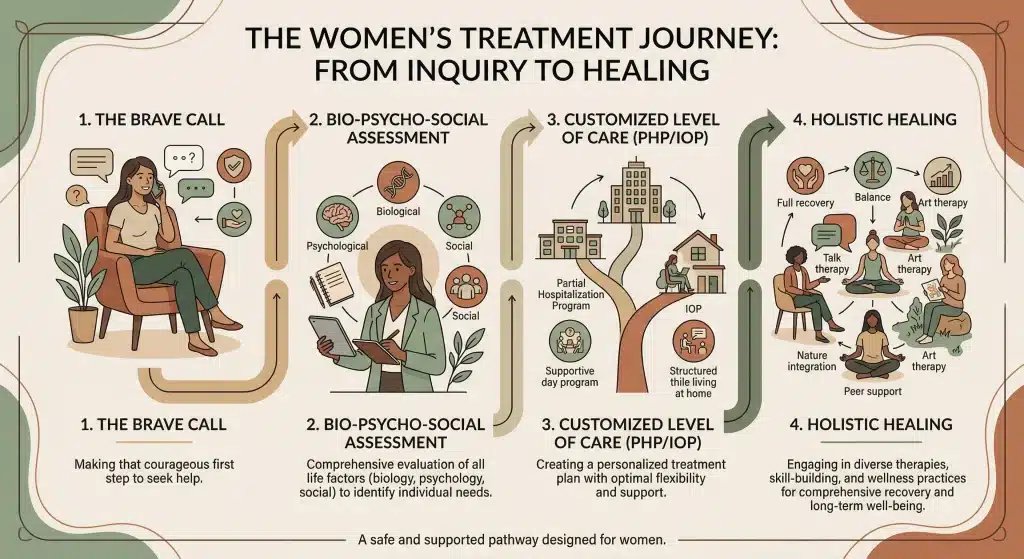
The journey does not begin when you walk through the doors; it begins the moment you pick up the phone. For many women, this is the hardest step.
What Happens: When you call Sun County Wellness, you will not speak to an automated robot or a cold clinical administrator. You will speak to a compassionate Admissions Coordinator who understands exactly how heavy the phone feels in your hand.
- The “Vibe Check”: This is a conversational, no-pressure phone call. We will ask you to share a little bit about what you are experiencing—whether it is chronic insomnia, panic attacks, reliance on wine to unwind, or a profound sense of emptiness.
- Removing the Financial Fear: We know the second question is always, “Can I afford this?” Our team will take your insurance information and conduct a free, confidential Verification of Benefits. Thanks to the Mental Health Parity Act, most major PPO insurance plans cover our programs as a medical necessity. We handle the bureaucracy so you don’t have to.
Discover more about how we advocate for your coverage on our Admissions and Insurance page.
Step 2: The Bio-Psycho-Social Assessment (Intake)
Once the logistics are settled, your clinical journey begins with a comprehensive assessment. We do not use a “cookie-cutter” approach, because your pain is uniquely yours.
According to the National Institute of Mental Health (NIMH), women experience depression and anxiety differently than men due to complex biological and environmental factors. We evaluate you across three distinct pillars:
- Biological: Our medical and psychiatric team will look at your physical health. Are your hormones fluctuating (perimenopause, PMDD)? Is your thyroid functioning correctly? Are you suffering from chronic inflammation or nutritional deficits caused by stress?
- Psychological: We explore your cognitive landscape. Do you suffer from perfectionism? Are you carrying unresolved trauma, grief, or a severe inner critic?
- Sociological: We look at your environment. Are you in a high-conflict marriage? Are you drowning in corporate burnout? Do you lack a supportive community?
By mapping out these three areas, we create a bespoke Master Treatment Plan tailored entirely to your biology and your lifestyle.
Step 3: Determining Your Level of Care (PHP vs. IOP)
Many women delay treatment because they believe “rehab” means abandoning their children and disappearing for 30 days. At Sun County Wellness, we specialize in Outpatient Care, allowing you to heal without hitting “pause” on your entire life.
Based on your assessment, we will place you in one of two primary tracks:
- Partial Hospitalization Program (PHP): Often called “Day Treatment.” You attend clinical programming in our beautiful facility for roughly 6 hours a day, 5 days a week. You treat your recovery like a full-time job during the day, but you return to the comfort of your own home (or a supportive sober living environment) at night.
- Intensive Outpatient Program (IOP): A step-down level of care, typically 3 hours a day, 3 to 5 days a week. This provides robust clinical support while allowing you the flexibility to maintain a modified work schedule and be present for your family.
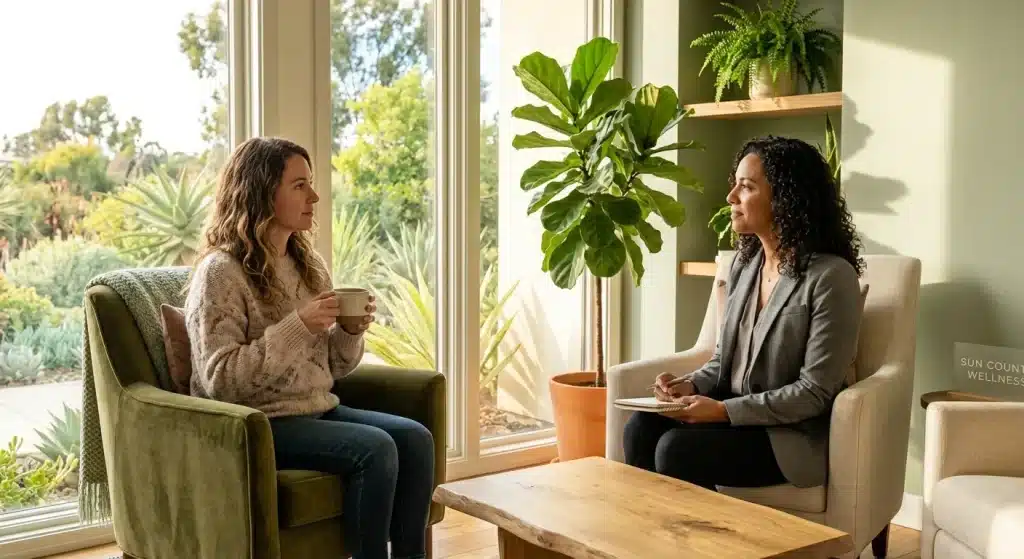
Step 4: A Day in the Life (The Rhythm of Recovery)
What actually happens during those 3 to 6 hours a day? It isn’t just sitting in a sterile room talking about your feelings. It is a carefully orchestrated rhythm designed to pull your nervous system out of “Fight or Flight” and into “Rest and Digest.”
Here is what a typical day in our Women’s PHP looks like in San Juan Capistrano:
Morning: Grounding and Intention
- 9:00 AM: You arrive at our sun-drenched facility. We begin with intention setting, mindfulness, and a check-in. How did you sleep? What is your emotional temperature today?
- Somatic Movement: We utilize trauma-informed yoga or a guided walk on the local SJC trails. You cannot heal the mind while the body is tense. We use movement to flush stagnant cortisol out of your system.
Mid-Morning: The Power of Sisterhood (Process Groups)
- 10:30 AM: You sit in a comfortable, beautifully designed room with other intelligent, successful, exhausted women.
- The Magic: This is where the shame evaporates. You will hear another mother or executive say, “I am so tired of holding everything together that I fantasize about running away.” The realization that you are not uniquely broken—that you are simply sharing the universal burden of the modern woman—is profoundly healing.
Afternoon: Evidence-Based Clinical Therapy
- 1:00 PM: After a nourishing, farm-to-table lunch (Nutritional Psychiatry), we do the heavy lifting. You will engage in specialized therapies:
- Cognitive Behavioral Therapy (CBT): Dismantling the “imposter syndrome” and catastrophic thinking driving your anxiety.
- Dialectical Behavior Therapy (DBT): Learning concrete “distress tolerance” skills to survive a panic attack without self-medicating with wine or pills.
- Cognitive Behavioral Therapy (CBT): Dismantling the “imposter syndrome” and catastrophic thinking driving your anxiety.
- Dialectical Behavior Therapy (DBT): Learning concrete “distress tolerance” skills to survive a panic attack without self-medicating with wine or pills.
Late Afternoon: Holistic Integration
- 2:30 PM: We close the day with experiential therapy. This might be Equine-Assisted Therapy, where you interact with horses to practice non-verbal boundary setting and authentic connection, or art therapy to express emotions that are too heavy for words.
Step 5: The "Messy Middle" (Doing the Deep Work)
We must be honest: Healing is not a straight, upward line. There is a phase in treatment we call the “Messy Middle.”
During your first week, you might feel a “Pink Cloud” of relief simply because you finally put the burden down. But around week two or three, as you begin advanced trauma therapies like EMDR (Eye Movement Desensitization and Reprocessing), the emotional anesthesia wears off.
- The Vulnerability Hangover: You are feeling feelings you have suppressed for decades. You might feel irritable, unusually tired, or want to quit the program.
- The Breakthrough: This is an “Extinction Burst.” It means the therapy is working. Your defense mechanisms are fighting back because they are losing control. Our expert clinicians act as your anchor during this phase, helping your nervous system realize that feeling the pain will not kill you. The breakthrough always happens right after the breakdown.
Step 6: Family Systems and Boundary Building
You cannot heal a woman in a vacuum, send her back to an unchanged environment, and expect her to stay well. Women are the emotional centers of their ecosystems.
According to the American Psychological Association (APA), incorporating family dynamics into mental health treatment significantly improves long-term outcomes.
- Boundary School: The number one issue we see in high-functioning women is the inability to say “no.” In treatment, we role-play boundary setting. We teach you how to tolerate the temporary guilt of disappointing someone else rather than betraying yourself.
- Couples/Family Counseling: We offer mediated sessions with your partner or family. We teach them how to support your new boundaries, explaining the difference between “enabling” your anxiety and “validating” your feelings.
Step 7: Discharge and The "New Normal" (Aftercare)
The goal of treatment is not to keep you in therapy forever; it is to give you the blueprint to become your own healer.
As you approach the end of your program, you do not just fall off a cliff. We engage in rigorous Discharge Planning.
- The Step-Down: If you were in PHP, you will gradually transition to IOP, allowing you to return to work or full-time parenting while maintaining a therapeutic safety net for a few hours a week.
- The Maintenance Plan: We help you secure an outpatient therapist and psychiatrist in your local community for ongoing maintenance.
- The Alumni Sisterhood: You become part of the Sun County Wellness alumni network—a vibrant, connected community of women in Orange County who continue to support each other through the ups and downs of real life.

Conclusion: Permission to Put the Armor Down
The idea of entering mental health treatment is daunting because you have spent your entire life being the “Strong One.” You have convinced the world that you are unbreakable.
But true strength is the wisdom to know when to put the weight down.
Stepping through the doors of Sun County Wellness is not an admission of defeat; it is a declaration of your own worth. It is a decision to stop surviving and start living.
The process is designed to hold you gently. We take the guesswork out of healing. We provide the schedule, the science, the sanctuary, and the sisterhood. All you have to do is show up and be willing to be seen.
If you are ready to find out what life looks like on the other side of exhaustion, contact Sun County Wellness today. We are waiting for you.
Frequently Asked Questions (FAQs)
Will I be forced to take psychiatric medication? No. Medication is a highly effective tool, but it is never a mandate. Our board-certified psychiatric team will conduct an evaluation and recommend options if they believe a biological “floor” (like an SSRI) is necessary to stabilize severe depression or panic so that therapy can work. The decision is always collaborative and entirely up to you.
Can I continue working while in treatment? It depends on the level of care. Our Intensive Outpatient Program (IOP) is specifically designed for high-functioning professionals and mothers, offering flexible scheduling (typically 3 hours a day) that allows you to maintain your career. Our PHP program is more immersive and may require a temporary leave of absence (FMLA), which legally protects your job.
What makes Sun County Wellness different from a hospital? We are a trauma-informed sanctuary, not a sterile institution. Located in historic San Juan Capistrano, we utilize the natural “Blue Mind” healing of the nearby ocean, equestrian therapy, and upscale, comfortable environments. We treat you as an empowered adult, removing the institutionalized shame of traditional mental healthcare.
Do you treat addiction alongside anxiety and depression? Yes. It is incredibly common for women to use alcohol (the “wine mom” culture) or prescription pills to self-medicate their anxiety or burnout. We specialize in Dual Diagnosis, treating the substance dependency and the underlying mental health condition simultaneously for lasting recovery.