
Depression in Women: Why It Feels Different (and Harder to Explain)
Medical Disclaimer: The content provided in this article is for informational purposes only and does not constitute medical advice. Major Depressive Disorder is a serious, life-threatening medical condition. If you are experiencing thoughts of self-harm, suicidal ideation, or feel entirely unable to function, please call 988 or go to the nearest emergency room immediately. For a confidential clinical assessment and holistic treatment options, contact Sun County Wellness.
Introduction: The Gap Between How You Look and How You Feel
If you live in South Orange County, you are surrounded by an atmosphere of curated perfection. From the immaculate coastal homes of Dana Point to the high-achieving corporate parks of Irvine, there is a cultural expectation that you should be thriving.
To the outside world, you probably are. You might be the woman who organizes the neighborhood charity drives, the executive who closes the impossible deals, or the mother who ensures her children have a picture-perfect childhood.
But when you are alone in your car, or when the house finally goes quiet at midnight, a different reality sets in.
You feel a profound, suffocating emptiness. You are exhausted to the marrow of your bones, yet you cannot sleep. You look at your beautiful life—your family, your career, your home—and you feel an agonizing wave of guilt because you cannot force yourself to feel any joy.
When you try to explain this to a partner or a friend, the words fall flat. “I’m just tired,” you say. Because how do you explain that you feel like you are drowning when you are standing on dry land?
At Sun County Wellness in San Juan Capistrano, we want you to know: You are not crazy, and you are not ungrateful. You are likely suffering from clinical depression.
Depression in women rarely looks like the sad, weeping stereotypes we see in movies. It is complex, insidious, and deeply intertwined with female biology and societal expectations. In this comprehensive guide, we will explore why depression feels different for women, the hidden somatic (physical) symptoms you might be ignoring, and how our holistic, trauma-informed sanctuary can help you find your light again.
If you are ready to stop pretending you are okay, explore our Women’s Mental Health Treatment Programs.

The "Functional" Trap: Why Nobody Sees Your Pain
According to the National Institute of Mental Health (NIMH), women are nearly twice as likely as men to be diagnosed with major depression. However, despite this high prevalence, women’s depression is frequently missed by doctors, families, and even the women themselves.
Why? Because women are socialized to be hyper-functional caretakers.
From a young age, women are taught to absorb the emotional discomfort of the room and ensure everyone else is okay. When a woman becomes depressed, she rarely stops functioning. Instead, she puts on a mask.
The "Invisible Load"
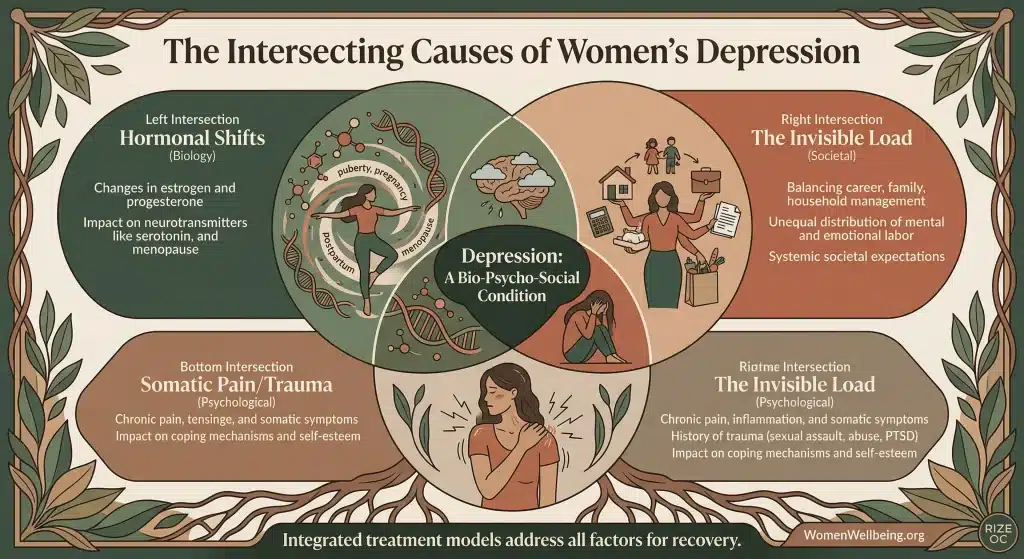
Sociologists call the mental management of a household and career the “Invisible Load” or the “Second Shift.” You are constantly anticipating needs, scheduling appointments, and managing the emotional temperature of your family.
When depression hits, you don’t drop the load; you just use adrenaline and anxiety to carry it. You enter a state of Functional Depression.
- The Reality: You still show up to the PTA meeting. You still cook dinner. You still hit your sales quota. But you do it while feeling completely emotionally detached from the experience. You are operating like a ghost in your own life.
- The Cost: Because you are still “producing,” no one asks if you are okay. And because no one asks, you convince yourself that your pain isn’t valid enough to seek help.
The Biological Reality: It’s Not "Just Hormones"
When women attempt to explain their mood shifts, society is quick to dismiss it with a condescending, “It’s just hormones.” While hormones absolutely play a critical role, framing it as a casual inconvenience ignores the profound neurobiological impact of the female endocrine system.
Estrogen, Progesterone, and Serotonin
The female brain is exquisitely sensitive to fluctuations in estrogen and progesterone. These hormones are not just reproductive; they are neurosteroids that directly modulate the production of Serotonin and Dopamine (the brain’s primary mood stabilizers).
- PMDD (Premenstrual Dysphoric Disorder): For some women, the natural drop in hormones before their cycle triggers a severe, debilitating depressive episode characterized by rage, hopelessness, and suicidal ideation.
- Postpartum Depression: The massive hormonal crash following childbirth, combined with systemic inflammation and sleep deprivation, can rewrite the brain’s chemistry, causing depression that can linger for years if untreated.
- Perimenopause: The erratic hormonal roller coaster of a woman’s late 30s and 40s is a primary trigger for mid-life depression. The drop in estrogen can cause severe brain fog, memory loss, and a deep sense of apathy that mimics clinical depression perfectly.
You cannot “positive think” your way out of a biological chemical deficit. It requires a medical and clinical intervention.
The Body Speaks: Somatic Symptoms of Depression
One of the main reasons women’s depression is harder to explain is because it often doesn’t show up as an emotion. It shows up as a physical illness.
This is known as Somatic Depression. When the mind is too overwhelmed or conditioned to suppress emotional pain, the body will carry the score. The nervous system translates the psychological agony into physical distress.
If you have visited multiple doctors in South Orange County for mystery ailments, only to be told your labs are “normal,” you may be experiencing the somatic symptoms of depression:
1. Severe Gastrointestinal Distress
The gut and the brain are inextricably linked by the Vagus Nerve. In fact, 90% of your body’s serotonin is manufactured in the digestive tract. When your brain is severely depressed, your gut shuts down. Women with hidden depression frequently suffer from chronic nausea, debilitating bloating, and conditions diagnosed as Irritable Bowel Syndrome (IBS).
2. The "Lead Apron" Fatigue
This is not the kind of tired you feel after a long day of work. This is Psychomotor Retardation. Your limbs feel like they weigh 500 pounds. Walking up the stairs feels like wading through wet concrete. You can sleep for 12 hours and wake up feeling entirely unrefreshed because your brain is stuck in a heavy, dorsal vagal shutdown.
3. Chronic Pain and Tension
When you are depressed, the brain’s pain receptors become hypersensitive. You may experience chronic, unexplained lower back pain, severe tension migraines, or jaw pain from grinding your teeth at night (bruxism). Your body is physically bracing against the weight of your unexpressed grief.
The Anger Misconception: When Depression Looks Like Rage
We are conditioned to expect depressed women to be quiet, withdrawn, and tearful. But very often, female depression wears the mask of Irritability and Rage.
According to the American Psychological Association (APA), anger is a frequently overlooked symptom of clinical depression.
- The “Short Fuse”: You find yourself snapping at your partner for breathing too loudly. You experience intense road rage on the 5 Freeway. You have zero patience for your children’s normal behavior.
- The “Why”: Depression depletes your emotional bandwidth. You have absolutely no “shock absorbers” left. When a minor inconvenience occurs, your nervous system cannot handle the extra stimuli, resulting in an explosive reaction.
Following these outbursts, women are usually consumed by a secondary wave of toxic shame and guilt, reinforcing the depressive belief that they are a “bad” mother, partner, or person.
The Self-Medication Trap in Orange County
When a woman’s internal world feels like a bleak, exhausting landscape, she will naturally look for an escape hatch.
In affluent communities, the culture of self-medication is heavily normalized, making it incredibly easy for women to hide their coping mechanisms in plain sight.
- The “Wine O’Clock” Culture: A heavy pour of Cabernet at 6:00 PM feels like the only way to manually shut off your brain and transition from “work/mom mode” to “sleep mode.” But alcohol is a central nervous system depressant. It provides a temporary illusion of relief while actively destroying the brain’s serotonin production, ensuring you wake up the next morning feeling even more depressed and anxious.
- The Stimulant Cycle: Many high-functioning women turn to prescription stimulants (like Adderall) or excess caffeine just to find the energy to perform their daily duties, masking the profound exhaustion of their depression.
This creates a Dual Diagnosis—where a mental health condition and a substance dependency become hopelessly intertwined. At Sun County Wellness, we understand that you cannot treat the drinking without treating the profound emptiness that drives it.
Healing at Sun County Wellness: Reclaiming Your Light
You cannot heal a deeply dysregulated, depressed nervous system in the same chaotic environment that drained it. You need a pattern interruption. You need a sanctuary.
San Juan Capistrano is not just our location; it is an active participant in your recovery. Here is how we treat the unique presentation of women’s depression using a blend of elite clinical science and holistic, somatic healing.
1. Somatic Experiencing and Nervous System Regulation
Because your depression lives in your body as much as your brain, talk therapy alone is rarely enough. We use trauma-informed yoga, breathwork, and Somatic Experiencing to help you safely inhabit your physical form again. We teach you how to manually stimulate the Vagus nerve to pull your biology out of the “Freeze” state and back into the flow of life.
2. Equine-Assisted Psychotherapy
San Juan Capistrano’s equestrian roots provide one of our most powerful modalities. Horses are highly attuned biofeedback mirrors.
- You cannot “fake it” with a horse. If you approach them carrying the heavy, numb energy of depression, they will react to it.
- By learning to connect with a 1,200-pound animal non-verbally, women experience a profound, somatic sense of safety and love that bypasses the cynical, depressed mind entirely. It reignites the capacity to feel.
3. Advanced Clinical Therapies (CBT and EMDR)
Our licensed clinicians use evidence-based therapies to rewire the hardware of your brain.
- Cognitive Behavioral Therapy (CBT): We help you identify the cruel, catastrophic thoughts that depression feeds you (“I am a burden,” “Nothing will ever change”) and teach you to systematically dismantle them.
- EMDR: If your depression is rooted in unresolved trauma, emotional abuse, or childhood neglect, EMDR helps process these trapped memories so they stop draining your daily energy.
4. The Power of the Sisterhood
Depression convinces you that you are uniquely broken and entirely alone.
In our Women-Only Programs, that lie is destroyed on the very first day. You will sit in our beautifully appointed, sunlit rooms with other successful, brilliant, exhausted women who will look at you and say, “I feel exactly the same way.” The shame evaporates in the presence of shared truth.

Flexible Levels of Care: Healing Without Losing Everything
We know that the women we treat cannot simply abandon their lives for 30 days. Your family and your career rely on you.
That is why we offer robust, highly structured outpatient programs that provide the immersive healing of rehab while allowing you to sleep in your own bed.
- Partial Hospitalization Program (PHP): This is “Day Treatment.” You attend clinical therapy, psychiatric care, and holistic groups for roughly 6 hours a day, 5 days a week. You treat your healing like a full-time job during the day, and return to your sanctuary at night.
- Intensive Outpatient Program (IOP): A step-down level of care (typically 3 hours a day, 3-5 days a week). This allows you to gradually reintegrate into your career and family life, practicing your new coping skills in the real world with a powerful clinical safety net holding you up.
Explore how we customize these paths on our Treatment Programs page.
Conclusion: You Are Allowed to Put the Cape Down
You have spent your entire life being the strong one. You have been the glue holding everyone else’s world together, even while your own world felt like it was crumbling.
You do not have to be strong anymore. You just have to be human.
Depression is a liar. It tells you that this gray, heavy, exhausting existence is all there is. It tells you that asking for help makes you a burden. But the truth is, the vibrant, capable, laughing woman you used to be is not gone. She is just buried under a biological and emotional storm.
San Juan Capistrano offers the sacred ground. We offer the clinical roadmap and the compassionate hands to help you dig her out.
If you are ready to feel the warmth of the sun again, contact Sun County Wellness today. Let us help you find your way back to life.
Frequently Asked Questions (FAQs)
How do I explain to my partner that my depression makes me angry, not sad?
It helps to reframe the anger as “overstimulation” and “depletion.” You can explain that your emotional gas tank is completely empty, so when a normal stressor occurs, your brain goes straight into a defensive “fight” mode because it lacks the energy to process it calmly. We often utilize family therapy to help partners translate these symptoms.
Will I have to be on antidepressants forever?
Not necessarily. While psychiatric medication can be a vital, life-saving tool to provide a biological “floor” during a severe depressive episode, it is not always a permanent sentence. Many women use medication to stabilize while they do the deep work in therapy, and eventually taper off under medical supervision. Your treatment plan will be uniquely tailored to your biology.
Does insurance cover PHP and IOP for depression?
Yes. Because Major Depressive Disorder is a recognized medical condition, clinical treatment at the PHP and IOP levels is typically covered by major PPO health insurance plans under the Mental Health Parity Act. Our admissions team can verify your specific benefits free of charge.
I feel guilty spending money and time on treatment when my kids need me.
This is the “Invisible Load” speaking. A depressed, burnt-out mother cannot provide the emotional presence she wants to give her children. Think of treatment as the oxygen mask on an airplane: you must secure your own mask before helping others. Investing in your mental health is the most profound gift you can give your family, because it returns the real you to them.