
Why You Feel Guilty Resting (And How to Let That Go)
Medical Disclaimer: The content provided in this article is for informational purposes only and does not constitute medical advice. Chronic burnout, severe anxiety, and an inability to rest can lead to debilitating physical illness and major depressive episodes. If you are experiencing chest pain, uncontrollable panic attacks, or thoughts of self-harm, please call 988 or go to the nearest emergency room immediately. For a confidential clinical assessment and holistic treatment options, contact Sun County Wellness.
Introduction: The Agony of the Empty Sunday
It is a beautiful Sunday afternoon in South Orange County. The weather is perfect. You have finally completed the laundry, answered the urgent emails, organized the family calendar for the upcoming week, and finished the grocery shopping.
You finally sit down on the couch. This is the moment you have been craving all week—a moment to just breathe.
But within three minutes, a familiar, crawling sensation begins in your chest. Your heart rate slightly elevates. A voice in your head whispers, “You shouldn’t be sitting here. There is something else you need to do. You are wasting time.”
You try to ignore it, but the physical discomfort becomes unbearable. You suddenly remember a closet that needs organizing, or an email you could draft for Monday morning. You get up from the couch, exhausted, and go back to work.
This is Relaxation-Induced Anxiety, commonly known as “Rest Guilt.”
If you are a woman living in the high-pressure culture of Southern California, feeling guilty for resting is practically an epidemic. We are conditioned to believe that our worth is inextricably linked to our output. We treat rest as a reward that we must constantly “earn,” rather than a biological necessity for survival.
At Sun County Wellness, nestled in the quiet, grounding hills of San Juan Capistrano, we see the devastating consequences of this mindset every single day. We treat women who have run themselves into the ground because their nervous systems literally forgot how to stop.
In this comprehensive guide, we will break down the neuroscience behind why sitting still feels so dangerous, how trauma fuels the “productivity trap,” the difference between fake rest and true restoration, and how our holistic sanctuary can help you finally put the heavy burden down.
If you are ready to learn how to rest without apologizing for it, explore our Women’s Mental Health Treatment Programs at Sun County Wellness.

The Neuroscience: Why Resting Feels Like a Threat
To understand why you feel guilty resting, you have to understand that this is not a character flaw. It is a neurobiological adaptation.
The Adrenaline Addiction
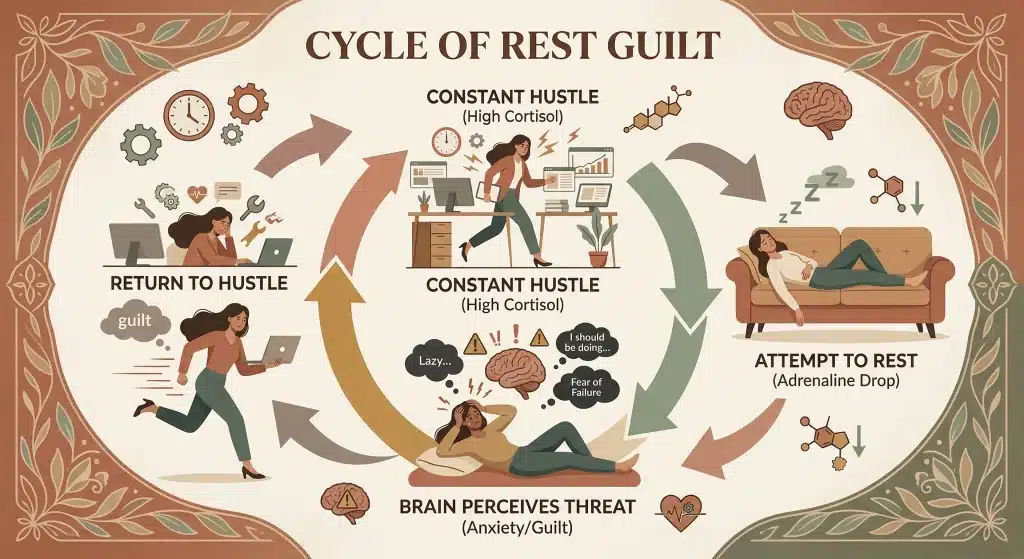
When you live a highly demanding life—managing a career, a household, and the emotional needs of a family—your brain perceives your daily schedule as a series of constant threats. To help you survive this, your brain’s Amygdala pumps out a steady stream of cortisol and adrenaline.
Over the years, your nervous system adapts to this high-adrenaline state. It becomes your baseline. When you finally sit down to rest, the adrenaline drops. Your brain, which is used to running at 100 miles per hour, suddenly registers this drop in chemicals as an “emergency.” It sends a panic signal: “Why are we slowing down? Is there a predator? Are we in danger?”
Your brain actually interprets stillness as a threat to your survival. The guilt you feel is your brain’s way of tricking you back into motion so it can get the adrenaline hit it has become addicted to.
The "Default Mode Network" and Suppressed Emotion
When you are constantly busy, your brain is engaged in the “Task-Positive Network.” You are focused on the external world.
When you stop moving, your brain switches to the Default Mode Network (DMN). The DMN is responsible for internal reflection, processing memories, and feeling emotions. If you have been suppressing anxiety, grief, marital dissatisfaction, or past trauma, these feelings have been waiting for a quiet moment to surface. The second you sit on the couch, the DMN activates, and the suppressed emotions flood in.
You aren’t afraid of resting; you are afraid of what you will feel when you finally stop outrunning yourself.
The Sociological Trap: The "Invisible Load" and Capitalist Conditioning
Biology is only half the picture. The intense guilt women feel about resting is heavily fueled by cultural and sociological conditioning.
1. The "Good Girl" Syndrome
From a very young age, women are socialized to be accommodating, helpful, and productive. We are praised when we are serving others. We learn early on that our value in a family or a community is based on our usefulness.
- The Conditioning: “If I am not being useful, I am not valuable. If I am not valuable, I will be abandoned.”
- The Result: Resting feels like an act of selfishness that threatens your standing in your family and society.
2. The Burden of the Invisible Load
Women disproportionately carry the “Invisible Load” (or cognitive labor) of a household. This means that even when a woman is physically resting, her mind is cataloging the grocery list, anticipating the children’s doctor appointments, and planning the holidays.
According to the American Psychological Association (APA), this chronic, unequal distribution of mental labor means that for many women, “free time” simply does not exist. Resting feels guilty because you know that any task you don’t do now will simply be waiting for you tomorrow, often compounding into a larger crisis.
3. The Hustle Culture of Orange County
In affluent areas like Newport Beach, Irvine, and San Juan Capistrano, achievement is the local currency. We are surrounded by images of women who seemingly “do it all”—running businesses, maintaining perfect physiques, and curating immaculate homes. In this environment, rest is often framed as a weakness. If y
Productivity as a Trauma Response
For many high-functioning women, an obsession with productivity is not ambition. It is a trauma response.
If you experienced childhood trauma—such as an unpredictable home environment, emotionally unavailable parents, or conditional love based on academic or athletic success—you learned a very specific survival strategy.
You learned that chaos could be managed if you were in control. You learned that if you were “perfect,” you would not be criticized or hurt.
- Productivity as Armor: For the traumatized high-achiever, “doing” is a shield against vulnerability. If you are always checking off a to-do list, no one can accuse you of being lazy or inadequate.
- Fawning: Over-working is often a manifestation of the “Fawn” trauma response. You are over-accommodating the needs of your boss, your spouse, or your children in a desperate, subconscious attempt to keep the peace and secure your own safety.
When productivity is your armor, resting requires taking the armor off. And taking the armor off feels terrifying.
Fake Rest vs. True Restoration
Because true rest feels so uncomfortable, many women engage in “Fake Rest.” These are activities that look like relaxing but actually keep the nervous system highly stimulated or dissociated.
What Fake Rest Looks Like:
- Doomscrolling: Lying in bed staring at Instagram or TikTok for two hours. This is not rest; it is Dorsal Vagal Shutdown (Freeze). You are bombarding your brain with micro-stressors, blue light, and comparison traps.
- “Productive” Relaxing: Listening to a self-improvement podcast while aggressively organizing the pantry.
- The “Wine O’Clock” Numb: Drinking alcohol to force the brain to quiet down. While it provides a temporary illusion of relaxation by mimicking GABA, it ultimately destroys restorative REM sleep and triggers a massive spike in anxiety the next morning.
According to the National Institute of Mental Health (NIMH), self-medicating with alcohol is a leading driver of chronic anxiety disorders in women.
What True Rest Looks Like:
True rest requires entering the Parasympathetic Nervous System (Rest and Digest).
- It is reading a fiction book for pleasure.
- It is staring at the ocean without looking at your phone.
- It is taking a nap.
- It is engaging in a hobby that produces absolutely zero financial or societal value (like painting terribly, just for the joy of the colors).
How to Actually Let Go of the Guilt
You cannot simply tell yourself to stop feeling guilty. You have to train your nervous system to tolerate the sensation of stillness. Here is how we guide women through this process.
1. Titrate Your Rest
If you have been driving 100 miles per hour for a decade, slamming on the brakes will cause you to crash. You must Titrate (slowly introduce) rest.
- The Practice: Do not try to sit still for an hour. Start with five minutes. Set a timer. Sit on the couch for exactly five minutes without your phone. Notice the anxiety rising in your chest, breathe through it, and when the timer goes off, get up.
- The Goal: You are proving to your brain that you can be still, feel the discomfort, and survive it. Gradually increase the time to 10 minutes, then 20.
2. Rename Your Rest
Language matters. If your brain is addicted to “productivity,” reframe rest as the most productive thing you can do for your biology.
- The Shift: Instead of saying, “I am being lazy right now,” tell yourself, “I am actively engaging in cellular repair. I am down-regulating my cortisol levels so my immune system can function.” Speak to your brain in a language it respects.
3. Somatic Grounding
When the guilt hits, your mind is usually time-traveling to future tasks. You must use your body to anchor yourself in the present.
- Earthing: Take your shoes off and stand in the grass or the sand. The physical sensation forces the brain out of the “worry loop” and into the sensory cortex.
- The Physiological Sigh: Take two sharp inhales through the nose, followed by one long, slow exhale through the mouth. This specific breathing pattern manually stimulates the Vagus nerve, physically slowing the heart rate and signaling safety to the primal brain.

Healing at Sun County Wellness: The SJC Sanctuary
For many women, the home environment is so fraught with triggers—chores, work laptops, marital dynamics—that learning to rest there is impossible. You need a pattern interruption. You need a sanctuary.
At Sun County Wellness, located in the historic and deeply grounding town of San Juan Capistrano, we provide the exact environment your nervous system needs to power down safely.
Here is how our clinical and holistic programs teach women how to rest:
1. The Environment as Therapy
San Juan Capistrano is the antithesis of “hustle culture.” The adobe architecture of the Mission, the ancient pepper trees, and the proximity to the ocean provide a sensory landscape of peace. We utilize this environment to heal the “Nature Deficit Disorder” that keeps women wired and exhausted.
2. Equine-Assisted Therapy
You cannot fake rest around a horse. Because horses are prey animals, they are exquisitely attuned to human nervous systems.
- In our equine therapy programs, if you approach a horse with hidden, frantic anxiety (the “productive” mask), the horse will become agitated.
- To connect with the horse, you must physically lower your heart rate, drop your mask, and become still. The horse provides immediate, profound biofeedback, teaching you what true, congruent calmness actually feels like in your body.
3. Advanced Clinical Processing (EMDR and CBT)
We do not just treat the symptom of burnout; we treat the root cause.
- CBT (Cognitive Behavioral Therapy): We help you identify the cognitive distortions (“I am only lovable if I am useful”) and replace them with healthy, realistic boundaries.
- EMDR: If your inability to rest is rooted in childhood trauma or the fear of unsafety, we use EMDR to help the brain process those trapped memories, removing the unconscious drive to over-function.
4. The Power of the Sisterhood
Guilt thrives in isolation. In our Women-Only Programs (PHP and IOP), the armor comes off. You will sit in a beautifully appointed, safe space with other highly successful, utterly exhausted women who understand exactly what the “Invisible Load” feels like. Hearing another woman validate your exhaustion is profoundly healing. It breaks the shame cycle and gives you permission to finally set the burden down.
Explore our flexible levels of care on our Admissions and Assessments page.

Conclusion: You Are a Human Being, Not a Human Doing
You have spent your entire life proving your worth through your actions. You have built careers, raised families, and kept the world spinning for everyone around you.
You have proven how strong you are. Now, it is time to prove that you can be soft.
Rest is not a luxury. It is not a prize you get at the end of a to-do list that never actually ends. Rest is your biological right. You are worthy of taking up space, simply because you exist. You do not have to earn your right to breathe.
It is time to stop running from the silence and start learning how to live within it.
San Juan Capistrano offers the sacred, grounding earth. Sun County Wellness offers the clinical roadmap. You just have to give yourself permission to step off the wheel.
If you are ready to turn off the alarm bell and finally find rest, contact Sun County Wellness today. Let us help you find your way back to calm.
Frequently Asked Questions (FAQs)
How do I know if my inability to rest is a clinical anxiety disorder? Look at the “Functional Impairment.” If your inability to rest is causing severe insomnia, chronic physical pain (like migraines or TMJ), driving you to self-medicate with alcohol, or causing you to snap at your loved ones out of sheer exhaustion, it has crossed the line into a clinical issue. It is time to seek professional support, such as an Intensive Outpatient Program (IOP).
Will resting make me lose my ambition or my career edge? This is the most common fear among high-achievers. The answer is absolutely not. When you are running on anxiety, you are using a “dirty” fuel source that eventually burns out the engine. True rest repairs your cognitive function. When you heal, you will still be ambitious and successful, but you will operate from a place of clarity and purpose, rather than panic and fear.
Is burnout treatment covered by insurance? Yes. Severe burnout is clinically treated under diagnoses like Generalized Anxiety Disorder, Major Depressive Disorder, or PTSD. Under the federal Mental Health Parity Act, most major PPO insurance plans cover clinical treatment (PHP and IOP) as a medical necessity. Our admissions team can verify your specific benefits free of charge.
How do I explain to my family that I need time to rest and heal? Use the “oxygen mask” analogy. You can explain, “I have been pouring from an empty cup for a long time, and I am starting to break down. To be the best mother/partner I can be, I need to take this time to repair my own health so I can be fully present for you.” We also offer family therapy to help your loved ones understand and support your boundaries.