
Medical Disclaimer: The content provided in this article is for informational purposes only and does not constitute medical, legal, or financial advice. Severe postpartum depression, chronic anxiety, burnout, and substance use disorders require professional clinical intervention. If you are experiencing active suicidal ideation, severe dissociation, or a life-threatening medical emergency, please call 988 or go to the nearest emergency room immediately. For a confidential clinical assessment and admission inquiries, contact Sun County Wellness.
Introduction: The Terrifying Question Keeping You Sick
You are exhausted to the marrow of your bones.
You wake up every morning in South Orange County with a racing heart, immediately mentally cataloging the lunches that need to be packed, the school drop-offs, the corporate emails waiting in your inbox, and the emotional temperature of everyone in your house. You are the glue holding your entire family together.
But internally, you are shattering.
You know you need professional mental health help. You know that the nightly glasses of wine are no longer just “taking the edge off”—they have become a necessity to survive the anxiety. You know the dark, heavy blanket of depression is keeping you from truly engaging with the children you love so fiercely.
You finally reach the point of wanting to make the call. But almost instantly, you hit a massive, paralyzing wall of fear:
“If I go to treatment, what happens to my kids? Will they think I abandoned them? Will my family fall apart? Will someone think I am an unfit mother?”
At Sun County Wellness, located in the grounding hills of San Juan Capistrano, we hear these exact questions from heartbroken, terrified mothers every single day. The “Mom Guilt” associated with seeking medical care for a psychiatric condition is the number one barrier keeping women stuck in a cycle of suffering.
We want to dismantle that fear right now.
Getting mental health treatment does not mean disappearing into a locked hospital ward for 30 days. It does not mean you are a bad mother; it means you are a profoundly responsible one. In this comprehensive guide, we will break down exactly how modern outpatient treatment works, how to manage your household logistics, how to explain your healing to your children, and why fixing your own nervous system is the greatest gift you will ever give your family.
If you are ready to put your oxygen mask on first, explore our Women’s Mental Health Treatment Programs at Sun County Wellness.

Section 1: The Neuroscience of Motherhood (Why You Can’t “Fake It”)
Many mothers operating with high-functioning anxiety or severe depression believe they are successfully hiding it from their children. You paint on a smile, you attend the soccer games, you bake the cookies, and you go through the motions of the day.
But you cannot fake a regulated nervous system.
According to the American Psychological Association (APA), children are exquisitely attuned to the physiological states of their primary caregivers. This happens through a biological process called Co-Regulation.
- Mirror Neurons: Your children’s brains are equipped with mirror neurons. If your nervous system is stuck in the “Red Zone” (Sympathetic Fight or Flight), your body is pumping out cortisol, your breathing is shallow, and your muscles are tense. Your child’s nervous system reads these micro-cues and automatically mirrors them.
- The “Walking on Eggshells” Effect: When a mother is profoundly depressed, exhausted, or anxious, children intuitively sense the emotional unavailability or volatility. They often respond by developing their own anxiety, becoming hyper-vigilant “fixers” trying to cheer you up, or acting out aggressively to get attention.
You might think you are protecting them by “pushing through” your burnout, but you are actually passing the dysregulation down. When you heal your own nervous system, you automatically heal the energetic ecosystem of your entire home.
Section 2: The “Disappearing” Myth: What Treatment Actually Looks Like
The most paralyzing fear mothers have is the idea of packing a suitcase, saying goodbye to their crying children, and disappearing into a residential rehab facility for a month.
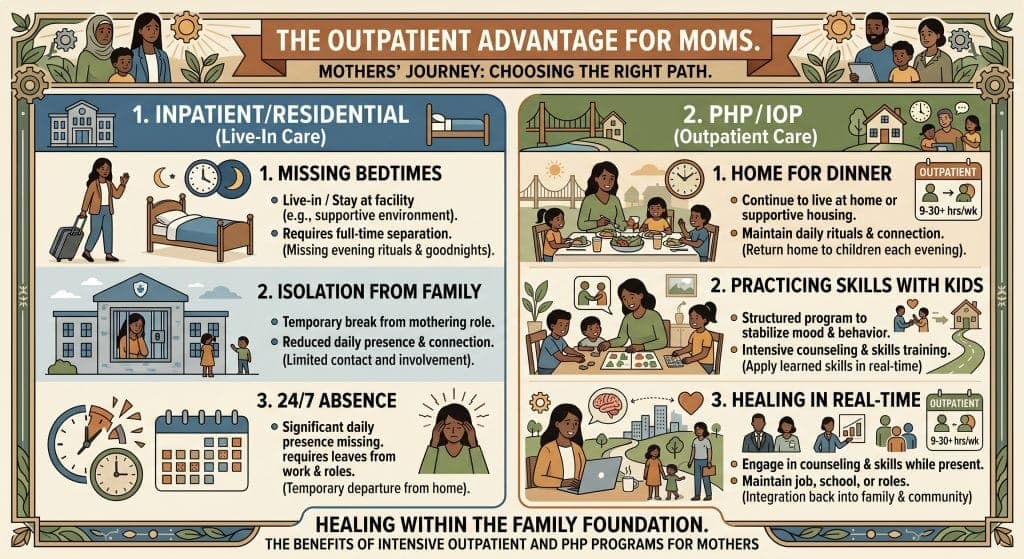
While inpatient residential care is sometimes medically necessary for acute crisis stabilization (like severe physical detox or active suicidal planning), it is not the only option.
At Sun County Wellness, we specialize in the Outpatient Continuum of Care. This means you receive world-class, rigorous clinical medicine during the day, and you sleep in your own bed at night.
1. Partial Hospitalization Program (PHP)
Often called “Day Treatment,” PHP is the ultimate middle ground for mothers in crisis.
- The Schedule: You attend our beautiful, serene facility in San Juan Capistrano for roughly 6 hours a day, 5 days a week (typically 9:00 AM to 3:00 PM).
- The Reality: You can drop your kids off at school in the morning, come to treatment to do the deep clinical work, and be home in time to cook dinner and tuck them into bed. You do not disappear. You remain a daily, visible presence in your children’s lives while treating your recovery like a full-time job during school hours.
2. Intensive Outpatient Program (IOP)
If you need to maintain your career or cannot secure full-time daytime childcare, IOP offers robust clinical support on a part-time basis.
- The Schedule: You attend therapy for roughly 3 hours a day, 3 to 5 days a week.
- The Reality: This acts as a powerful clinical safety net. It allows you to practice the emotional regulation boundaries you learn in therapy immediately in your own home environment, bridging the gap between the clinic and your living room.
Explore how these flexible programs fit into your life on our Admissions and Assessments page.
Section 3: Managing the “Second Shift” (Logistics of Life)
If you are in a PHP program from 9 AM to 3 PM, you are dedicating a massive portion of your energy to neurobiological healing. This means you have to temporarily relinquish control of the “Invisible Load.”
For high-functioning women, giving up control is often harder than the therapy itself.
1. Delegating the Chaos You must enlist your “village.” If you have a partner, this is the time for them to step up and manage the household logistics. If you are a single mother or your partner works demanding hours, lean on grandparents, trusted friends, or hire temporary childcare for the afternoons.
- The Mindset Shift: Do not view this as being a “burden.” If you were diagnosed with breast cancer and needed daily chemotherapy, your community would rally to bring casseroles and drive the carpool. Clinical depression, trauma, and severe anxiety require the exact same medical grace.
2. Embracing “Imperfect Help” When you ask for help, others will do things differently than you do. The laundry might be folded wrong. Your kids might eat pizza three nights in a row. Their hair might not be perfectly braided for school.
- The Lesson: Let it go. The world will not end. Tolerating “imperfect help” is actually a profound form of exposure therapy for women with high-functioning, perfectionist anxiety.
Section 4: How to Explain Treatment to Your Children
Children are incredibly perceptive. If you are gone during the day and come home exhausted, and no one talks about why, their brains will invent a reason—and they will usually blame themselves.
According to the Child Mind Institute, speaking honestly (but age-appropriately) about mental health removes the stigma and reassures the child that they are safe.
Here are actionable scripts based on your child’s age:
For Toddlers and Preschoolers (Ages 3–6)
Keep it concrete, simple, and focused on physical safety.
- The Script: “Mommy has been feeling really tired and a little sad lately. Just like when you get a tummy ache and we go to the doctor, Mommy is going to a special doctor for grown-ups during the day. They are teaching me how to get my energy back so I can feel better and play with you more!”
For Elementary Age (Ages 7–11)
At this age, children understand the concept of learning and practicing skills.
- The Script: “You know how sometimes you get really stressed out about a math test, or frustrated with your friends? Grown-ups get stressed out too. Lately, my worry-brain has been working overtime, and it’s making me feel sick. I am going to a program every day where therapists act like coaches. They are teaching me new tools to handle my stress so I can be the best, healthiest mom for you.”
For Teenagers (Ages 12+)
Teens value authenticity. If you lie to them, they will know, and they will resent you. Be honest, but maintain the parental boundary (do not make them your therapist).
- The Script: “I want to be completely honest with you. I have been struggling with severe anxiety/burnout/depression for a while now. I realized that trying to fix it on my own isn’t working. I am entering an intensive outpatient program. I’m telling you this because I want you to know that it is always okay to ask for help when you are hurting. It is my job to take care of my health, so you never have to worry about taking care of me.”

Section 5: The “CPS” Fear: Will I Lose My Kids?
We must address the most terrifying, whispered fear that keeps mothers from seeking help: “If I admit I have severe depression, trauma, or a substance use problem to a medical professional, will Child Protective Services (CPS) take my kids away?”
The clinical and legal reality is: NO.
Seeking voluntary medical treatment for a psychiatric condition or substance use disorder is the exact opposite of child endangerment. It is proof of responsible, protective parenting.
- The Reality: Courts and child welfare agencies view parents who actively seek and participate in treatment highly favorably. You are identifying a medical issue and taking proactive steps to ensure your children have a safe, stable environment.
- The True Danger: The risk of losing custody does not come from getting help; it comes from refusing help until the untreated disease causes a catastrophic event (like a DUI with a child in the car, or severe, observable neglect).
Your medical records at Sun County Wellness are bound by strict federal HIPAA and 42 CFR Part 2 privacy laws. You are safe here, and your family is safe here.
Section 6: The Sun County Sanctuary (Healing the Mother)
When you choose to step into treatment at Sun County Wellness, you are not just entering a clinic; you are entering a sanctuary designed exclusively for the female nervous system.
We understand that a mother’s nervous system is deeply tied to her environment. Here is how we heal the whole woman in San Juan Capistrano:
1. The Power of the Sisterhood
Isolation is the cruelest symptom of maternal depression. In our Women-Only PHP and IOP programs, you will sit in a beautifully appointed, serene room with other mothers, executives, and women who will look at you and say, “I feel that exact same way.” The profound relief of being seen, understood, and validated without the pressure of the “male gaze” or societal expectations accelerates healing exponentially.
2. Somatic and Equine Therapy
You cannot logic your way out of burnout. We must signal safety to your physical body.
- Equine Therapy: San Juan Capistrano is equestrian country. Interacting with horses—highly intuitive prey animals—teaches you how to regulate your own heart rate and establish non-verbal boundaries without guilt.
- Somatic Grounding: We utilize trauma-informed yoga and “Earthing” on the beautiful trails of South Orange County to pull you out of your racing, anxious mind and back into the present moment.
3. Dual Diagnosis and Trauma Care (EMDR)
If you have been relying on a nightly bottle of wine to numb the chaos of motherhood, or if your depression is rooted in unresolved childhood trauma, we treat it all simultaneously. We use advanced, evidence-based modalities like EMDR to process trauma and Cognitive Behavioral Therapy (CBT) to rewire the cognitive distortions (“I am a bad mom”) that keep you stuck.
Learn more about our integrated approach on our Dual Diagnosis Treatment page.

Section 7: The Generational ROI of Your Recovery
When the guilt creeps in about spending money on your insurance deductible or taking time away from your kids to attend therapy, we challenge you to look at the Return on Investment (ROI).
What is the ultimate, generational impact of a healed mother?
- Breaking the Cycle: If you grew up in a home with untreated trauma, anxiety, or addiction, you know the scars it leaves. By doing the hard, terrifying work of going to treatment now, you become the cycle-breaker. You ensure that your daughters and sons do not inherit the same unhealed wounds.
- Teaching Emotional Intelligence: When you learn Distress Tolerance and Emotional Regulation skills in Dialectical Behavior Therapy (DBT), you bring those skills home. You teach your children, by example, how to survive their own bad days without shutting down or lashing out.
- Returning to Joy: Your children do not want a “perfect” mother who is a hollow shell. They want a mother who can laugh from her belly. They want a mother who is genuinely present when she reads them a book, rather than mentally vibrating with anxiety about tomorrow’s to-do list.
Conclusion: Put the Oxygen Mask on First
Every time you fly on an airplane, the flight attendant gives the same vital instruction: “In the event of an emergency, secure your own oxygen mask before assisting others.”
If you try to put the mask on your child while you are suffocating, you will both pass out.
Your family is in turbulence right now. You are running out of oxygen. Going to mental health treatment is not an act of abandoning your children; it is the act of securing your oxygen mask so you can be the strong, vibrant, capable mother they need to survive the flight.
You do not have to keep white-knuckling your way through life. You are allowed to put the heavy armor down.
San Juan Capistrano offers the sacred, grounded earth. Sun County Wellness offers the clinical roadmap. You just have to make the call.
If you are ready to breathe again, contact Sun County Wellness today for a 100% free, confidential clinical assessment.
Frequently Asked Questions (FAQs)
Does insurance cover PHP or IOP for mothers? Yes. Under the federal Mental Health Parity Act, most major PPO health insurance plans cover treatment for clinical anxiety, trauma, and major depressive disorders in a PHP or IOP setting, treating it as a medical necessity. Our team can verify your specific benefits free of charge.
Can I take time off work for treatment without losing my job? Absolutely. Under the federal Family and Medical Leave Act (FMLA), eligible employees are entitled to up to 12 weeks of job-protected, unpaid leave to seek treatment for a serious health condition. Your HR department is legally bound by HIPAA to keep your diagnosis strictly confidential.
Will I have to be on psychiatric medication to be a “good” mom? Medication is a tool, not a mandate or a measure of your worth as a mother. For some women, medication provides a temporary biological “floor” so they have the energy to engage in therapy. For others, holistic and somatic therapies are enough to achieve lasting remission. The decision is always collaborative and tailored to your unique biology.
What if I can’t attend treatment five days a week? We understand the logistical demands of motherhood. While PHP is immersive, our Intensive Outpatient Program (IOP) is designed as a highly flexible step-down level of care (typically 3 hours a day, 3-5 days a week), allowing you to weave robust clinical support seamlessly into your busy life.