
Addiction in Women: Warning Signs You Shouldn’t Ignore
Medical Disclaimer: The content provided in this article is for informational purposes only and does not constitute medical advice. Substance use disorders are serious medical conditions, and withdrawal from alcohol or certain prescription medications can be life-threatening. If you are experiencing physical withdrawal symptoms, severe depression, or suicidal ideation, please call 911 or go to the nearest emergency room immediately. For confidential clinical assessments and holistic treatment options, contact Sun County Wellness.
Introduction: The Perfect Facade
If you drive through the sun-drenched, rolling hills of San Juan Capistrano, you will see a picture of Southern California perfection. You see successful women running businesses, managing households, leading PTA meetings, and attending weekend yoga classes.
To the outside world, these women have it all together. They are the pillars of their communities and their families.
But behind closed doors, a different reality is unfolding for many of them. The pressure to maintain this flawless image is crushing. To survive the exhausting demands of the “invisible load,” many women turn to a seemingly harmless crutch: a glass of wine at 5:00 PM, a prescription pill to get to sleep, or a stimulant to wake up and do it all over again.
What starts as a coping mechanism can quickly become a cage.
At Sun County Wellness, we know that addiction in women rarely looks like the stereotypes portrayed on television. It often looks like your neighbor, your coworker, or your best friend. It looks highly functional—until it isn’t. Because female addiction is heavily stigmatized and heavily masked, the warning signs are often missed until the woman is in a state of absolute crisis.
In this comprehensive guide, we will pull back the curtain on women’s addiction. We will explore the dangerous cultural normalization of substance use, the biological reasons women get sicker faster than men, the subtle warning signs you cannot afford to ignore, and how our holistic sanctuary in South Orange County can help you or your loved one find true freedom.
If you are ready to drop the mask and start healing, explore our Women’s Addiction and Mental Health Programs at Sun County Wellness.

The Cultural Trap: Normalizing the Numb
Why are addiction rates rising so rapidly among women? The answer lies partly in how our culture markets to us.
We live in an era of “Mommy Wine Culture” and the “Executive Happy Hour.” If you scroll through social media, you are bombarded with memes and merchandise that joke about needing alcohol to survive parenting or the corporate grind. “Mommy’s Sippy Cup” or “Wine: Because Kids.” The Danger of the Joke: This marketing normalizes the idea that the only way for a woman to cope with the overwhelming, systemic stress of modern life is to self-medicate with a central nervous system depressant. It tells women that it is cute or funny to be dependent on alcohol.
Furthermore, there is a silent epidemic of prescription drug abuse among women.
- Stimulants (Adderall/Vyvanse): Abused to maintain impossible productivity standards and suppress appetite.
- Benzodiazepines (Xanax/Valium): Prescribed for anxiety, but frequently abused to manually shut down a racing, overworked brain at night.
When the culture tells you that a chemical is your “little helper,” it becomes incredibly difficult to admit when that helper has taken over your life.
The Science: The "Telescoping" Effect in Female Biology
Addiction is not a gender-neutral disease. Women’s bodies process substances fundamentally differently than men’s bodies.
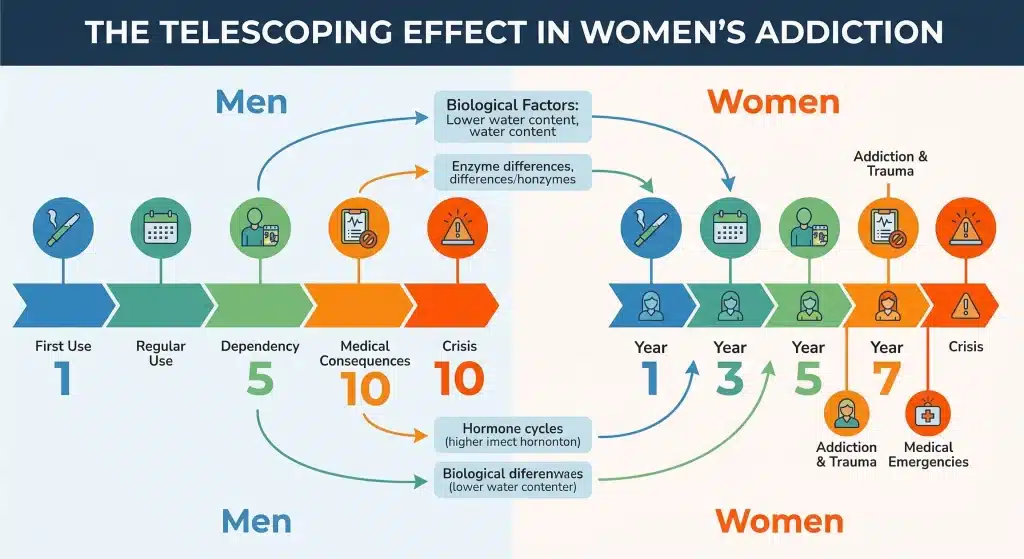
According to the National Institute on Drug Abuse (NIDA), women experience a phenomenon known as Telescoping.
What is Telescoping? Telescoping means that women progress from their first use of a substance to a severe addiction—and to medical emergencies—much faster than men do.
- Biological Vulnerability: Women generally have a higher body fat percentage and lower water content than men, meaning alcohol and drugs remain in the bloodstream in higher concentrations for longer periods. Women also have less of the stomach enzyme (gastric alcohol dehydrogenase) that breaks down alcohol before it enters the blood.
- The Physical Toll: Because of this biological sensitivity, women develop liver disease, cardiovascular issues, and brain atrophy at much lower levels of consumption and after a shorter duration of use compared to men.
You do not have the luxury of waiting to see if it “gets better.” Your body is breaking down faster than you realize.
Warning Signs You Shouldn't Ignore
Because women are experts at masking their struggles, you have to look for the subtle fractures in the facade. Whether you are analyzing your own behavior or observing a loved one, here are the critical warning signs that casual use has crossed the line into a Substance Use Disorder (SUD).
1. Behavioral Signs: The Art of Hiding
Addiction thrives in secrecy. If you are protecting your habit, the habit is controlling you.
- Pre-Gaming and “Topping Off”: Having a drink in secret before going to a social event, or staying up to finish the bottle after the family has gone to bed.
- The Recycling Bin Audit: Hiding empty bottles at the bottom of the trash, throwing them away at a gas station, or rotating which liquor stores you visit so the cashiers don’t judge your frequency.
- Shifting Social Circles: You find yourself making excuses to skip coffee dates or morning hikes, preferring to only attend events where alcohol or your substance of choice will be present and acceptable.
- The Defensive Flare: If a partner or friend gently questions how much you are drinking or using, you react with disproportionate rage, defensiveness, or immediate gaslighting (“I only had one, you’re crazy!”).
2. Psychological Signs: The Emotional Rollercoaster
Substances hijack the brain’s reward and emotional regulation centers.
- The “Hangxiety” Cycle: Waking up at 3:00 AM with your heart pounding, flooded with a crushing sense of dread and panic. You drink to calm your anxiety, but the alcohol causes a massive chemical spike in anxiety (Glutamate Rebound) when it wears off.
- Emotional Blunting: You feel numb. The things that used to bring you profound joy—playing with your children, pursuing a hobby, a beautiful sunset—now evoke no emotion unless you are under the influence.
- Obsessive Thinking: You may not be drinking all day, but you are thinking about drinking all day. You spend mental energy calculating when you can have your next glass or your next pill.
3. Physical Signs: The Body Keeps the Score
You might think you are hiding it, but your body is communicating the distress.
- Unexplained Exhaustion: Waking up exhausted despite sleeping for nine hours. (Substances like alcohol destroy restorative REM sleep, meaning you are unconscious but not resting).
- Changes in Appearance: Puffy face, broken capillaries, dull skin, or sudden, unexplained weight loss or gain.
- Tolerance and Withdrawal: Needing three glasses of wine to feel the relaxation that one glass used to provide. Experiencing trembling hands, sweating, or severe nausea if you skip your usual dose.
The Dual Diagnosis Reality: Addiction as a Symptom
Why do women use? In our experience at Sun County Wellness, women rarely use substances simply because it is “fun.” They use substances to survive an underlying pain.
This is known as a Dual Diagnosis—having a substance use disorder alongside a co-occurring mental health condition.
According to the Substance Abuse and Mental Health Services Administration (SAMHSA), treating the addiction without treating the underlying mental health issue almost guarantees a relapse.
Common Drivers of Female Addiction:
- Unresolved Trauma: A staggering percentage of women with substance use disorders are survivors of childhood abuse, sexual assault, or domestic violence. The substance is used to numb the flashbacks and quiet the hyper-vigilance of PTSD.
- Severe Anxiety and Burnout: For the high-achieving woman, the sheer volume of responsibilities creates chronic nervous system dysregulation. A pill or a drink feels like the only way to hit the “pause” button on a racing mind.
- Postpartum Depression: The isolation, hormonal crash, and immense pressure of new motherhood often drive women to self-medicate in secret.
At Sun County Wellness, we do not shame you for your coping mechanism. We treat the trauma so that you no longer need the drug to survive.
The Shame Barrier: Why Women Wait to Get Help
If the warning signs are there, why don’t women ask for help?
The answer is Shame.
Mothers, in particular, face a terrifying stigma. There is a deep, agonizing fear that if they admit they have a problem, they will be judged as “bad mothers” or, worse, that they will lose custody of their children.
Professional women fear losing their licenses, their partnerships, or their hard-earned reputations in the community.
We want you to hear this clearly: Addiction is a medical disease, not a moral failing. The American Psychiatric Association (APA) officially classifies it as a brain disorder. Getting treatment for a brain disorder makes you a responsible, courageous mother and professional—not a bad one.
Waiting for a “Rock Bottom”—like a DUI, a public collapse, or liver failure—is dangerous and unnecessary. You have the power to intervene while your life is still intact.
Healing at Sun County Wellness: The Sanctuary Approach
You cannot heal trauma and addiction in a chaotic environment. You need a sanctuary. At Sun County Wellness, located in the peaceful, grounding hills of San Juan Capistrano, we provide a treatment experience specifically curated for the female nervous system.
1. Gender-Specific Healing
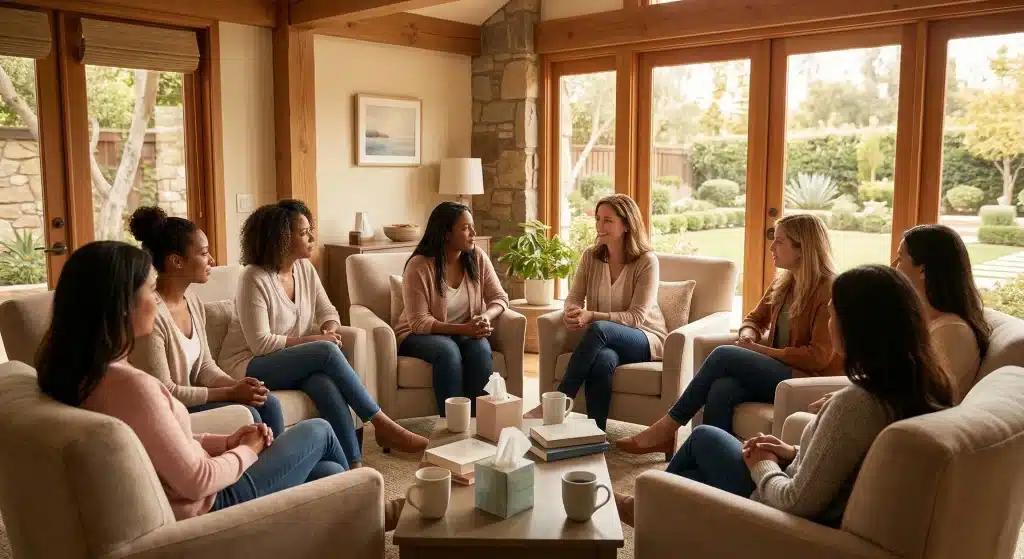
We believe that women heal best in the company of other women. In our gender-specific programs, the armor comes off. You are free from the male gaze, free from societal performance, and safe to discuss the unique traumas of womanhood. Sitting in a circle of women who nod their heads and say, “Me too,” is the most powerful antidote to shame in existence.
2. Comprehensive Levels of Care
We know that life does not stop when you need help. We offer flexible, high-tier clinical programs:
- Partial Hospitalization Program (PHP): Intensive, full-day clinical care (roughly 9 AM to 3 PM) that allows you to sleep in the comfort of your own home or a sober living environment at night.
- Intensive Outpatient Program (IOP): A step-down level of care that allows you to maintain your career or family obligations while receiving robust therapeutic support for several hours a week.
3. Holistic and Somatic Therapies
Because addiction lives in the body as well as the mind, we integrate natural, South OC healing modalities into our clinical curriculum.
- Equine-Assisted Therapy: San Juan Capistrano’s equestrian roots provide a profound therapeutic tool. Horses act as emotional mirrors, helping women reconnect with their intuition and practice non-verbal boundary setting.
- EMDR (Eye Movement Desensitization and Reprocessing): The gold standard for treating the underlying trauma that fuels the addiction.
- Somatic Movement and “Blue Mind” Therapy: Utilizing the nearby coastline and nature trails to naturally regulate the nervous system and lower cortisol.

Conclusion: You Deserve to Be Free
Addiction is a thief. It steals your presence, your joy, your memory, and your self-worth. It convinces you that you cannot survive without it, while simultaneously destroying your life.
But the thief can be evicted.
You do not have to live in secret anymore. You do not have to wake up at 3:00 AM flooded with regret and panic. The vibrant, capable, laughing woman you used to be is not gone; she is just buried under a chemical dependency. Let us help you find her again.
You are worthy of a life that is truly, beautifully yours.
If you recognized the warning signs in yourself or a loved one, do not wait for the crash. Contact Sun County Wellness today. Let us be your safe harbor.
Frequently Asked Questions (FAQs)
Will I lose my children if I go to rehab? This is a common fear, but seeking voluntary medical treatment for a substance use disorder is viewed favorably by courts and child welfare agencies. It demonstrates that you are a protective, responsible parent taking steps to ensure a safe environment. Getting help is the best way to protect your family.
Do I have to live at the facility? No. Sun County Wellness specializes in PHP and IOP levels of care, known as “Day Treatment.” You receive intense, hospital-grade clinical therapy during the day but return to your home or a supportive sober living residence in the evening.
How do I know if I’m an alcoholic or just a heavy drinker? The clinical definition focuses on loss of control and continued use despite negative consequences. If you set rules for your drinking and break them, if you hide your consumption, or if alcohol is negatively impacting your mental health, relationships, or career, you meet the criteria for help. You don’t need a “label” to seek a better life.
Does insurance cover addiction treatment for women? Yes. Under the Mental Health Parity Act, most major PPO insurance plans cover addiction treatment (including PHP and IOP) as a medical necessity. Our admissions team can quickly and confidentially verify your benefits to explain your coverage.