
Medical Disclaimer: The content provided in this article is for informational purposes only and does not constitute medical advice. Determining the appropriate level of psychiatric or addiction care requires a comprehensive clinical assessment. If you are experiencing a life-threatening emergency, acute withdrawal symptoms, or active suicidal plans, please call 988 or go to the nearest emergency room immediately. For a confidential assessment to find the right treatment path for you, contact Sun County Wellness.
Introduction: Decoding the Alphabet Soup of Recovery
You have finally reached the breaking point.
The chronic anxiety, the crushing executive burnout, the unresolved trauma, or the reliance on wine to simply survive the week has become too heavy to carry. You have made the incredibly courageous decision to stop white-knuckling your existence and seek professional help.
You take a deep breath, open your laptop, and search for women’s mental health treatment in Orange County. And almost immediately, your courage is met with a wall of confusing acronyms.
PHP. IOP. RTC. MAT. LOC.
It feels like you need a medical degree just to figure out how to get help. For the high-functioning woman—whether you are a CEO in Irvine or a stay-at-home mother in Dana Point—this confusion triggers immediate panic. You might be staring at the screen wondering:
“Is PHP a locked hospital ward? Do I have to leave my kids for 30 days? Is IOP enough support for my depression? How can I heal without dropping all my responsibilities?”
At Sun County Wellness, we believe that clarity is the foundation of healing. The anxiety of not understanding the process should never be the reason you delay getting your life back. In this comprehensive guide, we are going to translate the clinical jargon into plain English, tailored specifically for the female experience. We will break down the fundamental differences between a Partial Hospitalization Program (PHP) and an Intensive Outpatient Program (IOP), explore why women need specialized treatment, and help you determine which level of care fits your life in Southern California.
If you are ready to stop guessing and start healing, explore our Women’s Mental Health Treatment Programs at Sun County Wellness.

Section 1: The “Continuum of Care” (Treatment is a Ladder)
To understand PHP and IOP, you first have to understand how modern clinical treatment is structured.
Rehab is not a single, isolated event; it is a Continuum of Care. The American Society of Addiction Medicine (ASAM) outlines specific levels of care designed to match the exact severity of a patient’s illness.
Think of recovery as a ladder. You start on the rung where you need the most support, and as your nervous system regulates and you gain coping skills, you step down to the next rung, gaining more independence along the way.
- Rung 1: Medical Detox / Residential (Highest Intensity): 24/7 locked or monitored clinical care. You sleep at the facility. This is for acute stabilization, severe physical withdrawal, or active suicidal ideation.
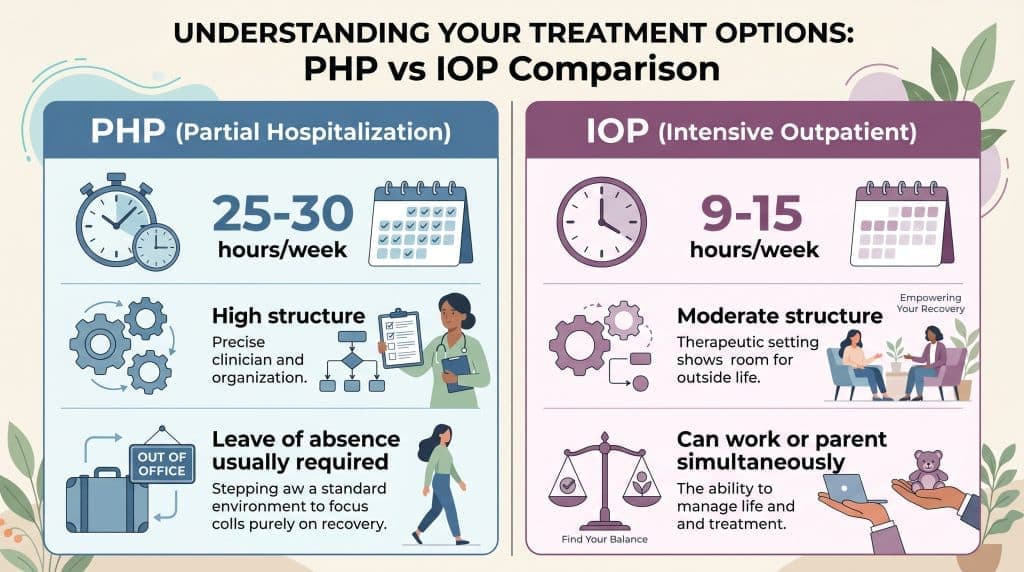
- Rung 2: Partial Hospitalization Program – PHP (High Intensity): Immersive, all-day clinical treatment. You focus entirely on healing during the day, but you sleep safely at home.
- Rung 3: Intensive Outpatient Program – IOP (Moderate Intensity): Part-time clinical treatment. You maintain your career/parenting duties while receiving robust therapeutic support.
- Rung 4: Standard Outpatient (Maintenance): You see a private therapist or psychiatrist for 1 to 2 hours a week.
At Sun County Wellness, nestled in the grounding hills of San Juan Capistrano, we specialize in the crucial middle rungs of this ladder: PHP and IOP. We focus on healing the whole woman while allowing her to remain tethered to her real life.
Section 2: What is PHP? (The “Day Treatment” Model)
PHP stands for Partial Hospitalization Program.
The name itself is often the biggest source of anxiety for our female clients. The word “Hospitalization” summons images of cold, sterile white walls, hospital gowns, and a complete loss of autonomy.
Let’s clear the air immediately: PHP is not a hospital stay.
At Sun County Wellness, our facility looks and feels like a premium, boho-chic wellness sanctuary. PHP is best understood as “Day Treatment.” It provides the intense, rigorous clinical immersion of an inpatient residential rehab, but with a massive difference: You get to leave at the end of the day.
The Structure of Women’s PHP
- The Time Commitment: PHP is a full-time job for your nervous system. You will typically attend clinical programming for roughly 5 to 6 hours a day, 5 days a week (e.g., Monday through Friday, 9:00 AM to 3:00 PM).
- The Sleeping Arrangement: At 3:00 PM, you go home. You can make dinner for your family, sleep in your own bed, or, if your home environment is unsafe or triggering, sleep in a highly structured, upscale Women’s Sober Living Environment (SLE) nearby.
- The Clinical Oversight: PHP offers a very high level of medical and psychiatric care. You will have regular access to board-certified psychiatrists for medication management, ensuring your biology is stabilized while you do the deep therapeutic work.
Who is the Ideal Candidate for PHP?
PHP is for the woman who is in a state of high distress or vulnerability, but who is medically safe enough not to require 24/7 lockdown.
- You are experiencing a severe depressive episode or daily panic attacks that make it utterly impossible for you to function at work or care for your children.
- You are caught in a cycle of self-medication (drinking daily to cope with anxiety) and need a massive pattern interruption to break the habit loop.
- You have tried seeing a weekly therapist, but the 50 minutes a week is like throwing a cup of water on a house fire. You need absolute, immersive support to stabilize.
Section 3: What is IOP? (The “Real World” Bridge)
IOP stands for Intensive Outpatient Program.
If PHP is the intensive “surgery” to stabilize the emotional crisis, IOP is the “physical therapy” to rebuild your strength. IOP is the critical bridge between full-time treatment and full-time life. It is designed to provide a robust clinical safety net while allowing you to reclaim your independence and manage the “Invisible Load” of womanhood.
The Structure of Women’s IOP
- The Time Commitment: IOP is a part-time commitment. You will typically attend clinical groups and individual therapy for 3 hours a day, 3 to 5 days a week.
- The Flexibility: Because we treat high-functioning professionals and mothers in Orange County, we offer flexible scheduling tracks. This means you can drop the kids off at school, attend your IOP session in the morning, and have your afternoon free to manage your life.
- The Integration: You live at home and continue to manage your normal household or career responsibilities, using the clinic as your emotional anchor.
Who is the Ideal Candidate for IOP?
- You have successfully completed a PHP or Residential program and need a “step-down” safety net to prevent a relapse as you return to normal life.
- You are a working professional or busy mother who is struggling with significant anxiety, trauma, or burnout, but you must maintain your career/parenting duties and cannot take a full leave of absence.
- You have a safe, supportive home environment and a strong internal motivation to practice your coping skills.
Section 4: A Day in the Life (Healing the SJC Way)
Whether you are in PHP or IOP at Sun County Wellness, you are not just sitting around venting. You are engaging in a highly structured, neurobiologically informed curriculum designed exclusively for the female nervous system.
Here is a look at the clinical modalities you will experience in both programs:
1. The Power of the Sisterhood (Process Groups)
Mental illness thrives in isolation. In our women-only process groups, you sit with other intelligent, high-functioning women who understand exactly what the pressure of modern womanhood feels like. When another mother admits she drinks to numb the exhaustion of parenting, or an executive admits she is paralyzed by imposter syndrome, the shame evaporates. You realize you are not uniquely broken.
2. Cognitive Behavioral Therapy (CBT)
We teach you to act as a lawyer in your own mind. You will learn to identify the “Cognitive Distortions” (the lies your perfectionism or anxiety tells you) and replace them with neutral, evidence-based truths to stop a panic spiral before it starts.
3. Somatic and Holistic Therapies
You cannot talk your way out of a traumatized nervous system; you have to feel your way out. We utilize the grounding energy of San Juan Capistrano through:
- Trauma-Informed Yoga: Reconnecting with your body safely.
- Equine-Assisted Therapy: Working with horses to rebuild non-verbal boundaries and self-trust.
- Earthing and Blue Mind: Utilizing the local trails and proximity to the ocean to physically lower your cortisol levels.
4. Dual Diagnosis Treatment
If you are drinking to cope with PTSD, or using stimulants to cope with burnout, we treat the mental health condition and the addiction simultaneously. According to the Substance Abuse and Mental Health Services Administration (SAMHSA), treating co-occurring disorders concurrently is the clinical gold standard for sustainable recovery.
Section 5: The “Real World” Advantage of Outpatient Care
There is a well-known phenomenon in the addiction and mental health industry called “Rehab Shock.”
A woman goes to an ultra-luxury, 30-day inpatient rehab. She is completely separated from her life. She doesn’t have her phone, she doesn’t face traffic, and she doesn’t have to deal with her stressful marriage. She feels “cured.” Then, on day 31, she drives home, opens her inbox, has an argument with her partner, and immediately relapses. She never learned how to be sober or regulated in her actual life.
PHP and IOP prevent Rehab Shock.
Because you go home at the end of the day in both PHP and IOP, you are “road-testing” your recovery in real-time.
- The Scenario: You go home on a Tuesday night and experience a massive panic attack because you are overwhelmed by household chores.
- The Advantage: Instead of spiraling out of control for a week, you walk into Sun County Wellness on Wednesday morning. You bring that exact trigger to your therapist. We dissect it, process it, and give you a tool (like a DBT distress tolerance skill) to handle it better on Wednesday night.
You are building the airplane while flying it. This creates a type of durable, battle-tested resilience that a 30-day inpatient bubble simply cannot replicate.

Section 6: Balancing the “Invisible Load” and Mom Guilt
For the women we treat in South Orange County, the biggest barrier to entry isn’t money or fear of therapy; it is Guilt.
“I can’t go to PHP; my kids need me.” “I can’t take time off work; everything will fall apart.”
We understand this fear, but we must challenge it: If you do not take the time to treat your mental health now, you will eventually collapse, and your family will be forced to cope with your total absence. You cannot pour from an empty cup. Seeking treatment is the ultimate act of maternal and professional stewardship. Furthermore, you have immense legal protections to help you balance this.
The Family and Medical Leave Act (FMLA)
Under federal law, eligible employees are entitled to up to 12 weeks of unpaid, job-protected leave to seek treatment for a serious medical condition—which explicitly includes severe anxiety, clinical depression, and trauma recovery.
- If you need the intense stabilization of a PHP, you can utilize FMLA to take a brief leave of absence. Your HR department is bound by strict HIPAA confidentiality laws; your employer does not need to know your specific psychiatric diagnosis.
The IOP Workaround
If taking a leave of absence is truly impossible, this is where IOP shines. The part-time schedule allows you to integrate your life-saving medical care around your work or parenting schedule, utilizing intermittent FMLA or simply blocking off your calendar for your health.
Section 7: Does Insurance Cover PHP and IOP?
The fear of financial ruin often keeps women trapped in their pain. The good news is that high-quality treatment is more accessible than ever.
Thanks to the Mental Health Parity and Addiction Equity Act (MHPAEA), private health insurance companies are federally mandated to cover mental health and substance abuse treatment at the same level they cover physical medical and surgical procedures.
- PPO Insurance: Because both PHP and IOP are clinical, licensed levels of medical care, they are widely covered by major PPO insurance plans (such as Anthem Blue Cross, Aetna, Cigna, and UnitedHealthcare).
- Cost-Effectiveness: Because you are not paying the massive overhead costs for overnight “room and board” and 24/7 nursing (as you would in residential rehab), PHP and IOP are incredibly cost-effective. Many clients hit their out-of-pocket maximum quickly, resulting in insurance covering the remainder of their care at 100%.
At Sun County Wellness, we have a dedicated admissions team that handles all the bureaucratic red tape for you. We will verify your benefits and give you a transparent breakdown of your coverage. Visit our Insurance Verification page to learn more.
Section 8: The Decision Checklist
Are you still unsure which path to take? Ask yourself these three questions to help determine your starting point:
1. Can you stay safe and function through the day on your own?
- No: You likely need Medical Detox or Inpatient Residential care first to physically stabilize, or immediate entry into PHP for full-day monitoring.
- Yes, but I am barely holding it together: You are a strong candidate for PHP or IOP.
2. How safe and supportive is your home environment?
- It is highly toxic/triggering: You need the 30-hour-a-week sanctuary of PHP, paired with a Sober Living home.
- It is safe and supportive: You can succeed in IOP while living at home.
3. What is your current functional capacity?
- I cannot get out of bed, go to work, or care for my kids: You need the immersive reset of PHP.
- I am still working and parenting, but I am white-knuckling my days, snapping at my kids, and suffering from panic attacks: The flexible support of IOP is your best bridge to health.

Conclusion: Start Where You Are
The most dangerous thing you can do is wait for the “perfect time” to get help. There will never be a month where your inbox is empty, your family demands nothing of you, and your calendar is completely clear.
Perfectionism is the enemy of recovery.
You do not have to completely pause your life to save it. Whether you need the deep, immersive reset of a Partial Hospitalization Program, or the flexible, real-world integration of an Intensive Outpatient Program, the goal is exactly the same: To build a life and a nervous system that you do not feel the need to escape from.
You have carried the weight of this invisible battle for long enough. Let us carry the map for a while.
If you are ready to find the level of care that fits your life, contact Sun County Wellness today for a completely free, confidential clinical assessment.
Frequently Asked Questions (FAQs)
Can I switch from PHP to IOP? Yes. In fact, this is the standard, clinically recommended pathway. Women usually start in PHP to aggressively stabilize a crisis for 2 to 4 weeks. Once they regain their footing, they “step down” to IOP for 8 to 12 weeks to transition back into full-time work and family life safely.
Do you conduct drug testing in PHP and IOP? Yes. For clients in our dual-diagnosis or substance use tracks, we conduct randomized testing. This ensures a safe, triggering-free environment for all our clients and provides a crucial layer of accountability during early recovery.
Are holistic therapies covered by insurance in these programs? Insurance typically covers the core clinical components of treatment (psychiatry, group therapy, individual CBT/EMDR). At Sun County Wellness, we integrate our holistic modalities (like equine therapy and trauma-informed yoga) seamlessly into the clinical curriculum, ensuring you receive a comprehensive, whole-person healing experience during your covered treatment day.
Will I see a psychiatrist in IOP? Yes, though the frequency differs. In PHP, you will have very regular, often weekly, oversight from a psychiatrist to manage acute medication needs. In IOP, you will still have access to psychiatric care for medication management, but typically on a less intensive, maintenance-level schedule.