
Trauma in Women: How It Affects Mental Health and Recovery
Medical Disclaimer: The content provided in this article is for informational purposes only and does not constitute medical advice. Unresolved trauma can lead to severe mental health crises, including deep depression, dissociation, and suicidal ideation. If you feel unsafe or are experiencing an emergency, please call 988 or go to the nearest emergency room immediately. For confidential trauma assessment and holistic treatment options, contact Sun County Wellness.
Introduction: The Weight of the Invisible Backpack
When you walk the sunlit, dusty trails of San Juan Capistrano, surrounded by the scent of wild sage and the distant sound of mission bells, it is easy to assume that everyone here is living a perfectly peaceful life. From the outside, the women of Orange County often appear flawless. They are managing successful careers, raising beautiful families, and curating lives that look effortless.
But beneath the surface of that perfection, many women are carrying an invisible, crushing weight.
You might not even call it “trauma.” You might call it chronic stress. You might call it anxiety. You might just think it is your personality to be perpetually exhausted, highly reactive, or constantly waiting for the other shoe to drop.
But what if your exhaustion isn’t a personality trait? What if it is a trauma response?
For generations, women have been taught to minimize their pain. If you didn’t survive a war zone or a catastrophic accident, society tells you that you don’t have “real” trauma. This minimization keeps millions of women trapped in a cycle of anxiety, depression, and self-medication, wondering why they can’t just “get over it.”
At Sun County Wellness, we know that trauma is not defined by the event; it is defined by how your nervous system processed the event. In this comprehensive guide, we will break down what trauma actually looks like in adult women, the profound connection between trauma and mental health, and how the grounding sanctuary of South Orange County can help you set the backpack down for good.
If you are ready to heal the root cause of your pain, explore our Women’s Mental Health and Trauma Programs at Sun County Wellness.

Redefining Trauma: Big "T" vs. Little "t"
The first step in recovery is validation. You must validate your own story. According to the American Psychological Association (APA), trauma is an emotional response to a terrible event. However, psychology now recognizes that trauma exists on a broad spectrum.
Big "T" Trauma
These are the catastrophic, life-altering events that most people immediately associate with the word “trauma.”
- Sexual assault or domestic violence.
- Sudden death of a loved one.
- A severe car accident or natural disaster.
Little "t" Trauma (Complex Trauma)
This is where the majority of high-functioning women are suffering in silence. “Little t” traumas are highly distressing events that occur repeatedly over time. Because they are cumulative, they are often just as damaging—if not more so—than a single catastrophic event.
- Growing up with a narcissistic or emotionally absent parent.
- Enduring a high-conflict, emotionally abusive marriage (gaslighting).
- Chronic financial instability or childhood neglect.
- The systemic trauma of misogyny, racism, or marginalization.
When “little t” traumas pile up, they create Complex PTSD (C-PTSD). Your brain learns that the world is inherently unsafe, and your nervous system rewires itself to keep you permanently on guard.
The Neuroscience of Trauma in Women
To understand why you feel so overwhelmed, we have to look at the brain. Trauma causes a literal, physiological injury to your central nervous system.
- The Amygdala (The Alarm Bell): This is the brain’s threat-detection center. Trauma causes the amygdala to become enlarged and hyper-reactive. It starts perceiving non-threats (an unanswered text, a messy kitchen, a loud noise) as life-or-death emergencies.
- The Hippocampus (The Timekeeper): This part of the brain logs memories with a timestamp. Under extreme stress, the hippocampus goes offline. This means traumatic memories are stored without a timestamp. When you are triggered today, your brain thinks the trauma is happening right now. You are not remembering the past; you are reliving it.
The Female Trauma Response: The "Fawn" Instinct
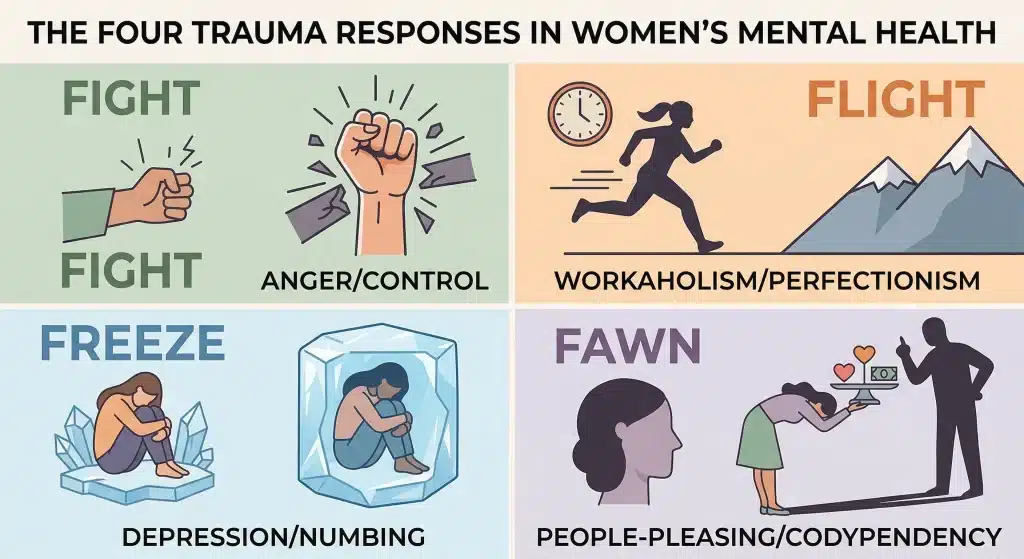
We have all heard of “Fight, Flight, or Freeze.” But for women, the most common trauma response is Fawn.
Fawning is the instinct to merge with the needs of others to ensure your own safety. It is people-pleasing taken to a pathological level.
- The Symptom: You cannot say “no.” You anticipate the moods of your partner or boss and twist yourself into knots to keep them happy. You apologize for things that aren’t your fault.
- The Cost: You lose your identity. You become a chameleon, constantly performing to avoid conflict. This leads to deep, simmering resentment and profound burnout.
The Body Keeps the Score: Somatic Symptoms
Women are frequently socialized to live “from the neck up,” ignoring the signals their bodies are sending them. But as Dr. Bessel van der Kolk famously wrote, the body keeps the score.
If you do not process your trauma emotionally, your body will process it physically. When your nervous system is trapped in chronic “Fight or Flight,” your body is flooded with cortisol and adrenaline. Over time, this chemical bath creates systemic inflammation.
Common Somatic Signs of Unresolved Trauma in Women:
- Autoimmune Disorders: There is a massive clinical correlation between childhood trauma and the development of autoimmune diseases (like Hashimoto’s, Lupus, or Fibromyalgia) later in life. The body essentially begins attacking itself because it is in a perpetual state of defense.
- Chronic Pelvic and Hip Pain: The hips and pelvic floor are where the body stores “flight” energy. Years of suppressed trauma lead to severe, unexplained pelvic pain or tightness.
- Gastrointestinal Chaos: The Gut-Brain Axis is highly sensitive to trauma. IBS, chronic nausea, and extreme bloating are often direct results of a traumatized, dysregulated vagus nerve.
If you have been to a dozen doctors who tell you your labs are “normal” but you still feel physical agony, the root cause may be stored trauma.
The Intersection of Trauma and Addiction
At Sun County Wellness, we rarely see addiction in a vacuum. It is almost always a symptom of a deeper wound.
According to the Substance Abuse and Mental Health Services Administration (SAMHSA), individuals with a history of trauma are significantly more likely to develop a substance use disorder. We call this a Dual Diagnosis.
Why Women Self-Medicate: When your internal world feels like a burning building, you will grab whatever you can to put out the fire.
- Alcohol: The “Wine Mom” culture in Orange County provides the perfect cover for trauma drinking. Alcohol temporarily mimics GABA (the calming chemical in the brain), bringing a hyper-vigilant nervous system to a grinding halt.
- Prescription Pills: Benzodiazepines (Xanax) are used to silence panic attacks, while stimulants (Adderall) are abused to push through the exhaustion of chronic depression.
- Eating Disorders: Restricting food or binge eating are powerful, physical ways to assert control when the rest of your life feels terrifyingly out of control.
You cannot treat the addiction without treating the trauma. If you take away the alcohol but leave the trauma untreated, the woman will be left defenseless against the agony of her own memories. Healing requires treating the whole person.
The San Juan Capistrano Sanctuary: Healing Through Safety
You cannot heal trauma in the same chaotic environment that created it. To rewire a traumatized brain, you must first establish profound, undeniable Safety.
This is why San Juan Capistrano is uniquely suited for trauma recovery. The environment acts as an active participant in your healing journey.
1. Eco-Therapy and The "Blue Mind"
We pull our clients out of clinical, fluorescent-lit rooms and into the healing landscape of South Orange County.
- Earthing: Walking barefoot on the local trails or the sands of Dana Point helps neutralize free radicals and naturally lowers cortisol levels.
- Blue Mind: Proximity to the ocean has been clinically shown to induce a meditative state, slowing the brain waves and signaling to the amygdala that the immediate threat has passed.
2. Equine-Assisted Therapy
San Juan Capistrano’s rich equestrian culture provides one of the most powerful trauma therapies available. Horses are prey animals; their survival depends on reading the nervous systems of those around them. They cannot be lied to, and they cannot be manipulated by “fawning.”
- The Breakthrough: A horse will only approach and connect with you when your internal energy matches your external presentation. When a 1,200-pound animal chooses to rest its head on your shoulder because it feels your authentic calm, it provides a somatic experience of safety and trust that talk therapy simply cannot replicate.

Evidence-Based Clinical Treatment
While nature and environment are essential, complex trauma requires rigorous, evidence-based clinical intervention. At Sun County Wellness, our licensed therapists utilize top-tier modalities to help your brain finally “process” the past.
EMDR (Eye Movement Desensitization and Reprocessing)
EMDR is the gold standard for trauma treatment, recognized by the World Health Organization (WHO).
- How it works: Instead of just talking about the trauma, EMDR uses bilateral stimulation (like eye movements or tapping) to activate both hemispheres of the brain. This allows the hippocampus to finally process the traumatic memory and “file it away” correctly.
- The Result: The memory remains, but the emotional charge and the physical panic attached to the memory are removed.
Somatic Experiencing
Because trauma lives in the body, we must involve the body in the cure.
- The Practice: Our therapists guide you to locate where the trauma is “stuck” in your physical form (a tight chest, a clenched jaw). Through guided breathwork and gentle movement, we help your body complete the “Fight or Flight” cycle that was interrupted during the trauma, allowing the nervous system to discharge the trapped energy.
Dialectical Behavior Therapy (DBT)
Trauma survivors often experience emotions at 110% intensity. DBT provides the “brakes.” We teach you distress tolerance skills—how to survive an emotional flashback or a panic attack without turning to self-harm or substances.
Finding the Right Level of Care: PHP and IOP
Trauma recovery is intense work. A weekly one-hour therapy session is often not enough to hold a woman safely while she unpacks decades of pain.
At Sun County Wellness, we offer robust, flexible levels of care designed for women who need a sanctuary but cannot completely pause their lives.
- Partial Hospitalization Program (PHP): This is “Day Treatment.” You attend intensive trauma therapy, holistic groups, and psychiatric care for roughly 6 hours a day, 5 days a week. You spend the day doing the deep work in our beautiful facility, but you return to your own home or a supportive sober living environment at night.
- Intensive Outpatient Program (IOP): A step-down level of care (typically 3 hours a day, 3-5 days a week). This allows you to gradually reintegrate into your career and family life while maintaining a powerful clinical safety net to process the triggers of the real world.
Learn more about how our Admissions Process can help you navigate insurance and find the right level of care.

Case Study: Claire’s Journey Back to Herself
The Situation: Claire, a 42-year-old marketing director, came to Sun County Wellness seeking help for “executive burnout.” She was highly successful but suffered from debilitating migraines and insomnia. She couldn’t relax unless she drank a bottle of wine. She insisted she had a “great childhood” and no trauma.
The Intervention: In our Women’s PHP, Claire began Somatic Experiencing and EMDR.
- The Discovery: She realized her “perfectionism” was a trauma response to an emotionally volatile, alcoholic parent. Her entire life was built around controlling her environment to prevent the chaos she experienced as a child.
- The Work: Claire processed the childhood neglect. In Equine Therapy, she learned how to set a boundary without feeling guilty.
The Result: Claire stepped down to IOP and eventually to weekly outpatient care. Today, she is sober. Her migraines have completely disappeared. She still works hard, but her drive is fueled by passion, not the terror of imperfection. She finally feels at home in her own body.
Conclusion: You Are Safe Now
Trauma convinces you that the danger is never over. It keeps you running on a treadmill of fear, exhaustion, and performance.
But you do not have to keep running.
The war is over. You survived. Now, it is time to learn how to live. Healing is possible, and it doesn’t mean becoming a different person; it means stripping away the armor to rediscover the vibrant, peaceful woman underneath.
San Juan Capistrano offers the sacred ground. We offer the clinical map. You just have to take the first step.
If you are ready to put down the heavy backpack, contact Sun County Wellness today. Let us help you find your way back to safety.
Frequently Asked Questions (FAQs)
Does insurance cover trauma therapy like EMDR? Yes. Because trauma and PTSD are recognized medical conditions that significantly impair functioning, treatments like EMDR within a PHP or IOP setting are typically covered by major PPO insurance plans under the Mental Health Parity Act. We can verify your specific benefits free of charge.
What if I can’t remember my trauma? This is very common. The brain uses “Dissociative Amnesia” to protect you from overwhelming memories. You do not need a perfect narrative memory to heal. Somatic therapy and EMDR can target the feelings and physical sensations of the trauma, allowing you to process the pain even if you cannot remember the exact event.
Will trauma therapy make me feel worse? Sometimes, healing requires feeling the pain you have been suppressing, which can cause a temporary increase in anxiety. This is why participating in a structured program (PHP/IOP) is crucial. We provide the “container” and the distress tolerance skills to keep you safe and grounded while you do the hard work.
Do I have to do group therapy? I have social anxiety. We understand that group therapy sounds terrifying to someone with trauma. However, isolation is where trauma thrives. Our women-only groups are carefully curated to be safe, trauma-informed spaces. Most women find that hearing another woman say, “I feel that exactly,” is the most profoundly healing part of the program.